

658
M. Dantas
in more than 50 production groups and articulated in 19 municipal periodic-markets
and one permanent market location (Org. Portal: Rede Xiquexique).
The CECAFES in the state capital is a space for direct marketing of farmers’
produce, and is the result of ten years of social demands and mobilization. CECAFES
was built in 2007 but only came into operation as of March, 2017. Currently, it offers a
modern commercial space with 40 small booths for family farming units and 27 store
booths for legal organizations, that is, cooperatives and associations of local farmers
and artisans. The participants interviewed for this case-study were 19 individual
farmers and artisans participating in the CECAFES market, and six farmers who are
members of the Xique-Xique Network. The other participating actors involved with
the projects are three community economic development agents, two academics and
two economist bank representatives.
In one question the farmers were asked if they had the support of any institutions
for their projects or farming activities, and to share their experience and nature of the
involvement with the institutions. The actors’ representants of supporting institutions
were asked to share their experience with farmers and cooperatives, and the nature
and experience of their involvement with the two projects the Xique-Xique Network
and CECAFES. The second question concerned the identification of expectations
from institutions. That is, what is expected and from whom. The participants were
asked if the recent change in governments has affected their projects, and if yes,
how?
4 Results
4.1 Institutions and Networks Actively Supporting Farmers
and Artisans
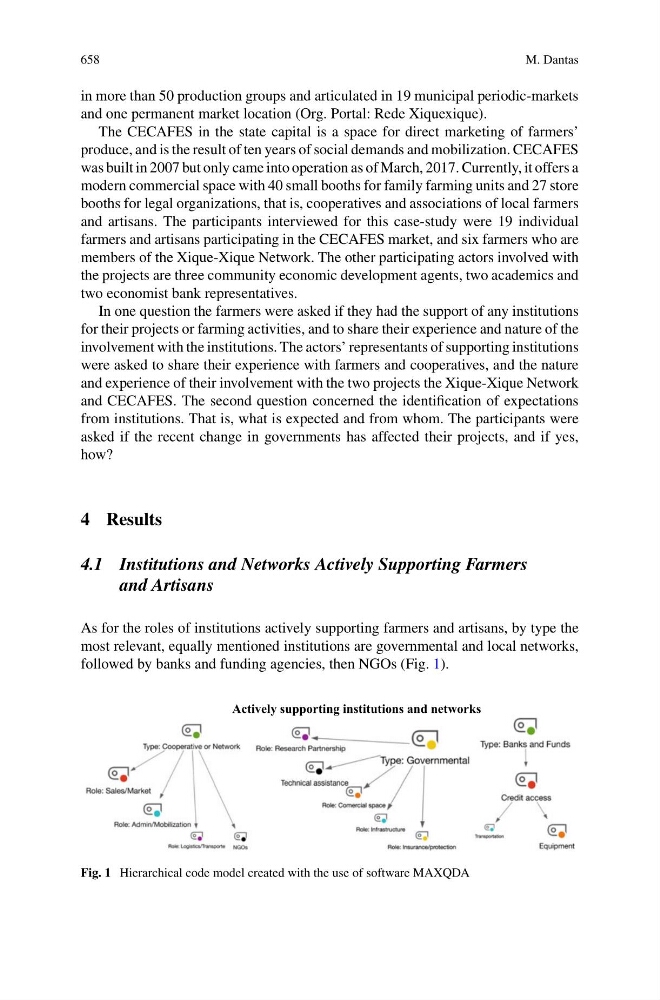
As for the roles of institutions actively supporting farmers and artisans, by type the
most relevant, equally mentioned institutions are governmental and local networks,
followed by banks and funding agencies, then NGOs (Fig. 1).
Actively supporting institutions and networks
Fig. 1 Hierarchical code model created with the use of software MAXQDA
M. Dantas
in more than 50 production groups and articulated in 19 municipal periodic-markets
and one permanent market location (Org. Portal: Rede Xiquexique).
The CECAFES in the state capital is a space for direct marketing of farmers’
produce, and is the result of ten years of social demands and mobilization. CECAFES
was built in 2007 but only came into operation as of March, 2017. Currently, it offers a
modern commercial space with 40 small booths for family farming units and 27 store
booths for legal organizations, that is, cooperatives and associations of local farmers
and artisans. The participants interviewed for this case-study were 19 individual
farmers and artisans participating in the CECAFES market, and six farmers who are
members of the Xique-Xique Network. The other participating actors involved with
the projects are three community economic development agents, two academics and
two economist bank representatives.
In one question the farmers were asked if they had the support of any institutions
for their projects or farming activities, and to share their experience and nature of the
involvement with the institutions. The actors’ representants of supporting institutions
were asked to share their experience with farmers and cooperatives, and the nature
and experience of their involvement with the two projects the Xique-Xique Network
and CECAFES. The second question concerned the identification of expectations
from institutions. That is, what is expected and from whom. The participants were
asked if the recent change in governments has affected their projects, and if yes,
how?
4 Results
4.1 Institutions and Networks Actively Supporting Farmers
and Artisans
As for the roles of institutions actively supporting farmers and artisans, by type the
most relevant, equally mentioned institutions are governmental and local networks,
followed by banks and funding agencies, then NGOs (Fig. 1).
Actively supporting institutions and networks
Fig. 1 Hierarchical code model created with the use of software MAXQDA