

538
R. Pretorius and M. Nicolau
3.4 The Handicraft Project
During the initial CAMP workshop in 2012, an inventory of the skills of community
members was compiled during Session 2 (Fig. 1). The existing skills of the participants included handicraft specifically related to textiles, clothing, fashion and crafts.
The development of these skills into an entrepreneurial opportunity was expressed
by a group of participants and during sessions 14 and 15 (Fig. 1) they critically evaluated the option of the creation of employment opportunities for community members
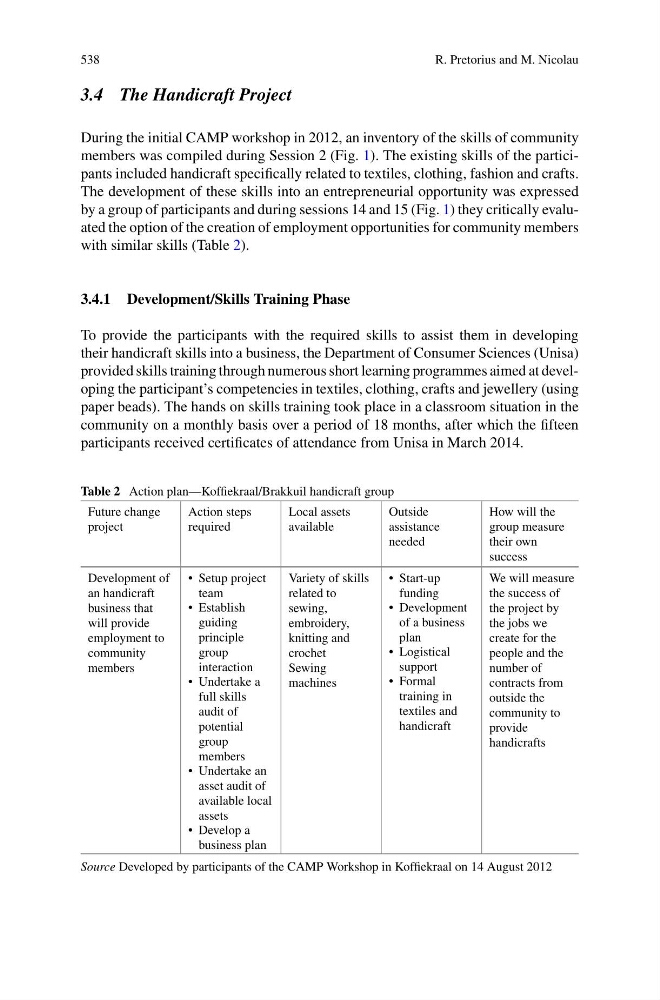
with similar skills (Table 2).
3.4.1 Development/Skills Training Phase
To provide the participants with the required skills to assist them in developing
their handicraft skills into a business, the Department of Consumer Sciences (Unisa)
provided skills training through numerous short learning programmes aimed at developing the participant’s competencies in textiles, clothing, crafts and jewellery (using
paper beads). The hands on skills training took place in a classroom situation in the
community on a monthly basis over a period of 18 months, after which the fifteen
participants received certificates of attendance from Unisa in March 2014.
Table 2 Action plan—Koffiekraal/Brakkuil handicraft group
Future change
project
Action steps
required
Local assets
available
Outside
assistance
needed
How will the
group measure
their own
success
Development of
an handicraft
business that
will provide
employment to
community
members
• Setup project
team
• Establish
guiding
principle
group
interaction
• Undertake a
full skills
audit of
potential
group
members
• Undertake an
asset audit of
available local
assets
• Develop a
business plan
Variety of skills
related to
sewing,
embroidery,
knitting and
crochet
Sewing
machines
• Start-up
funding
• Development
of a business
plan
• Logistical
support
• Formal
training in
textiles and
handicraft
We will measure
the success of
the project by
the jobs we
create for the
people and the
number of
contracts from
outside the
community to
provide
handicrafts
Source Developed by participants of the CAMP Workshop in Koffiekraal on 14 August 2012
R. Pretorius and M. Nicolau
3.4 The Handicraft Project
During the initial CAMP workshop in 2012, an inventory of the skills of community
members was compiled during Session 2 (Fig. 1). The existing skills of the participants included handicraft specifically related to textiles, clothing, fashion and crafts.
The development of these skills into an entrepreneurial opportunity was expressed
by a group of participants and during sessions 14 and 15 (Fig. 1) they critically evaluated the option of the creation of employment opportunities for community members
with similar skills (Table 2).
3.4.1 Development/Skills Training Phase
To provide the participants with the required skills to assist them in developing
their handicraft skills into a business, the Department of Consumer Sciences (Unisa)
provided skills training through numerous short learning programmes aimed at developing the participant’s competencies in textiles, clothing, crafts and jewellery (using
paper beads). The hands on skills training took place in a classroom situation in the
community on a monthly basis over a period of 18 months, after which the fifteen
participants received certificates of attendance from Unisa in March 2014.
Table 2 Action plan—Koffiekraal/Brakkuil handicraft group
Future change
project
Action steps
required
Local assets
available
Outside
assistance
needed
How will the
group measure
their own
success
Development of
an handicraft
business that
will provide
employment to
community
members
• Setup project
team
• Establish
guiding
principle
group
interaction
• Undertake a
full skills
audit of
potential
group
members
• Undertake an
asset audit of
available local
assets
• Develop a
business plan
Variety of skills
related to
sewing,
embroidery,
knitting and
crochet
Sewing
machines
• Start-up
funding
• Development
of a business
plan
• Logistical
support
• Formal
training in
textiles and
handicraft
We will measure
the success of
the project by
the jobs we
create for the
people and the
number of
contracts from
outside the
community to
provide
handicrafts
Source Developed by participants of the CAMP Workshop in Koffiekraal on 14 August 2012