

456
H. Y. Ching
training and staff development programs including programs to help employees with
integration”.
When a quantitative data appeared in the report, this was also considered in our
study. The following data were obtained from the companies as illustration: Volkswagen: 328,408,918 tonnes of CO 2 ; Hyundai: 2,544,847 tCO 2 e (tonnes of carbon dioxide) equivalent); Daimler: Direct and indirect 2938 (in 1000 t); BMW: total inbound
and outbound CO 2 emission in tones 1,427,399; GM: direct emission 2,003,265 CO 2
and indirect 5,799,436 CO 2 .
4 Results and Discussions
4.1 Comparative Study of the Automobile Segment
In the automobile segment, the dimensions that had the greatest adherence in the sustainability reports were social and economic. In these two dimensions, the companies
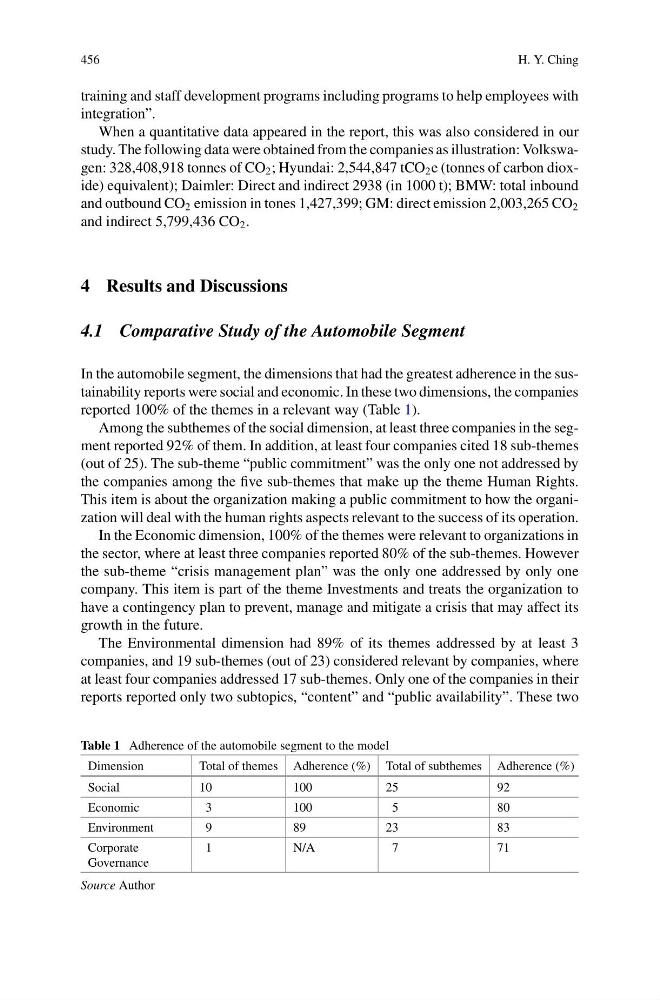
reported 100% of the themes in a relevant way (Table 1).
Among the subthemes of the social dimension, at least three companies in the segment reported 92% of them. In addition, at least four companies cited 18 sub-themes
(out of 25). The sub-theme “public commitment” was the only one not addressed by
the companies among the five sub-themes that make up the theme Human Rights.
This item is about the organization making a public commitment to how the organization will deal with the human rights aspects relevant to the success of its operation.
In the Economic dimension, 100% of the themes were relevant to organizations in
the sector, where at least three companies reported 80% of the sub-themes. However
the sub-theme “crisis management plan” was the only one addressed by only one
company. This item is part of the theme Investments and treats the organization to
have a contingency plan to prevent, manage and mitigate a crisis that may affect its
growth in the future.
The Environmental dimension had 89% of its themes addressed by at least 3
companies, and 19 sub-themes (out of 23) considered relevant by companies, where
at least four companies addressed 17 sub-themes. Only one of the companies in their
reports reported only two subtopics, “content” and “public availability”. These two
Table 1 Adherence of the automobile segment to the model
Dimension
Total of themes Adherence (%) Total of subthemes Adherence (%)
Social
10
100
25
92
Economic
3
100
5
80
Environment
9
89
23
83
Corporate
Governance
1
N/A
7
71
Source Author
H. Y. Ching
training and staff development programs including programs to help employees with
integration”.
When a quantitative data appeared in the report, this was also considered in our
study. The following data were obtained from the companies as illustration: Volkswagen: 328,408,918 tonnes of CO 2 ; Hyundai: 2,544,847 tCO 2 e (tonnes of carbon dioxide) equivalent); Daimler: Direct and indirect 2938 (in 1000 t); BMW: total inbound
and outbound CO 2 emission in tones 1,427,399; GM: direct emission 2,003,265 CO 2
and indirect 5,799,436 CO 2 .
4 Results and Discussions
4.1 Comparative Study of the Automobile Segment
In the automobile segment, the dimensions that had the greatest adherence in the sustainability reports were social and economic. In these two dimensions, the companies
reported 100% of the themes in a relevant way (Table 1).
Among the subthemes of the social dimension, at least three companies in the segment reported 92% of them. In addition, at least four companies cited 18 sub-themes
(out of 25). The sub-theme “public commitment” was the only one not addressed by
the companies among the five sub-themes that make up the theme Human Rights.
This item is about the organization making a public commitment to how the organization will deal with the human rights aspects relevant to the success of its operation.
In the Economic dimension, 100% of the themes were relevant to organizations in
the sector, where at least three companies reported 80% of the sub-themes. However
the sub-theme “crisis management plan” was the only one addressed by only one
company. This item is part of the theme Investments and treats the organization to
have a contingency plan to prevent, manage and mitigate a crisis that may affect its
growth in the future.
The Environmental dimension had 89% of its themes addressed by at least 3
companies, and 19 sub-themes (out of 23) considered relevant by companies, where
at least four companies addressed 17 sub-themes. Only one of the companies in their
reports reported only two subtopics, “content” and “public availability”. These two
Table 1 Adherence of the automobile segment to the model
Dimension
Total of themes Adherence (%) Total of subthemes Adherence (%)
Social
10
100
25
92
Economic
3
100
5
80
Environment
9
89
23
83
Corporate
Governance
1
N/A
7
71
Source Author