

Methodology for the Environmental Service Suppliers’ …
409
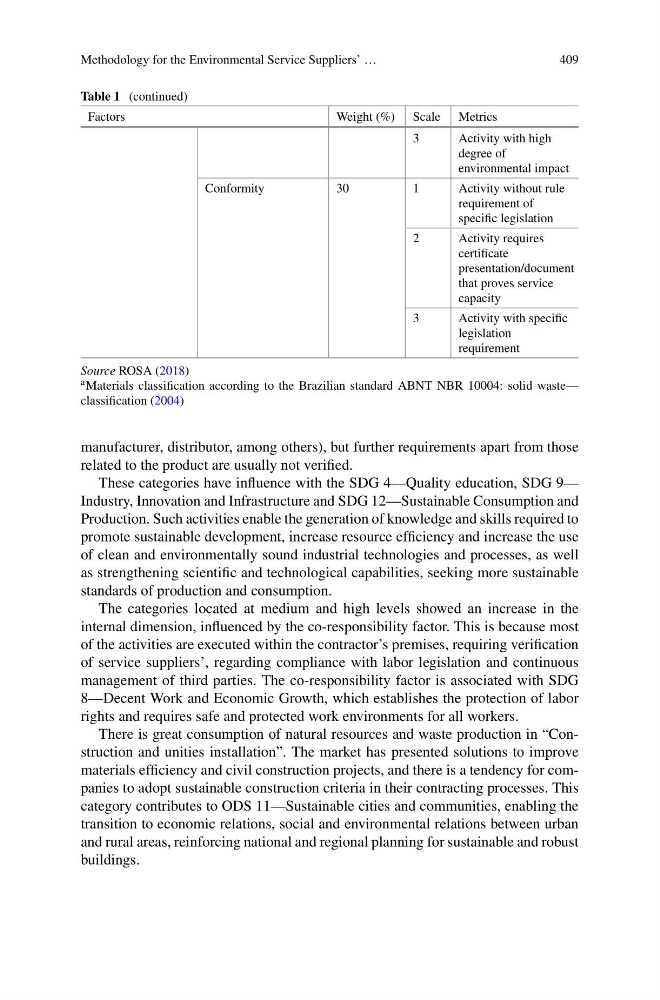
Table 1 (continued)
Factors
Weight (%) Scale Metrics
3
Activity with high
degree of
environmental impact
Conformity
30
1
Activity without rule
requirement of
specific legislation
2
Activity requires
certificate
presentation/document
that proves service
capacity
3
Activity with specific
legislation
requirement
Source ROSA (2018)
a Materials classification according to the Brazilian standard ABNT NBR 10004: solid waste—
classification (2004)
manufacturer, distributor, among others), but further requirements apart from those
related to the product are usually not verified.
These categories have influence with the SDG 4—Quality education, SDG 9—
Industry, Innovation and Infrastructure and SDG 12—Sustainable Consumption and
Production. Such activities enable the generation of knowledge and skills required to
promote sustainable development, increase resource efficiency and increase the use
of clean and environmentally sound industrial technologies and processes, as well
as strengthening scientific and technological capabilities, seeking more sustainable
standards of production and consumption.
The categories located at medium and high levels showed an increase in the
internal dimension, influenced by the co-responsibility factor. This is because most
of the activities are executed within the contractor’s premises, requiring verification
of service suppliers’, regarding compliance with labor legislation and continuous
management of third parties. The co-responsibility factor is associated with SDG
8—Decent Work and Economic Growth, which establishes the protection of labor
rights and requires safe and protected work environments for all workers.
There is great consumption of natural resources and waste production in “Construction and unities installation”. The market has presented solutions to improve
materials efficiency and civil construction projects, and there is a tendency for companies to adopt sustainable construction criteria in their contracting processes. This
category contributes to ODS 11—Sustainable cities and communities, enabling the
transition to economic relations, social and environmental relations between urban
and rural areas, reinforcing national and regional planning for sustainable and robust
buildings.
409
Table 1 (continued)
Factors
Weight (%) Scale Metrics
3
Activity with high
degree of
environmental impact
Conformity
30
1
Activity without rule
requirement of
specific legislation
2
Activity requires
certificate
presentation/document
that proves service
capacity
3
Activity with specific
legislation
requirement
Source ROSA (2018)
a Materials classification according to the Brazilian standard ABNT NBR 10004: solid waste—
classification (2004)
manufacturer, distributor, among others), but further requirements apart from those
related to the product are usually not verified.
These categories have influence with the SDG 4—Quality education, SDG 9—
Industry, Innovation and Infrastructure and SDG 12—Sustainable Consumption and
Production. Such activities enable the generation of knowledge and skills required to
promote sustainable development, increase resource efficiency and increase the use
of clean and environmentally sound industrial technologies and processes, as well
as strengthening scientific and technological capabilities, seeking more sustainable
standards of production and consumption.
The categories located at medium and high levels showed an increase in the
internal dimension, influenced by the co-responsibility factor. This is because most
of the activities are executed within the contractor’s premises, requiring verification
of service suppliers’, regarding compliance with labor legislation and continuous
management of third parties. The co-responsibility factor is associated with SDG
8—Decent Work and Economic Growth, which establishes the protection of labor
rights and requires safe and protected work environments for all workers.
There is great consumption of natural resources and waste production in “Construction and unities installation”. The market has presented solutions to improve
materials efficiency and civil construction projects, and there is a tendency for companies to adopt sustainable construction criteria in their contracting processes. This
category contributes to ODS 11—Sustainable cities and communities, enabling the
transition to economic relations, social and environmental relations between urban
and rural areas, reinforcing national and regional planning for sustainable and robust
buildings.