

236
G. M. Oliveira et al.
Strengths
Simplicity of a single score outcome
Tailored designed for Portugal
Focused on local communities and territories
Based only on credible data sources (the
national statistical office)
Adaptable to other regional scales
Easy reading graphical presentation
Weakness
Does not cover all SDGs
Unbalance of individual indicators
Variables selection dependent on data
availability
Poor punctuality of some data: time lag over
7 years
Allows only comparative analysis
Opportunities
Allows the follow-up of local interventions
and plans at a year basis
Shows the need to improve data collection
and management
Threats
WeGIx is one more in a myriad of indices
May be replaceable by other local indexes
Being used for political action instead of
serving for information
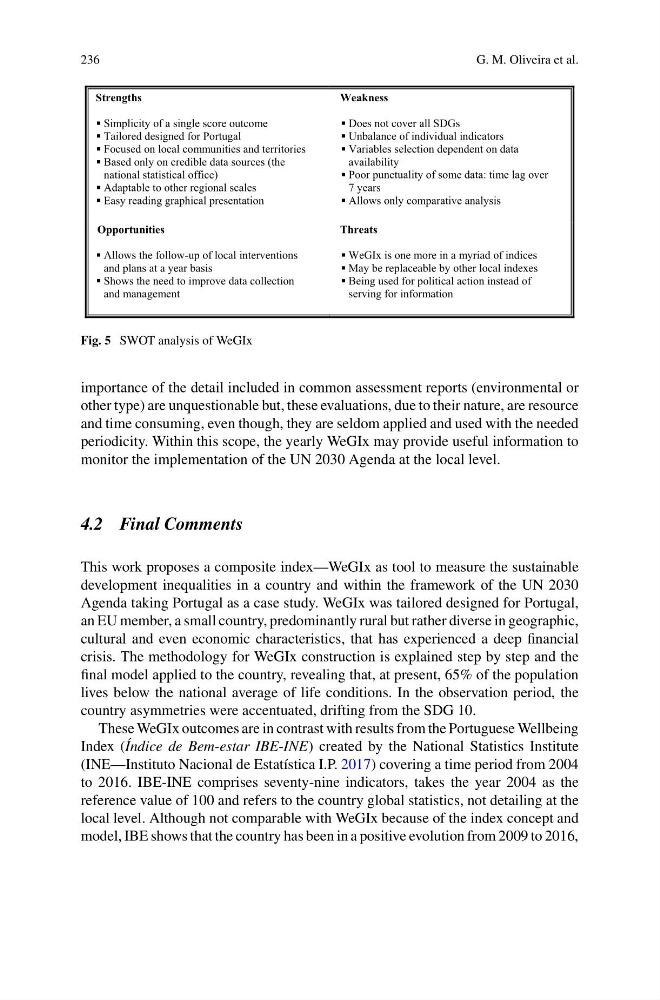
Fig. 5 SWOT analysis of WeGIx
importance of the detail included in common assessment reports (environmental or
other type) are unquestionable but, these evaluations, due to their nature, are resource
and time consuming, even though, they are seldom applied and used with the needed
periodicity. Within this scope, the yearly WeGIx may provide useful information to
monitor the implementation of the UN 2030 Agenda at the local level.
4.2 Final Comments
This work proposes a composite index—WeGIx as tool to measure the sustainable
development inequalities in a country and within the framework of the UN 2030
Agenda taking Portugal as a case study. WeGIx was tailored designed for Portugal,
an EU member, a small country, predominantly rural but rather diverse in geographic,
cultural and even economic characteristics, that has experienced a deep financial
crisis. The methodology for WeGIx construction is explained step by step and the
final model applied to the country, revealing that, at present, 65% of the population
lives below the national average of life conditions. In the observation period, the
country asymmetries were accentuated, drifting from the SDG 10.
These WeGIx outcomes are in contrast with results from the Portuguese Wellbeing
Index (Índice de Bem-estar IBE-INE) created by the National Statistics Institute
(INE—Instituto Nacional de Estatística I.P. 2017) covering a time period from 2004
to 2016. IBE-INE comprises seventy-nine indicators, takes the year 2004 as the
reference value of 100 and refers to the country global statistics, not detailing at the
local level. Although not comparable with WeGIx because of the index concept and
model, IBE shows that the country has been in a positive evolution from 2009 to 2016,
G. M. Oliveira et al.
Strengths
Simplicity of a single score outcome
Tailored designed for Portugal
Focused on local communities and territories
Based only on credible data sources (the
national statistical office)
Adaptable to other regional scales
Easy reading graphical presentation
Weakness
Does not cover all SDGs
Unbalance of individual indicators
Variables selection dependent on data
availability
Poor punctuality of some data: time lag over
7 years
Allows only comparative analysis
Opportunities
Allows the follow-up of local interventions
and plans at a year basis
Shows the need to improve data collection
and management
Threats
WeGIx is one more in a myriad of indices
May be replaceable by other local indexes
Being used for political action instead of
serving for information
Fig. 5 SWOT analysis of WeGIx
importance of the detail included in common assessment reports (environmental or
other type) are unquestionable but, these evaluations, due to their nature, are resource
and time consuming, even though, they are seldom applied and used with the needed
periodicity. Within this scope, the yearly WeGIx may provide useful information to
monitor the implementation of the UN 2030 Agenda at the local level.
4.2 Final Comments
This work proposes a composite index—WeGIx as tool to measure the sustainable
development inequalities in a country and within the framework of the UN 2030
Agenda taking Portugal as a case study. WeGIx was tailored designed for Portugal,
an EU member, a small country, predominantly rural but rather diverse in geographic,
cultural and even economic characteristics, that has experienced a deep financial
crisis. The methodology for WeGIx construction is explained step by step and the
final model applied to the country, revealing that, at present, 65% of the population
lives below the national average of life conditions. In the observation period, the
country asymmetries were accentuated, drifting from the SDG 10.
These WeGIx outcomes are in contrast with results from the Portuguese Wellbeing
Index (Índice de Bem-estar IBE-INE) created by the National Statistics Institute
(INE—Instituto Nacional de Estatística I.P. 2017) covering a time period from 2004
to 2016. IBE-INE comprises seventy-nine indicators, takes the year 2004 as the
reference value of 100 and refers to the country global statistics, not detailing at the
local level. Although not comparable with WeGIx because of the index concept and
model, IBE shows that the country has been in a positive evolution from 2009 to 2016,