

Measuring the Implementation of Sustainable Development …
221
tributing to air degradation by emitting pollutants. According to the World Bank
(Kaza et al. 2018), waste management is an urban critical issue affecting the health
of communities and the quality of life in cities, thus, “Incinerators” and “Landfills”
were added to the variables set.
The initial forty-two variables selected for the WeGIx index, their database
sources, and variables characteristics are presented in Table 1. A positive (+) or
negative (−) character was attributed to each variable in accordance with the impact
of that variable in population life conditions. As an example: the variable “Selective
Urban Waste collection” was classified as positive because waste is duly separated
by material type and then directed to reuse, to recycling facilities or to energy valorisation. On the contrary, the variable “Undifferentiated Urban Waste collection”
contributes negatively to the environment, because urban waste is collected in the
same container, without any material type differentiation, and then disposed in a
landfill. All variables that concern consumption, such as water (19 WSC), electricity
(21 DEC) and fuel (22 FUEL), have negative polarity because within the sustainable
concept of development, consumption has to be penalized (Yang et al. 2018). Portugal has, for long, a complete territorial coverage of safe water and electricity supply,
thus the approach to these variables must consider sustainable consumption rather
than the supply of basic needs.
Most of the variables are of “output” type and a few of “process” type. Only the
variables relating to investments (37 IWMM and 41 IPBL) are of “input” type.
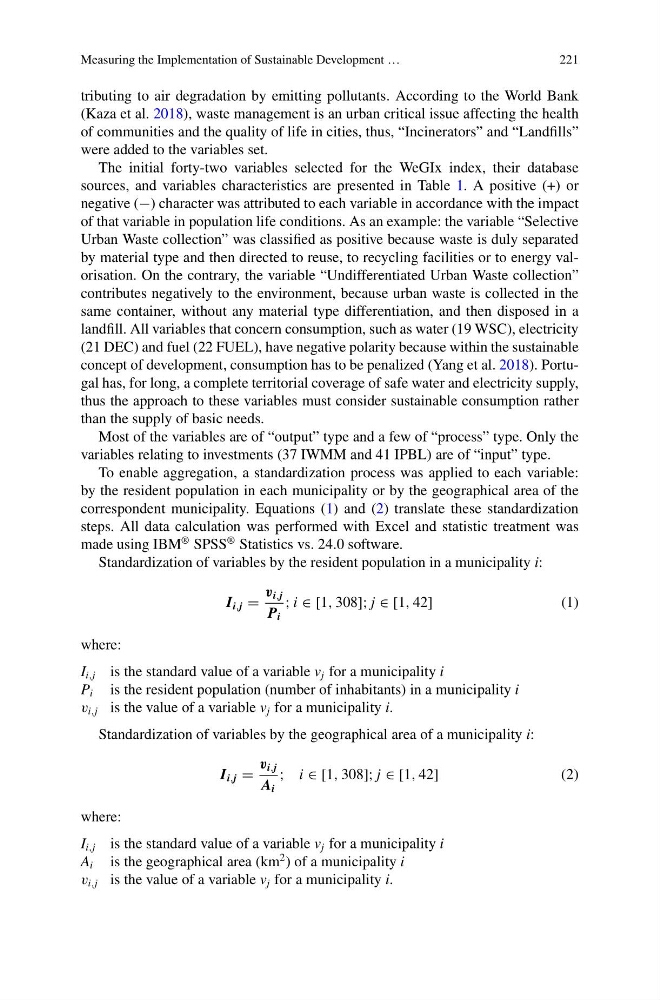
To enable aggregation, a standardization process was applied to each variable:
by the resident population in each municipality or by the geographical area of the
correspondent municipality. Equations (1) and (2) translate these standardization
steps. All data calculation was performed with Excel and statistic treatment was
made using IBM
® SPSS
® Statistics vs. 24.0 software.
Standardization of variables by the resident population in a municipality i:
I i,j =
v i,j
P i
; i ∈ [1, 308]; j ∈ [1, 42]
(1)
where:
I i,j is the standard value of a variable v j for a municipality i
P i is the resident population (number of inhabitants) in a municipality i
v i,j is the value of a variable v j for a municipality i.
Standardization of variables by the geographical area of a municipality i:
I i,j =
v i,j
A i
; i ∈ [1, 308]; j ∈ [1, 42]
(2)
where:
I i,j is the standard value of a variable v j for a municipality i
A i is the geographical area (km
2 ) of a municipality i
v i,j is the value of a variable v j for a municipality i.
221
tributing to air degradation by emitting pollutants. According to the World Bank
(Kaza et al. 2018), waste management is an urban critical issue affecting the health
of communities and the quality of life in cities, thus, “Incinerators” and “Landfills”
were added to the variables set.
The initial forty-two variables selected for the WeGIx index, their database
sources, and variables characteristics are presented in Table 1. A positive (+) or
negative (−) character was attributed to each variable in accordance with the impact
of that variable in population life conditions. As an example: the variable “Selective
Urban Waste collection” was classified as positive because waste is duly separated
by material type and then directed to reuse, to recycling facilities or to energy valorisation. On the contrary, the variable “Undifferentiated Urban Waste collection”
contributes negatively to the environment, because urban waste is collected in the
same container, without any material type differentiation, and then disposed in a
landfill. All variables that concern consumption, such as water (19 WSC), electricity
(21 DEC) and fuel (22 FUEL), have negative polarity because within the sustainable
concept of development, consumption has to be penalized (Yang et al. 2018). Portugal has, for long, a complete territorial coverage of safe water and electricity supply,
thus the approach to these variables must consider sustainable consumption rather
than the supply of basic needs.
Most of the variables are of “output” type and a few of “process” type. Only the
variables relating to investments (37 IWMM and 41 IPBL) are of “input” type.
To enable aggregation, a standardization process was applied to each variable:
by the resident population in each municipality or by the geographical area of the
correspondent municipality. Equations (1) and (2) translate these standardization
steps. All data calculation was performed with Excel and statistic treatment was
made using IBM
® SPSS
® Statistics vs. 24.0 software.
Standardization of variables by the resident population in a municipality i:
I i,j =
v i,j
P i
; i ∈ [1, 308]; j ∈ [1, 42]
(1)
where:
I i,j is the standard value of a variable v j for a municipality i
P i is the resident population (number of inhabitants) in a municipality i
v i,j is the value of a variable v j for a municipality i.
Standardization of variables by the geographical area of a municipality i:
I i,j =
v i,j
A i
; i ∈ [1, 308]; j ∈ [1, 42]
(2)
where:
I i,j is the standard value of a variable v j for a municipality i
A i is the geographical area (km
2 ) of a municipality i
v i,j is the value of a variable v j for a municipality i.