

152
C. Skanavis et al.
5 Methodology
5.1 Research Area
The current research was conducted in summer of 2017 at a Greek mountainous region with rich natural heritage, known as Nestorio. The village of
Nestorio, a small picturesque village in northern Greece, is located 28 km
southwestwards of the city Kastoria, at the banks of the river Aliakmon. Its
population, 954 residents, whose main occupation is agriculture. Mount Grammos,
with its peak at 2520 m, is the fourth largest mountain in Greece and “joins” the Prefecture of Kastoria River Aliakmonas and Sarantaporos. Gorgeous ravines, mixed
forests, subalpine lakes, dense vegetation and rare species of fauna (brown bear, deer,
wild boar, wolf, otter, wild boar, woodpecker, golden eagle, whitefish, birds of prey
and other wildlife), place the area of study, among the most beautiful regions of
Europe (Municipality of Nestorio 2018).
5.2 Research Sample
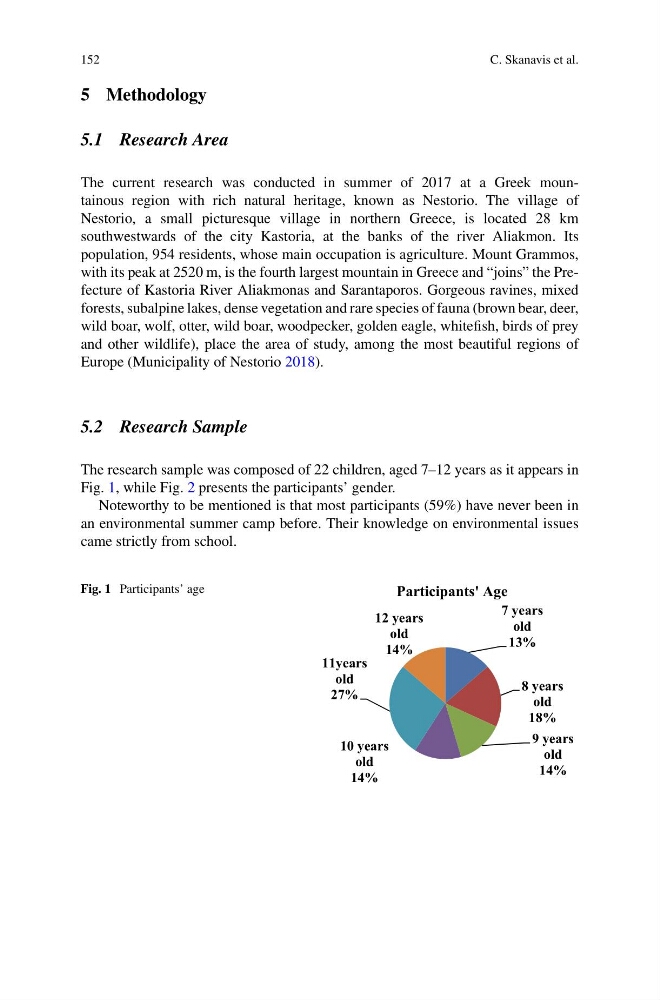
The research sample was composed of 22 children, aged 7–12 years as it appears in
Fig. 1, while Fig. 2 presents the participants’ gender.
Noteworthy to be mentioned is that most participants (59%) have never been in
an environmental summer camp before. Their knowledge on environmental issues
came strictly from school.
Fig. 1 Participants’ age
7 years
old
13%
8 years
old
18%
9 years
old
14%
10 years
old
14%
11years
old
27%
12 years
old
14%
Participants' Age
C. Skanavis et al.
5 Methodology
5.1 Research Area
The current research was conducted in summer of 2017 at a Greek mountainous region with rich natural heritage, known as Nestorio. The village of
Nestorio, a small picturesque village in northern Greece, is located 28 km
southwestwards of the city Kastoria, at the banks of the river Aliakmon. Its
population, 954 residents, whose main occupation is agriculture. Mount Grammos,
with its peak at 2520 m, is the fourth largest mountain in Greece and “joins” the Prefecture of Kastoria River Aliakmonas and Sarantaporos. Gorgeous ravines, mixed
forests, subalpine lakes, dense vegetation and rare species of fauna (brown bear, deer,
wild boar, wolf, otter, wild boar, woodpecker, golden eagle, whitefish, birds of prey
and other wildlife), place the area of study, among the most beautiful regions of
Europe (Municipality of Nestorio 2018).
5.2 Research Sample
The research sample was composed of 22 children, aged 7–12 years as it appears in
Fig. 1, while Fig. 2 presents the participants’ gender.
Noteworthy to be mentioned is that most participants (59%) have never been in
an environmental summer camp before. Their knowledge on environmental issues
came strictly from school.
Fig. 1 Participants’ age
7 years
old
13%
8 years
old
18%
9 years
old
14%
10 years
old
14%
11years
old
27%
12 years
old
14%
Participants' Age