

Brief Analysis of the Scientific Articles Produced About …
111
3
10
11
9
8
13
22
41
73
36
28
2008
2009
2010
2011
2012
2013
2014
2015
2016
2017
2018
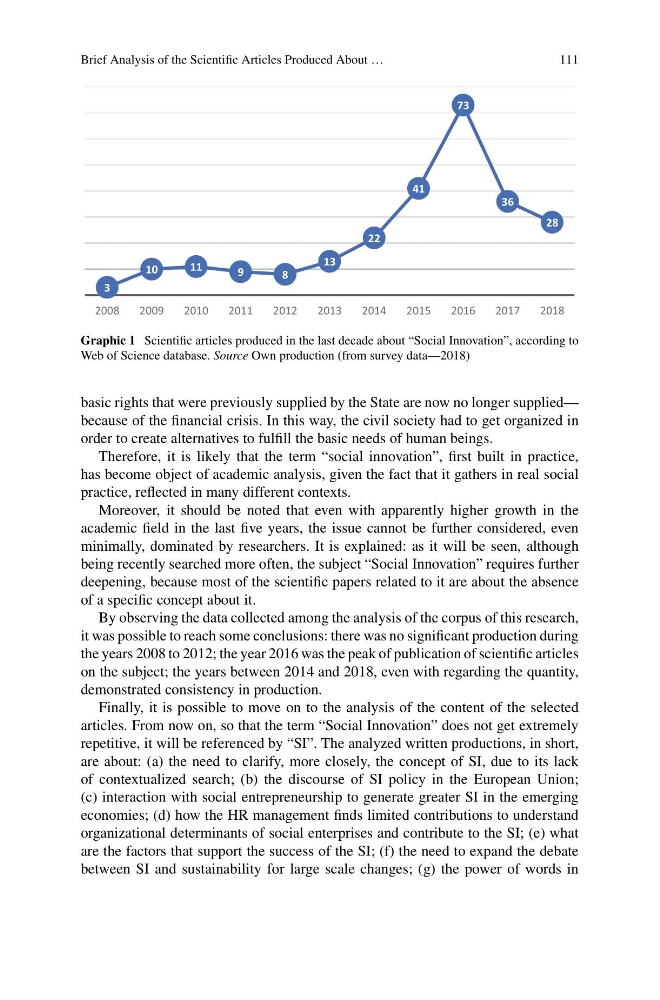
Graphic 1 Scientific articles produced in the last decade about “Social Innovation”, according to
Web of Science database. Source Own production (from survey data—2018)
basic rights that were previously supplied by the State are now no longer supplied—
because of the financial crisis. In this way, the civil society had to get organized in
order to create alternatives to fulfill the basic needs of human beings.
Therefore, it is likely that the term “social innovation”, first built in practice,
has become object of academic analysis, given the fact that it gathers in real social
practice, reflected in many different contexts.
Moreover, it should be noted that even with apparently higher growth in the
academic field in the last five years, the issue cannot be further considered, even
minimally, dominated by researchers. It is explained: as it will be seen, although
being recently searched more often, the subject “Social Innovation” requires further
deepening, because most of the scientific papers related to it are about the absence
of a specific concept about it.
By observing the data collected among the analysis of the corpus of this research,
it was possible to reach some conclusions: there was no significant production during
the years 2008 to 2012; the year 2016 was the peak of publication of scientific articles
on the subject; the years between 2014 and 2018, even with regarding the quantity,
demonstrated consistency in production.
Finally, it is possible to move on to the analysis of the content of the selected
articles. From now on, so that the term “Social Innovation” does not get extremely
repetitive, it will be referenced by “SI”. The analyzed written productions, in short,
are about: (a) the need to clarify, more closely, the concept of SI, due to its lack
of contextualized search; (b) the discourse of SI policy in the European Union;
(c) interaction with social entrepreneurship to generate greater SI in the emerging
economies; (d) how the HR management finds limited contributions to understand
organizational determinants of social enterprises and contribute to the SI; (e) what
are the factors that support the success of the SI; (f) the need to expand the debate
between SI and sustainability for large scale changes; (g) the power of words in
111
3
10
11
9
8
13
22
41
73
36
28
2008
2009
2010
2011
2012
2013
2014
2015
2016
2017
2018
Graphic 1 Scientific articles produced in the last decade about “Social Innovation”, according to
Web of Science database. Source Own production (from survey data—2018)
basic rights that were previously supplied by the State are now no longer supplied—
because of the financial crisis. In this way, the civil society had to get organized in
order to create alternatives to fulfill the basic needs of human beings.
Therefore, it is likely that the term “social innovation”, first built in practice,
has become object of academic analysis, given the fact that it gathers in real social
practice, reflected in many different contexts.
Moreover, it should be noted that even with apparently higher growth in the
academic field in the last five years, the issue cannot be further considered, even
minimally, dominated by researchers. It is explained: as it will be seen, although
being recently searched more often, the subject “Social Innovation” requires further
deepening, because most of the scientific papers related to it are about the absence
of a specific concept about it.
By observing the data collected among the analysis of the corpus of this research,
it was possible to reach some conclusions: there was no significant production during
the years 2008 to 2012; the year 2016 was the peak of publication of scientific articles
on the subject; the years between 2014 and 2018, even with regarding the quantity,
demonstrated consistency in production.
Finally, it is possible to move on to the analysis of the content of the selected
articles. From now on, so that the term “Social Innovation” does not get extremely
repetitive, it will be referenced by “SI”. The analyzed written productions, in short,
are about: (a) the need to clarify, more closely, the concept of SI, due to its lack
of contextualized search; (b) the discourse of SI policy in the European Union;
(c) interaction with social entrepreneurship to generate greater SI in the emerging
economies; (d) how the HR management finds limited contributions to understand
organizational determinants of social enterprises and contribute to the SI; (e) what
are the factors that support the success of the SI; (f) the need to expand the debate
between SI and sustainability for large scale changes; (g) the power of words in