

86
5.1 Introduction
Horticulture crops (vegetables and fruits) offers potentials to income generation and
job opportunities in the rural areas. It provides the necessary food supplements to
assure a balanced diet for a healthy population. In Egypt, the total cultivated areas
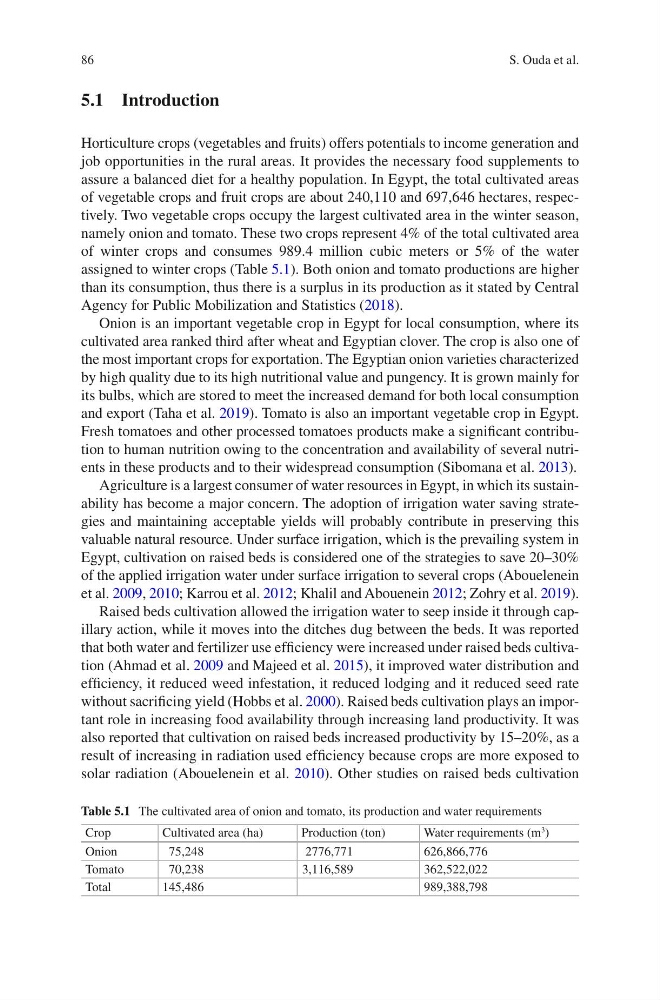
of vegetable crops and fruit crops are about 240,110 and 697,646 hectares, respectively. Two vegetable crops occupy the largest cultivated area in the winter season,
namely onion and tomato. These two crops represent 4% of the total cultivated area
of winter crops and consumes 989.4 million cubic meters or 5% of the water
assigned to winter crops (Table 5.1). Both onion and tomato productions are higher
than its consumption, thus there is a surplus in its production as it stated by Central
Agency for Public Mobilization and Statistics (2018).
Onion is an important vegetable crop in Egypt for local consumption, where its
cultivated area ranked third after wheat and Egyptian clover. The crop is also one of
the most important crops for exportation. The Egyptian onion varieties characterized
by high quality due to its high nutritional value and pungency. It is grown mainly for
its bulbs, which are stored to meet the increased demand for both local consumption
and export (Taha et al. 2019). Tomato is also an important vegetable crop in Egypt.
Fresh tomatoes and other processed tomatoes products make a significant contribution to human nutrition owing to the concentration and availability of several nutrients in these products and to their widespread consumption (Sibomana et al. 2013).
Agriculture is a largest consumer of water resources in Egypt, in which its sustainability has become a major concern. The adoption of irrigation water saving strategies and maintaining acceptable yields will probably contribute in preserving this
valuable natural resource. Under surface irrigation, which is the prevailing system in
Egypt, cultivation on raised beds is considered one of the strategies to save 20–30%
of the applied irrigation water under surface irrigation to several crops (Abouelenein
et al. 2009, 2010; Karrou et al. 2012; Khalil and Abouenein 2012; Zohry et al. 2019).
Raised beds cultivation allowed the irrigation water to seep inside it through capillary action, while it moves into the ditches dug between the beds. It was reported
that both water and fertilizer use efficiency were increased under raised beds cultivation (Ahmad et al. 2009 and Majeed et al. 2015), it improved water distribution and
efficiency, it reduced weed infestation, it reduced lodging and it reduced seed rate
without sacrificing yield (Hobbs et al. 2000). Raised beds cultivation plays an important role in increasing food availability through increasing land productivity. It was
also reported that cultivation on raised beds increased productivity by 15–20%, as a
result of increasing in radiation used efficiency because crops are more exposed to
solar radiation (Abouelenein et al. 2010). Other studies on raised beds cultivation
Table 5.1 The cultivated area of onion and tomato, its production and water requirements
Crop
Cultivated area (ha)
Production (ton)
Water requirements (m
3
)
Onion
75,248
2776,771
626,866,776
Tomato
70,238
3,116,589
362,522,022
Total
145,486
989,388,798
S. Ouda et al.
5.1 Introduction
Horticulture crops (vegetables and fruits) offers potentials to income generation and
job opportunities in the rural areas. It provides the necessary food supplements to
assure a balanced diet for a healthy population. In Egypt, the total cultivated areas
of vegetable crops and fruit crops are about 240,110 and 697,646 hectares, respectively. Two vegetable crops occupy the largest cultivated area in the winter season,
namely onion and tomato. These two crops represent 4% of the total cultivated area
of winter crops and consumes 989.4 million cubic meters or 5% of the water
assigned to winter crops (Table 5.1). Both onion and tomato productions are higher
than its consumption, thus there is a surplus in its production as it stated by Central
Agency for Public Mobilization and Statistics (2018).
Onion is an important vegetable crop in Egypt for local consumption, where its
cultivated area ranked third after wheat and Egyptian clover. The crop is also one of
the most important crops for exportation. The Egyptian onion varieties characterized
by high quality due to its high nutritional value and pungency. It is grown mainly for
its bulbs, which are stored to meet the increased demand for both local consumption
and export (Taha et al. 2019). Tomato is also an important vegetable crop in Egypt.
Fresh tomatoes and other processed tomatoes products make a significant contribution to human nutrition owing to the concentration and availability of several nutrients in these products and to their widespread consumption (Sibomana et al. 2013).
Agriculture is a largest consumer of water resources in Egypt, in which its sustainability has become a major concern. The adoption of irrigation water saving strategies and maintaining acceptable yields will probably contribute in preserving this
valuable natural resource. Under surface irrigation, which is the prevailing system in
Egypt, cultivation on raised beds is considered one of the strategies to save 20–30%
of the applied irrigation water under surface irrigation to several crops (Abouelenein
et al. 2009, 2010; Karrou et al. 2012; Khalil and Abouenein 2012; Zohry et al. 2019).
Raised beds cultivation allowed the irrigation water to seep inside it through capillary action, while it moves into the ditches dug between the beds. It was reported
that both water and fertilizer use efficiency were increased under raised beds cultivation (Ahmad et al. 2009 and Majeed et al. 2015), it improved water distribution and
efficiency, it reduced weed infestation, it reduced lodging and it reduced seed rate
without sacrificing yield (Hobbs et al. 2000). Raised beds cultivation plays an important role in increasing food availability through increasing land productivity. It was
also reported that cultivation on raised beds increased productivity by 15–20%, as a
result of increasing in radiation used efficiency because crops are more exposed to
solar radiation (Abouelenein et al. 2010). Other studies on raised beds cultivation
Table 5.1 The cultivated area of onion and tomato, its production and water requirements
Crop
Cultivated area (ha)
Production (ton)
Water requirements (m
3
)
Onion
75,248
2776,771
626,866,776
Tomato
70,238
3,116,589
362,522,022
Total
145,486
989,388,798
S. Ouda et al.