

61
productivity, thus increasing food availability. It was also reported that cultivation on
raised beds increased productivity by 15–22%, as a result of an increase in radiation
used efficiency because crops are more exposed to solar radiation (Abouelenein et al.
2010; Khalil and Abouelenein 2012; Zohry et al. 2019). Furthermore, Majeed et al.
(2015) indicated that raised beds planting of wheat, not only saved water but also
improved fertilizer use efficiency and increase grain yield by 15%, compared to flat
planting. Furthermore, it increase nitrogen use efficiency (Karrou et al. 2012; Majeed
et al. 2015), thus increase productivity. Other studies on raised beds cultivation
showed that it reduces seed mortality rates; and improves soil quality (Limon- Ortega
et al. 2002), which led to enhanced root growth, and gave higher yield (Dey et al.
2015). Root length density was also longer in upper 45 cm in beds due to porous soil
environment under raised beds cultivation (Dey et al. 2015). Raised beds cultivation
significantly increased maize growth, microbial functional groups and enzyme activities compare to flat planting, thus it increasing availability of essential nutrients
needed the crop by stimulating microbial activity (Zhang et al. 2012). Raised beds
planting also created better soil physical environment throughout the crop growth
period, which led to higher crop productivity (Aggarwal and Goswami 2003).
The other water saving strategy that can be used to face water scarcity is application of deficit irrigation instead of full irrigation to crops to increase its water use
efficiency and increase the productivity of unit of irrigation water. Deficit irrigation
is an irrigation practice characterized by application of irrigation water below the
full required amounts for optimal growth and yield, aiming at improving the
response of plants to a certain degree of water deficit in a positive manner, and
improving crop’s water use efficiency (Chai et al. 2016). When using deficit irrigation, the saved amount of irrigation water could be assigned to irrigate larger areas
of crops, which will increase food availably, thus food security.
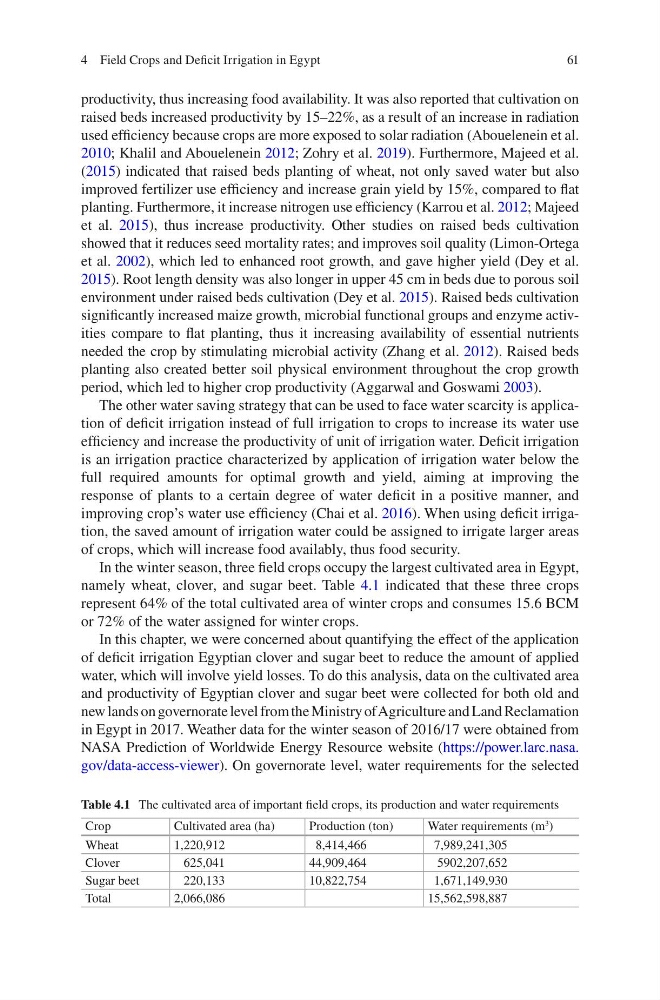
In the winter season, three field crops occupy the largest cultivated area in Egypt,
namely wheat, clover, and sugar beet. Table 4.1 indicated that these three crops
represent 64% of the total cultivated area of winter crops and consumes 15.6 BCM
or 72% of the water assigned for winter crops.
In this chapter, we were concerned about quantifying the effect of the application
of deficit irrigation Egyptian clover and sugar beet to reduce the amount of applied
water, which will involve yield losses. To do this analysis, data on the cultivated area
and productivity of Egyptian clover and sugar beet were collected for both old and
new lands on governorate level from the Ministry of Agriculture and Land Reclamation
in Egypt in 2017. Weather data for the winter season of 2016/17 were obtained from
NASA Prediction of Worldwide Energy Resource website (https://power.larc.nasa.
gov/data-access-viewer). On governorate level, water requirements for the selected
Table 4.1 The cultivated area of important field crops, its production and water requirements
Crop
Cultivated area (ha)
Production (ton)
Water requirements (m
3 )
Wheat
1,220,912
8,414,466
7,989,241,305
Clover
625,041
44,909,464
5902,207,652
Sugar beet
220,133
10,822,754
1,671,149,930
Total
2,066,086
15,562,598,887
4 Field Crops and Deficit Irrigation in Egypt
productivity, thus increasing food availability. It was also reported that cultivation on
raised beds increased productivity by 15–22%, as a result of an increase in radiation
used efficiency because crops are more exposed to solar radiation (Abouelenein et al.
2010; Khalil and Abouelenein 2012; Zohry et al. 2019). Furthermore, Majeed et al.
(2015) indicated that raised beds planting of wheat, not only saved water but also
improved fertilizer use efficiency and increase grain yield by 15%, compared to flat
planting. Furthermore, it increase nitrogen use efficiency (Karrou et al. 2012; Majeed
et al. 2015), thus increase productivity. Other studies on raised beds cultivation
showed that it reduces seed mortality rates; and improves soil quality (Limon- Ortega
et al. 2002), which led to enhanced root growth, and gave higher yield (Dey et al.
2015). Root length density was also longer in upper 45 cm in beds due to porous soil
environment under raised beds cultivation (Dey et al. 2015). Raised beds cultivation
significantly increased maize growth, microbial functional groups and enzyme activities compare to flat planting, thus it increasing availability of essential nutrients
needed the crop by stimulating microbial activity (Zhang et al. 2012). Raised beds
planting also created better soil physical environment throughout the crop growth
period, which led to higher crop productivity (Aggarwal and Goswami 2003).
The other water saving strategy that can be used to face water scarcity is application of deficit irrigation instead of full irrigation to crops to increase its water use
efficiency and increase the productivity of unit of irrigation water. Deficit irrigation
is an irrigation practice characterized by application of irrigation water below the
full required amounts for optimal growth and yield, aiming at improving the
response of plants to a certain degree of water deficit in a positive manner, and
improving crop’s water use efficiency (Chai et al. 2016). When using deficit irrigation, the saved amount of irrigation water could be assigned to irrigate larger areas
of crops, which will increase food availably, thus food security.
In the winter season, three field crops occupy the largest cultivated area in Egypt,
namely wheat, clover, and sugar beet. Table 4.1 indicated that these three crops
represent 64% of the total cultivated area of winter crops and consumes 15.6 BCM
or 72% of the water assigned for winter crops.
In this chapter, we were concerned about quantifying the effect of the application
of deficit irrigation Egyptian clover and sugar beet to reduce the amount of applied
water, which will involve yield losses. To do this analysis, data on the cultivated area
and productivity of Egyptian clover and sugar beet were collected for both old and
new lands on governorate level from the Ministry of Agriculture and Land Reclamation
in Egypt in 2017. Weather data for the winter season of 2016/17 were obtained from
NASA Prediction of Worldwide Energy Resource website (https://power.larc.nasa.
gov/data-access-viewer). On governorate level, water requirements for the selected
Table 4.1 The cultivated area of important field crops, its production and water requirements
Crop
Cultivated area (ha)
Production (ton)
Water requirements (m
3 )
Wheat
1,220,912
8,414,466
7,989,241,305
Clover
625,041
44,909,464
5902,207,652
Sugar beet
220,133
10,822,754
1,671,149,930
Total
2,066,086
15,562,598,887
4 Field Crops and Deficit Irrigation in Egypt