

30
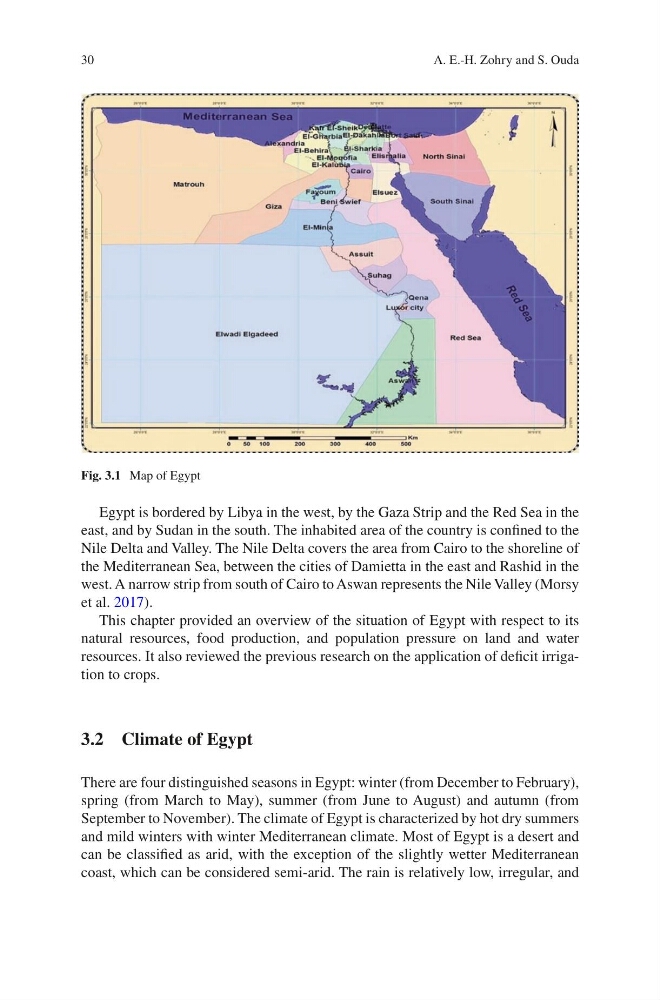
Egypt is bordered by Libya in the west, by the Gaza Strip and the Red Sea in the
east, and by Sudan in the south. The inhabited area of the country is confined to the
Nile Delta and Valley. The Nile Delta covers the area from Cairo to the shoreline of
the Mediterranean Sea, between the cities of Damietta in the east and Rashid in the
west. A narrow strip from south of Cairo to Aswan represents the Nile Valley (Morsy
et al. 2017).
This chapter provided an overview of the situation of Egypt with respect to its
natural resources, food production, and population pressure on land and water
resources. It also reviewed the previous research on the application of deficit irrigation to crops.
3.2 Climate of Egypt
There are four distinguished seasons in Egypt: winter (from December to February),
spring (from March to May), summer (from June to August) and autumn (from
September to November). The climate of Egypt is characterized by hot dry summers
and mild winters with winter Mediterranean climate. Most of Egypt is a desert and
can be classified as arid, with the exception of the slightly wetter Mediterranean
coast, which can be considered semi-arid. The rain is relatively low, irregular, and
Fig. 3.1 Map of Egypt
A. E.-H. Zohry and S. Ouda
Egypt is bordered by Libya in the west, by the Gaza Strip and the Red Sea in the
east, and by Sudan in the south. The inhabited area of the country is confined to the
Nile Delta and Valley. The Nile Delta covers the area from Cairo to the shoreline of
the Mediterranean Sea, between the cities of Damietta in the east and Rashid in the
west. A narrow strip from south of Cairo to Aswan represents the Nile Valley (Morsy
et al. 2017).
This chapter provided an overview of the situation of Egypt with respect to its
natural resources, food production, and population pressure on land and water
resources. It also reviewed the previous research on the application of deficit irrigation to crops.
3.2 Climate of Egypt
There are four distinguished seasons in Egypt: winter (from December to February),
spring (from March to May), summer (from June to August) and autumn (from
September to November). The climate of Egypt is characterized by hot dry summers
and mild winters with winter Mediterranean climate. Most of Egypt is a desert and
can be classified as arid, with the exception of the slightly wetter Mediterranean
coast, which can be considered semi-arid. The rain is relatively low, irregular, and
Fig. 3.1 Map of Egypt
A. E.-H. Zohry and S. Ouda