

183
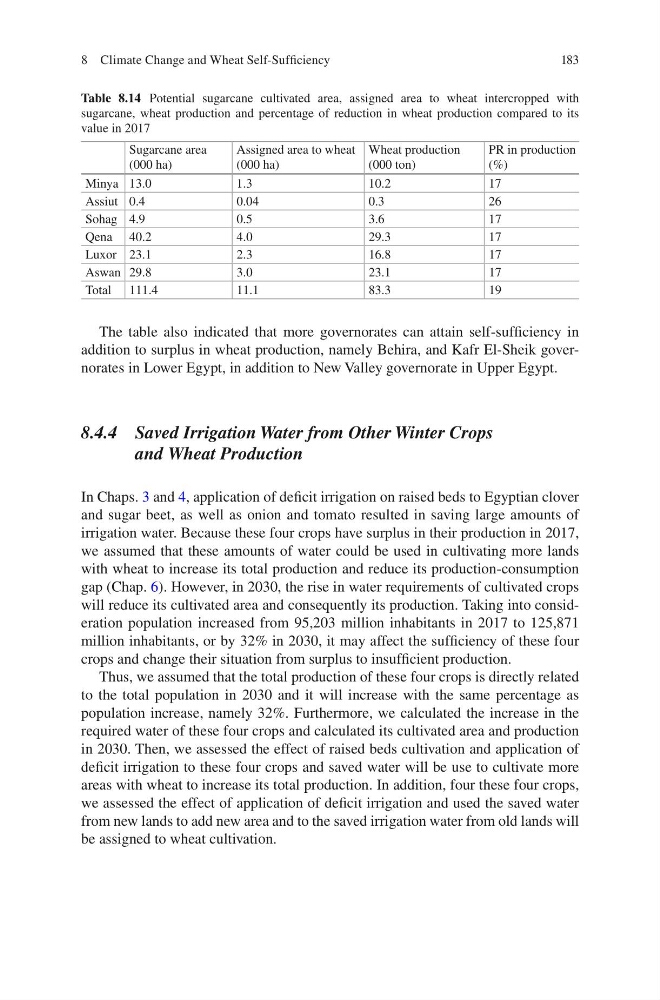
The table also indicated that more governorates can attain self-sufficiency in
addition to surplus in wheat production, namely Behira, and Kafr El-Sheik governorates in Lower Egypt, in addition to New Valley governorate in Upper Egypt.
8.4.4 Saved Irrigation Water from Other Winter Crops
and Wheat Production
In Chaps. 3 and 4, application of deficit irrigation on raised beds to Egyptian clover
and sugar beet, as well as onion and tomato resulted in saving large amounts of
irrigation water. Because these four crops have surplus in their production in 2017,
we assumed that these amounts of water could be used in cultivating more lands
with wheat to increase its total production and reduce its production-consumption
gap (Chap. 6). However, in 2030, the rise in water requirements of cultivated crops
will reduce its cultivated area and consequently its production. Taking into consideration population increased from 95,203 million inhabitants in 2017 to 125,871
million inhabitants, or by 32% in 2030, it may affect the sufficiency of these four
crops and change their situation from surplus to insufficient production.
Thus, we assumed that the total production of these four crops is directly related
to the total population in 2030 and it will increase with the same percentage as
population increase, namely 32%. Furthermore, we calculated the increase in the
required water of these four crops and calculated its cultivated area and production
in 2030. Then, we assessed the effect of raised beds cultivation and application of
deficit irrigation to these four crops and saved water will be use to cultivate more
areas with wheat to increase its total production. In addition, four these four crops,
we assessed the effect of application of deficit irrigation and used the saved water
from new lands to add new area and to the saved irrigation water from old lands will
be assigned to wheat cultivation.
Table 8.14 Potential sugarcane cultivated area, assigned area to wheat intercropped with
sugarcane, wheat production and percentage of reduction in wheat production compared to its
value in 2017
Sugarcane area
(000 ha)
Assigned area to wheat
(000 ha)
Wheat production
(000 ton)
PR in production
(%)
Minya 13.0
1.3
10.2
17
Assiut 0.4
0.04
0.3
26
Sohag 4.9
0.5
3.6
17
Qena 40.2
4.0
29.3
17
Luxor 23.1
2.3
16.8
17
Aswan 29.8
3.0
23.1
17
Total 111.4
11.1
83.3
19
8 Climate Change and Wheat Self-Sufficiency
The table also indicated that more governorates can attain self-sufficiency in
addition to surplus in wheat production, namely Behira, and Kafr El-Sheik governorates in Lower Egypt, in addition to New Valley governorate in Upper Egypt.
8.4.4 Saved Irrigation Water from Other Winter Crops
and Wheat Production
In Chaps. 3 and 4, application of deficit irrigation on raised beds to Egyptian clover
and sugar beet, as well as onion and tomato resulted in saving large amounts of
irrigation water. Because these four crops have surplus in their production in 2017,
we assumed that these amounts of water could be used in cultivating more lands
with wheat to increase its total production and reduce its production-consumption
gap (Chap. 6). However, in 2030, the rise in water requirements of cultivated crops
will reduce its cultivated area and consequently its production. Taking into consideration population increased from 95,203 million inhabitants in 2017 to 125,871
million inhabitants, or by 32% in 2030, it may affect the sufficiency of these four
crops and change their situation from surplus to insufficient production.
Thus, we assumed that the total production of these four crops is directly related
to the total population in 2030 and it will increase with the same percentage as
population increase, namely 32%. Furthermore, we calculated the increase in the
required water of these four crops and calculated its cultivated area and production
in 2030. Then, we assessed the effect of raised beds cultivation and application of
deficit irrigation to these four crops and saved water will be use to cultivate more
areas with wheat to increase its total production. In addition, four these four crops,
we assessed the effect of application of deficit irrigation and used the saved water
from new lands to add new area and to the saved irrigation water from old lands will
be assigned to wheat cultivation.
Table 8.14 Potential sugarcane cultivated area, assigned area to wheat intercropped with
sugarcane, wheat production and percentage of reduction in wheat production compared to its
value in 2017
Sugarcane area
(000 ha)
Assigned area to wheat
(000 ha)
Wheat production
(000 ton)
PR in production
(%)
Minya 13.0
1.3
10.2
17
Assiut 0.4
0.04
0.3
26
Sohag 4.9
0.5
3.6
17
Qena 40.2
4.0
29.3
17
Luxor 23.1
2.3
16.8
17
Aswan 29.8
3.0
23.1
17
Total 111.4
11.1
83.3
19
8 Climate Change and Wheat Self-Sufficiency