

122
It worth noting that wheat production from the suggested systems use the applied
water to the main crop in the intercropping system and did not use extra irrigation water.
6.3.3.1 Wheat Intercropped with Winter Tomato System
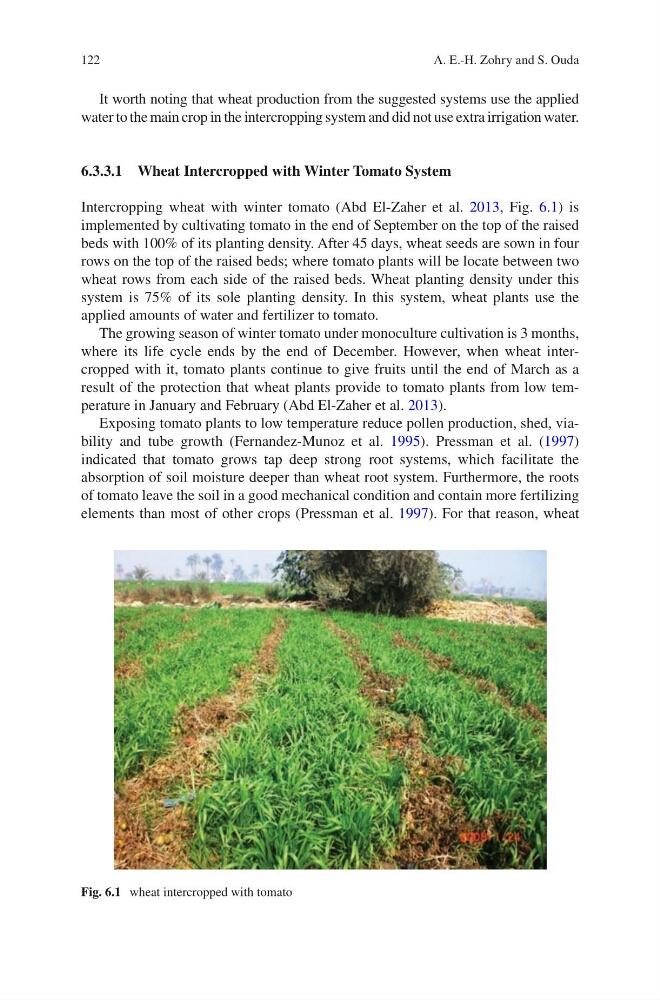
Intercropping wheat with winter tomato (Abd El-Zaher et al. 2013, Fig. 6.1) is
implemented by cultivating tomato in the end of September on the top of the raised
beds with 100% of its planting density. After 45 days, wheat seeds are sown in four
rows on the top of the raised beds; where tomato plants will be locate between two
wheat rows from each side of the raised beds. Wheat planting density under this
system is 75% of its sole planting density. In this system, wheat plants use the
applied amounts of water and fertilizer to tomato.
The growing season of winter tomato under monoculture cultivation is 3 months,
where its life cycle ends by the end of December. However, when wheat intercropped with it, tomato plants continue to give fruits until the end of March as a
result of the protection that wheat plants provide to tomato plants from low temperature in January and February (Abd El-Zaher et al. 2013).
Exposing tomato plants to low temperature reduce pollen production, shed, viability and tube growth (Fernandez-Munoz et al. 1995). Pressman et al. (1997)
indicated that tomato grows tap deep strong root systems, which facilitate the
absorption of soil moisture deeper than wheat root system. Furthermore, the roots
of tomato leave the soil in a good mechanical condition and contain more fertilizing
elements than most of other crops (Pressman et al. 1997). For that reason, wheat
Fig. 6.1 wheat intercropped with tomato
A. E.-H. Zohry and S. Ouda
It worth noting that wheat production from the suggested systems use the applied
water to the main crop in the intercropping system and did not use extra irrigation water.
6.3.3.1 Wheat Intercropped with Winter Tomato System
Intercropping wheat with winter tomato (Abd El-Zaher et al. 2013, Fig. 6.1) is
implemented by cultivating tomato in the end of September on the top of the raised
beds with 100% of its planting density. After 45 days, wheat seeds are sown in four
rows on the top of the raised beds; where tomato plants will be locate between two
wheat rows from each side of the raised beds. Wheat planting density under this
system is 75% of its sole planting density. In this system, wheat plants use the
applied amounts of water and fertilizer to tomato.
The growing season of winter tomato under monoculture cultivation is 3 months,
where its life cycle ends by the end of December. However, when wheat intercropped with it, tomato plants continue to give fruits until the end of March as a
result of the protection that wheat plants provide to tomato plants from low temperature in January and February (Abd El-Zaher et al. 2013).
Exposing tomato plants to low temperature reduce pollen production, shed, viability and tube growth (Fernandez-Munoz et al. 1995). Pressman et al. (1997)
indicated that tomato grows tap deep strong root systems, which facilitate the
absorption of soil moisture deeper than wheat root system. Furthermore, the roots
of tomato leave the soil in a good mechanical condition and contain more fertilizing
elements than most of other crops (Pressman et al. 1997). For that reason, wheat
Fig. 6.1 wheat intercropped with tomato
A. E.-H. Zohry and S. Ouda