

polysulfide (CaS x ), dithionites S(+III) by sodium dithionite (Na 2 S 2 O 4 ), sulfites S
(+IV) by sodium metabisulfite (Na 2 S 2 O 5 ) and sodium sulfite (Na 2 SO 3 ). These
compounds act only on inorganic contaminants, which are clearly dominated by
hexavalent chromium. Another type of components is iron in a low oxidation state
Fe(+II) in, e.g., ferrous sulfate (FeSO 4 ). The advantage of these compounds is,
unlike ZVI, their solubility in water and therefore better transport in groundwater.
Besides dithionite discussed in a case study below, the most used compounds are
calcium polysulfide and sodium metabisulfite. Calcium polysulfide reacts with
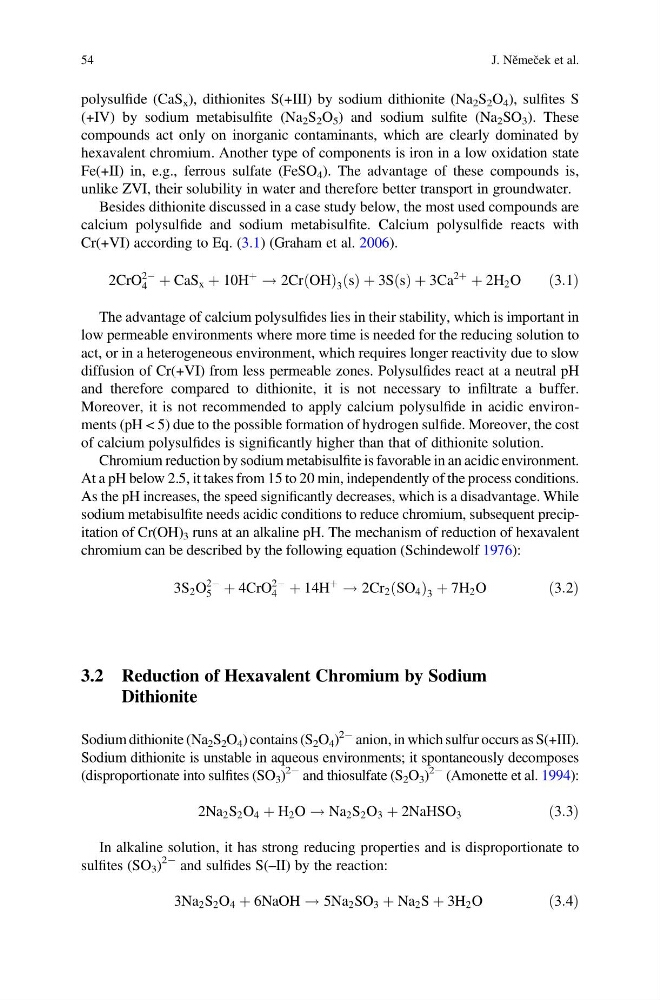
Cr(+VI) according to Eq. (3.1) (Graham et al. 2006).
2CrO
2À
4 þ CaS x þ 10H
þ
! 2Cr OH
ð Þ 3 s
ð Þ þ 3S s
ð Þ þ 3Ca
2þ
þ 2H 2 O
ð3:1Þ
The advantage of calcium polysulfides lies in their stability, which is important in
low permeable environments where more time is needed for the reducing solution to
act, or in a heterogeneous environment, which requires longer reactivity due to slow
diffusion of Cr(+VI) from less permeable zones. Polysulfides react at a neutral pH
and therefore compared to dithionite, it is not necessary to infiltrate a buffer.
Moreover, it is not recommended to apply calcium polysulfide in acidic environments (pH < 5) due to the possible formation of hydrogen sulfide. Moreover, the cost
of calcium polysulfides is significantly higher than that of dithionite solution.
Chromium reduction by sodium metabisulfite is favorable in an acidic environment.
At a pH below 2.5, it takes from 15 to 20 min, independently of the process conditions.
As the pH increases, the speed significantly decreases, which is a disadvantage. While
sodium metabisulfite needs acidic conditions to reduce chromium, subsequent precipitation of Cr(OH) 3 runs at an alkaline pH. The mechanism of reduction of hexavalent
chromium can be described by the following equation (Schindewolf 1976):
3S 2 O
2À
5 þ 4CrO
2À
4 þ 14H
þ
! 2Cr 2 SO 4
ð
Þ 3 þ 7H 2 O
ð3:2Þ
3.2 Reduction of Hexavalent Chromium by Sodium
Dithionite
Sodium dithionite (Na 2 S 2 O 4 ) contains (S 2 O 4 )
2À anion, in which sulfur occurs as S(+III).
Sodium dithionite is unstable in aqueous environments; it spontaneously decomposes
(disproportionate into sulfites (SO 3 )
2À and thiosulfate (S 2 O 3 )
2À (Amonette et al. 1994):
2Na 2 S 2 O 4 þ H 2 O ! Na 2 S 2 O 3 þ 2NaHSO 3
ð3:3Þ
In alkaline solution, it has strong reducing properties and is disproportionate to
sulfites (SO 3 )
2À and sulfides S(–II) by the reaction:
3Na 2 S 2 O 4 þ 6NaOH ! 5Na 2 SO 3 þ Na 2 S þ 3H 2 O
ð3:4Þ
54
J. Němeček et al.
(+IV) by sodium metabisulfite (Na 2 S 2 O 5 ) and sodium sulfite (Na 2 SO 3 ). These
compounds act only on inorganic contaminants, which are clearly dominated by
hexavalent chromium. Another type of components is iron in a low oxidation state
Fe(+II) in, e.g., ferrous sulfate (FeSO 4 ). The advantage of these compounds is,
unlike ZVI, their solubility in water and therefore better transport in groundwater.
Besides dithionite discussed in a case study below, the most used compounds are
calcium polysulfide and sodium metabisulfite. Calcium polysulfide reacts with
Cr(+VI) according to Eq. (3.1) (Graham et al. 2006).
2CrO
2À
4 þ CaS x þ 10H
þ
! 2Cr OH
ð Þ 3 s
ð Þ þ 3S s
ð Þ þ 3Ca
2þ
þ 2H 2 O
ð3:1Þ
The advantage of calcium polysulfides lies in their stability, which is important in
low permeable environments where more time is needed for the reducing solution to
act, or in a heterogeneous environment, which requires longer reactivity due to slow
diffusion of Cr(+VI) from less permeable zones. Polysulfides react at a neutral pH
and therefore compared to dithionite, it is not necessary to infiltrate a buffer.
Moreover, it is not recommended to apply calcium polysulfide in acidic environments (pH < 5) due to the possible formation of hydrogen sulfide. Moreover, the cost
of calcium polysulfides is significantly higher than that of dithionite solution.
Chromium reduction by sodium metabisulfite is favorable in an acidic environment.
At a pH below 2.5, it takes from 15 to 20 min, independently of the process conditions.
As the pH increases, the speed significantly decreases, which is a disadvantage. While
sodium metabisulfite needs acidic conditions to reduce chromium, subsequent precipitation of Cr(OH) 3 runs at an alkaline pH. The mechanism of reduction of hexavalent
chromium can be described by the following equation (Schindewolf 1976):
3S 2 O
2À
5 þ 4CrO
2À
4 þ 14H
þ
! 2Cr 2 SO 4
ð
Þ 3 þ 7H 2 O
ð3:2Þ
3.2 Reduction of Hexavalent Chromium by Sodium
Dithionite
Sodium dithionite (Na 2 S 2 O 4 ) contains (S 2 O 4 )
2À anion, in which sulfur occurs as S(+III).
Sodium dithionite is unstable in aqueous environments; it spontaneously decomposes
(disproportionate into sulfites (SO 3 )
2À and thiosulfate (S 2 O 3 )
2À (Amonette et al. 1994):
2Na 2 S 2 O 4 þ H 2 O ! Na 2 S 2 O 3 þ 2NaHSO 3
ð3:3Þ
In alkaline solution, it has strong reducing properties and is disproportionate to
sulfites (SO 3 )
2À and sulfides S(–II) by the reaction:
3Na 2 S 2 O 4 þ 6NaOH ! 5Na 2 SO 3 þ Na 2 S þ 3H 2 O
ð3:4Þ
54
J. Němeček et al.