

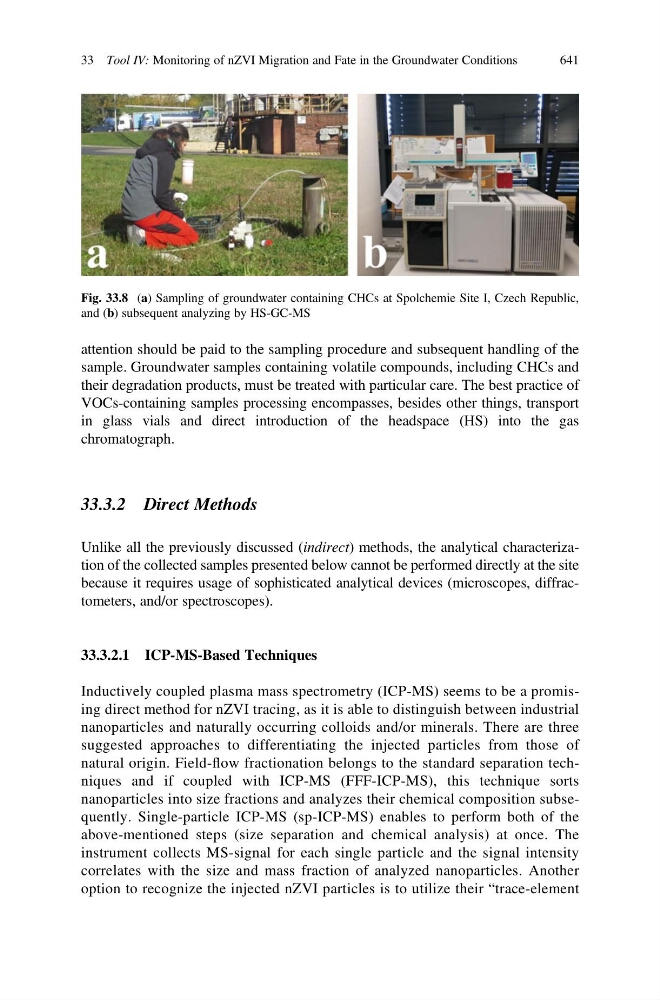
attention should be paid to the sampling procedure and subsequent handling of the
sample. Groundwater samples containing volatile compounds, including CHCs and
their degradation products, must be treated with particular care. The best practice of
VOCs-containing samples processing encompasses, besides other things, transport
in glass vials and direct introduction of the headspace (HS) into the gas
chromatograph.
33.3.2 Direct Methods
Unlike all the previously discussed (indirect) methods, the analytical characterization of the collected samples presented below cannot be performed directly at the site
because it requires usage of sophisticated analytical devices (microscopes, diffractometers, and/or spectroscopes).
33.3.2.1 ICP-MS-Based Techniques
Inductively coupled plasma mass spectrometry (ICP-MS) seems to be a promising direct method for nZVI tracing, as it is able to distinguish between industrial
nanoparticles and naturally occurring colloids and/or minerals. There are three
suggested approaches to differentiating the injected particles from those of
natural origin. Field-flow fractionation belongs to the standard separation techniques and if coupled with ICP-MS (FFF-ICP-MS), this technique sorts
nanoparticles into size fractions and analyzes their chemical composition subsequently. Single-particle ICP-MS (sp-ICP-MS) enables to perform both of the
above-mentioned steps (size separation and chemical analysis) at once. The
instrument collects MS-signal for each single particle and the signal intensity
correlates with the size and mass fraction of analyzed nanoparticles. Another
option to recognize the injected nZVI particles is to utilize their “trace-element
Fig. 33.8 (a) Sampling of groundwater containing CHCs at Spolchemie Site I, Czech Republic,
and (b) subsequent analyzing by HS-GC-MS
33 Tool IV: Monitoring of nZVI Migration and Fate in the Groundwater Conditions
641