

monitoring system can also bring unique information about distribution of the
injected liquids on the basis of measuring the temperature. A disadvantage of the
susceptibility method is its inclination to the falsely positive signals caused by pieces
of magnetically susceptible rocks, e.g., basalts, and magnetite-containing rocks. A
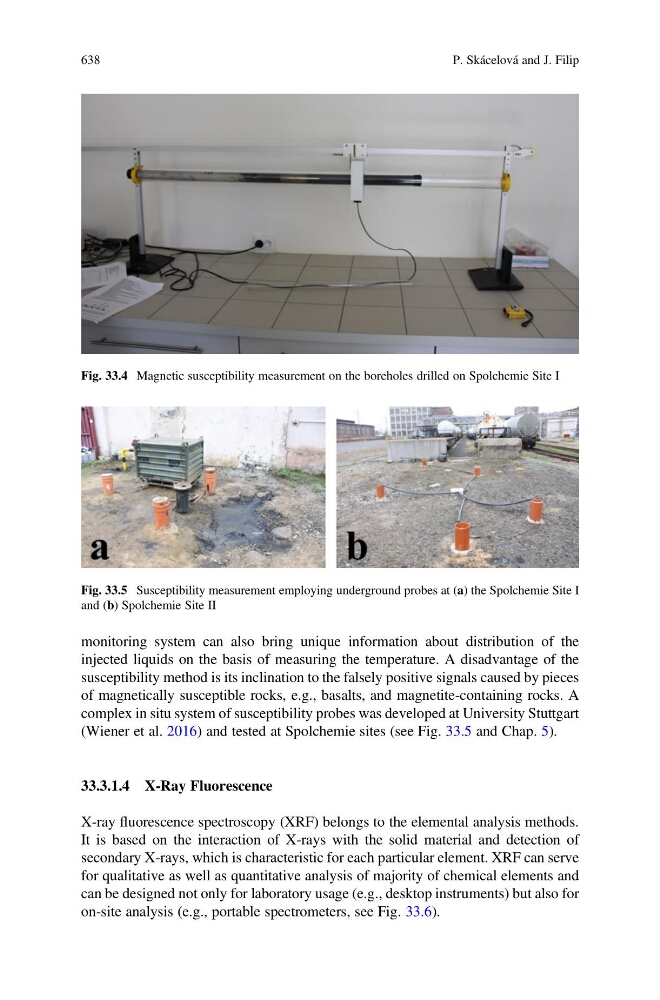
complex in situ system of susceptibility probes was developed at University Stuttgart
(Wiener et al. 2016) and tested at Spolchemie sites (see Fig. 33.5 and Chap. 5).
33.3.1.4 X-Ray Fluorescence
X-ray fluorescence spectroscopy (XRF) belongs to the elemental analysis methods.
It is based on the interaction of X-rays with the solid material and detection of
secondary X-rays, which is characteristic for each particular element. XRF can serve
for qualitative as well as quantitative analysis of majority of chemical elements and
can be designed not only for laboratory usage (e.g., desktop instruments) but also for
on-site analysis (e.g., portable spectrometers, see Fig. 33.6).
Fig. 33.4 Magnetic susceptibility measurement on the boreholes drilled on Spolchemie Site I
Fig. 33.5 Susceptibility measurement employing underground probes at (a) the Spolchemie Site I
and (b) Spolchemie Site II
638
P. Skácelová and J. Filip