

There are two different types of monitoring wells that can be prepared for the
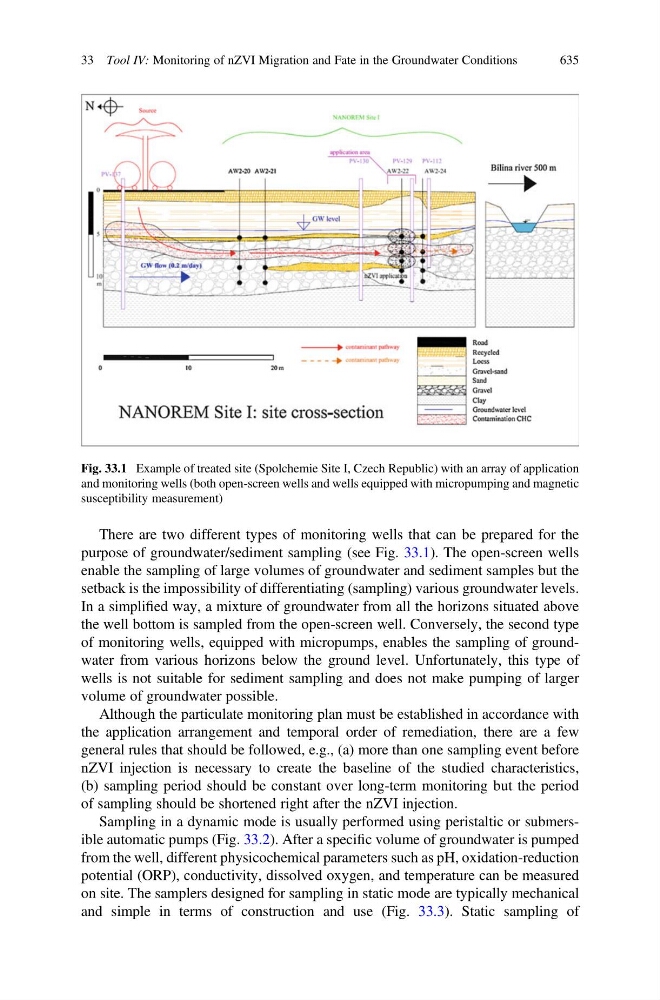
purpose of groundwater/sediment sampling (see Fig. 33.1). The open-screen wells
enable the sampling of large volumes of groundwater and sediment samples but the
setback is the impossibility of differentiating (sampling) various groundwater levels.
In a simplified way, a mixture of groundwater from all the horizons situated above
the well bottom is sampled from the open-screen well. Conversely, the second type
of monitoring wells, equipped with micropumps, enables the sampling of groundwater from various horizons below the ground level. Unfortunately, this type of
wells is not suitable for sediment sampling and does not make pumping of larger
volume of groundwater possible.
Although the particulate monitoring plan must be established in accordance with
the application arrangement and temporal order of remediation, there are a few
general rules that should be followed, e.g., (a) more than one sampling event before
nZVI injection is necessary to create the baseline of the studied characteristics,
(b) sampling period should be constant over long-term monitoring but the period
of sampling should be shortened right after the nZVI injection.
Sampling in a dynamic mode is usually performed using peristaltic or submersible automatic pumps (Fig. 33.2). After a specific volume of groundwater is pumped
from the well, different physicochemical parameters such as pH, oxidation-reduction
potential (ORP), conductivity, dissolved oxygen, and temperature can be measured
on site. The samplers designed for sampling in static mode are typically mechanical
and simple in terms of construction and use (Fig. 33.3). Static sampling of
Fig. 33.1 Example of treated site (Spolchemie Site I, Czech Republic) with an array of application
and monitoring wells (both open-screen wells and wells equipped with micropumping and magnetic
susceptibility measurement)
33 Tool IV: Monitoring of nZVI Migration and Fate in the Groundwater Conditions
635