

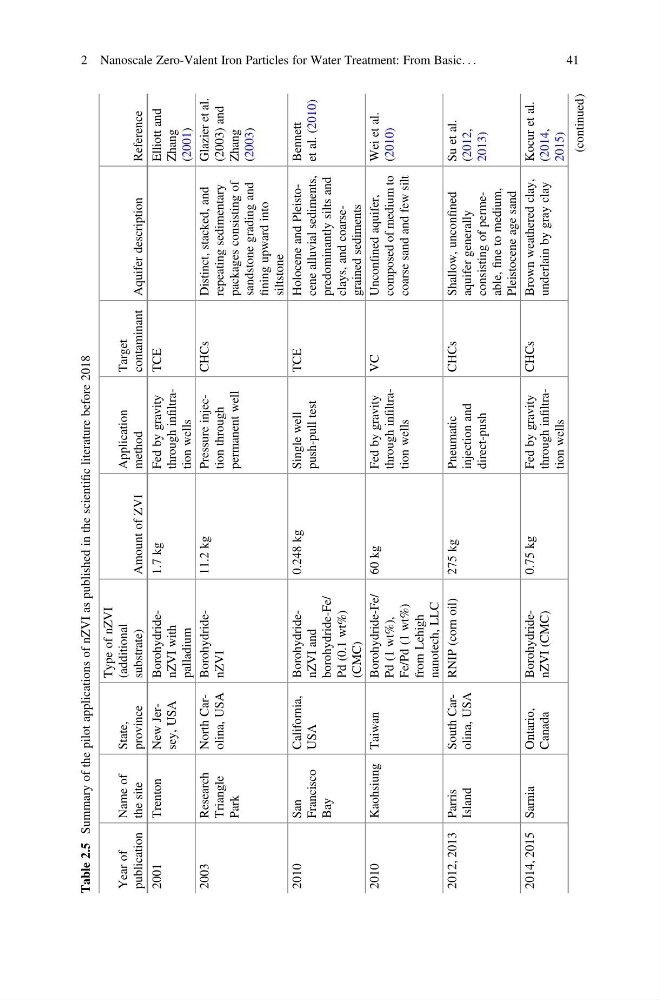
Table 2.5
Summary of the pilot applications of nZVI as published in the scientific literature before 2018
Year of
publication
Name of
the site
State,
province
Type of nZVI
(additional
substrate)
Amount of ZVI
Application
method
Target
contaminant Aquifer description
Reference
2001
Trenton
New Jersey, USA
BorohydridenZVI with
palladium
1.7 kg
Fed by gravity
through infiltration wells
TCE
Elliott and
Zhang
(2001)
2003
Research
Triangle
Park
North Carolina, USA
BorohydridenZVI
11.2 kg
Pressure injection through
permanent well
CHCs
Distinct, stacked, and
repeating sedimentary
packages consisting of
sandstone grading and
fining upward into
siltstone
Glazier et al.
(2003) and
Zhang
(2003)
2010
San
Francisco
Bay
California,
USA
BorohydridenZVI and
borohydride-Fe/
Pd (0.1 wt%)
(CMC)
0.248 kg
Single well
push-pull test
TCE
Holocene and Pleistocene alluvial sediments,
predominantly silts and
clays, and coarsegrained sediments
Bennett
et al. (2010)
2010
Kaohsiung Taiwan
Borohydride-Fe/
Pd (1 wt%),
Fe/Pd (1 wt%)
from Lehigh
nanotech, LLC
60 kg
Fed by gravity
through infiltration wells
VC
Unconfined aquifer,
composed of medium to
coarse sand and few silt
Wei et al.
(2010)
2012, 2013 Parris
Island
South Carolina, USA
RNIP (corn oil)
275 kg
Pneumatic
injection and
direct-push
CHCs
Shallow, unconfined
aquifer generally
consisting of permeable,
fine to medium,
Pleistocene age sand
Su et al.
(2012,
2013)
2014, 2015 Sarnia
Ontario,
Canada
BorohydridenZVI (CMC)
0.75 kg
Fed by gravity
through infiltration wells
CHCs
Brown weathered clay,
underlain by gray clay
Kocur et al.
(2014,
2015)
(continued)
2 Nanoscale Zero-Valent Iron Particles for Water Treatment: From Basic. . .
41
Summary of the pilot applications of nZVI as published in the scientific literature before 2018
Year of
publication
Name of
the site
State,
province
Type of nZVI
(additional
substrate)
Amount of ZVI
Application
method
Target
contaminant Aquifer description
Reference
2001
Trenton
New Jersey, USA
BorohydridenZVI with
palladium
1.7 kg
Fed by gravity
through infiltration wells
TCE
Elliott and
Zhang
(2001)
2003
Research
Triangle
Park
North Carolina, USA
BorohydridenZVI
11.2 kg
Pressure injection through
permanent well
CHCs
Distinct, stacked, and
repeating sedimentary
packages consisting of
sandstone grading and
fining upward into
siltstone
Glazier et al.
(2003) and
Zhang
(2003)
2010
San
Francisco
Bay
California,
USA
BorohydridenZVI and
borohydride-Fe/
Pd (0.1 wt%)
(CMC)
0.248 kg
Single well
push-pull test
TCE
Holocene and Pleistocene alluvial sediments,
predominantly silts and
clays, and coarsegrained sediments
Bennett
et al. (2010)
2010
Kaohsiung Taiwan
Borohydride-Fe/
Pd (1 wt%),
Fe/Pd (1 wt%)
from Lehigh
nanotech, LLC
60 kg
Fed by gravity
through infiltration wells
VC
Unconfined aquifer,
composed of medium to
coarse sand and few silt
Wei et al.
(2010)
2012, 2013 Parris
Island
South Carolina, USA
RNIP (corn oil)
275 kg
Pneumatic
injection and
direct-push
CHCs
Shallow, unconfined
aquifer generally
consisting of permeable,
fine to medium,
Pleistocene age sand
Su et al.
(2012,
2013)
2014, 2015 Sarnia
Ontario,
Canada
BorohydridenZVI (CMC)
0.75 kg
Fed by gravity
through infiltration wells
CHCs
Brown weathered clay,
underlain by gray clay
Kocur et al.
(2014,
2015)
(continued)
2 Nanoscale Zero-Valent Iron Particles for Water Treatment: From Basic. . .
41