

industry. In the Canadian context, water treatment challenges include high flow rates
and contamination, remoteness and extreme cold climate conditions, sensitive environments as well as evolving water quality standards and stricter regulations. Rapid
degradation kinetics and/or complete reactions avoid by-products formation and
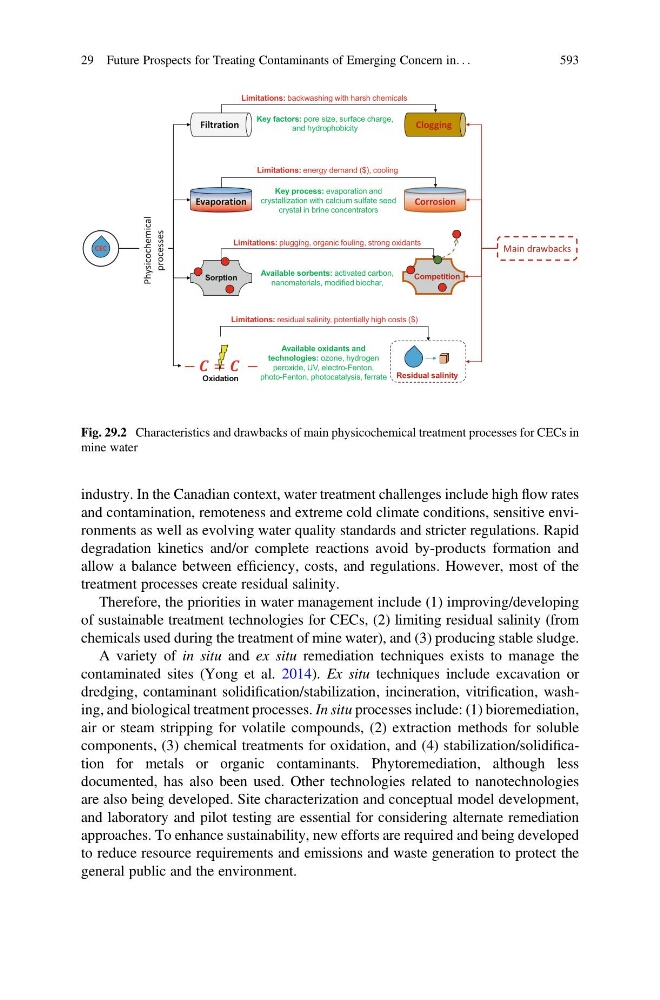
allow a balance between efficiency, costs, and regulations. However, most of the
treatment processes create residual salinity.
Therefore, the priorities in water management include (1) improving/developing
of sustainable treatment technologies for CECs, (2) limiting residual salinity (from
chemicals used during the treatment of mine water), and (3) producing stable sludge.
A variety of in situ and ex situ remediation techniques exists to manage the
contaminated sites (Yong et al. 2014). Ex situ techniques include excavation or
dredging, contaminant solidification/stabilization, incineration, vitrification, washing, and biological treatment processes. In situ processes include: (1) bioremediation,
air or steam stripping for volatile compounds, (2) extraction methods for soluble
components, (3) chemical treatments for oxidation, and (4) stabilization/solidification for metals or organic contaminants. Phytoremediation, although less
documented, has also been used. Other technologies related to nanotechnologies
are also being developed. Site characterization and conceptual model development,
and laboratory and pilot testing are essential for considering alternate remediation
approaches. To enhance sustainability, new efforts are required and being developed
to reduce resource requirements and emissions and waste generation to protect the
general public and the environment.
CEC
Limitations: backwashing with harsh chemicals
Filtration
Key factors: pore size, surface charge,
and hydrophobicity
Clogging
Evaporation
Corrosion
Limitations: energy demand ($), cooling
Key process: evaporation and
crystallization with calcium sulfate seed
crystal in brine concentrators
Sorption
Competition
Limitations: plugging, organic fouling, strong oxidants
Available sorbents: activated carbon,
nanomaterials, modified biochar,
− = −
Available oxidants and
technologies: ozone, hydrogen
peroxide, UV, electro-Fenton,
photo-Fenton, photocatalysis, ferrate Residual salinity
Limitations: residual salinity, potentially high costs ($)
Oxidation
Main drawbacks
Physicochemical
processes
Fig. 29.2 Characteristics and drawbacks of main physicochemical treatment processes for CECs in
mine water
29 Future Prospects for Treating Contaminants of Emerging Concern in. . .
593