

Keywords Organic/inorganic CECs · Advanced oxidation · Biological treatment ·
Residual toxicity
29.1 Sources and Characteristics of Contaminants
of Emerging Concern in Water and Soils/Sediments
Historically, the classification of contaminants of emerging concern (CECs) evolved
with industrial development, contaminant release, wastewater treatment issues and
challenges, scientific knowledge and regulations, etc. At the beginning of the 1990s,
priority pollutants referred to nonpolar hazardous compounds and heavy metals, and
intensive monitoring programs and treatment processes were developed to reduce
their release, and their consequent negative impacts on the environment (Petrović
et al. 2003). Today, these contaminants are better managed in industrialized countries. However, new unregulated or emerging contaminants have become a focus of
interest and awareness because of their potentially negative impact on the environment. There is a consensus within the scientific community that these contaminants
require legislative intervention; moreover, improvement of actual wastewater treatment facilities is needed as most of them have not been designed to treat these new
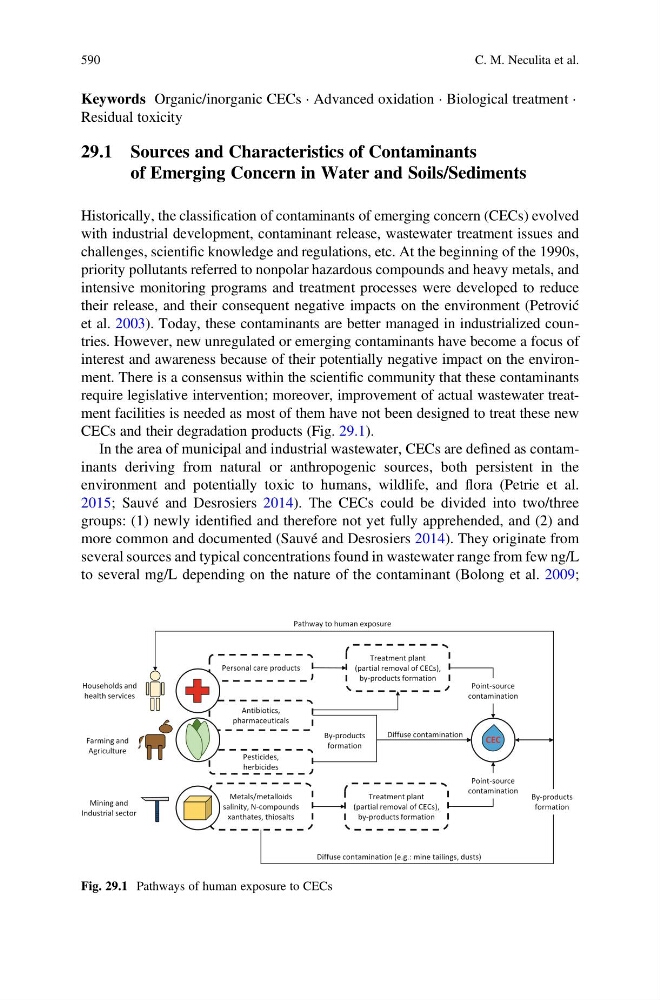
CECs and their degradation products (Fig. 29.1).
In the area of municipal and industrial wastewater, CECs are defined as contaminants deriving from natural or anthropogenic sources, both persistent in the
environment and potentially toxic to humans, wildlife, and flora (Petrie et al.
2015; Sauvé and Desrosiers 2014). The CECs could be divided into two/three
groups: (1) newly identified and therefore not yet fully apprehended, and (2) and
more common and documented (Sauvé and Desrosiers 2014). They originate from
several sources and typical concentrations found in wastewater range from few ng/L
to several mg/L depending on the nature of the contaminant (Bolong et al. 2009;
Metals/metalloids
salinity, N-compounds
xanthates, thiosalts
Pesticides,
herbicides
Antibiotics,
pharmaceuticals
Personal care products
Mining and
Industrial sector
Farming and
Agriculture
Households and
health services
Treatment plant
(partial removal of CECs),
by-products formation
Treatment plant
(partial removal of CECs),
by-products formation
Point-source
contamination
Point-source
contamination
Diffuse contamination
Diffuse contamination (e.g.: mine tailings, dusts)
By-products
formation
By-products
formation
Pathway to human exposure
CEC
Fig. 29.1 Pathways of human exposure to CECs
590
C. M. Neculita et al.