

their importance, broad diversity of mixtures, and shared toxicity mechanism
through AhR, their toxicity and risks are assessed through internationally accepted
mechanism using toxic equivalency factors (TEFs). Individual TEFs reflect toxic
potency relative to 2,3,7,8-TCDD, the most potent dioxin. The concentrations
detected in the environmental samples are then multiplied by respective TEFs, and
their sum (toxic equivalents—TEQs) provides comparative information on dioxinlike risks associated with the sample.
27.6.5.4 Polychlorinated Biphenyls (PCBs)
PCBs are a group of industrial chemicals that have been produced since 1929 and
broadly utilized in electrical equipment (transformers and capacitors) as well as in
open applications like liquids, sealants, lubricants, paints, adhesives, plasticizers.
Because of their persistent, bioaccumulative, and toxic (PBT) properties, their
production and use is now banned globally, but they still undergo environmental
cycling and pose environmental and health hazards. Similarly to PCDD/Fs, PCBs
are highly bioaccumulative affecting primarily organisms at the top of the food
chain. Many isomers (coplanar compounds, i.e., non-ortho-substituted like PCB126)
are known to share toxic modes of action with PCDD/Fs with assigned TEFs.
However, chronic toxic effects (like tumor promotion, endocrine disruptive properties, neurotoxicity, developmental toxicity, etc.) have also been documented at “noncoplanar” isomers, which have orders of magnitude higher levels in both products
and the environment (e.g., PCB153 and others). Many of these effects could be
attributed to hydroxy derivatives of PCBs formed by the metabolism.
27.6.5.5 Organochlorine Pesticides (OCPs)
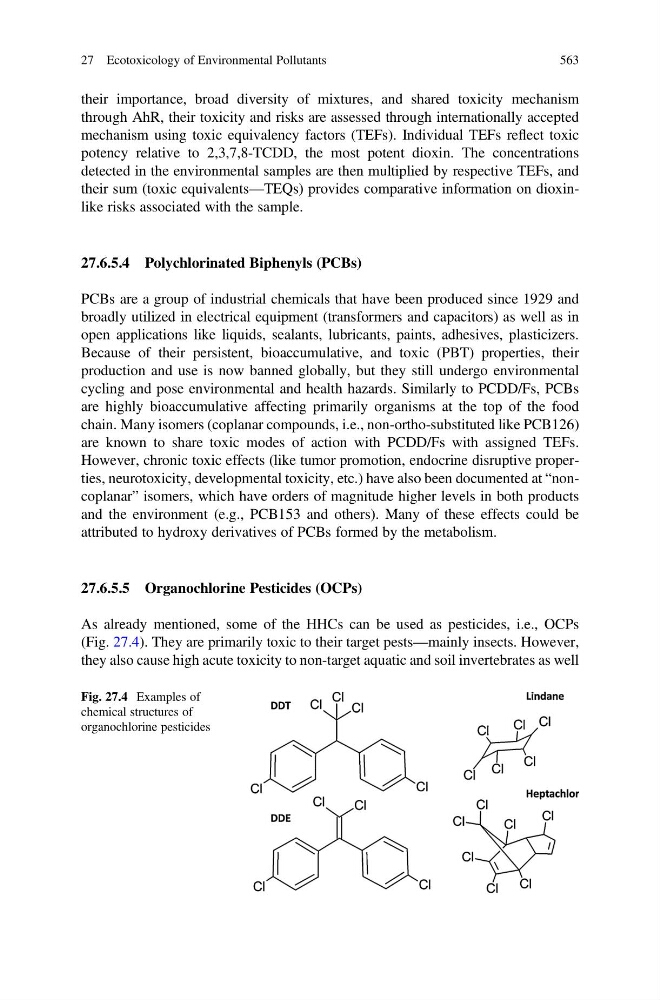
As already mentioned, some of the HHCs can be used as pesticides, i.e., OCPs
(Fig. 27.4). They are primarily toxic to their target pests—mainly insects. However,
they also cause high acute toxicity to non-target aquatic and soil invertebrates as well
Fig. 27.4 Examples of
chemical structures of
organochlorine pesticides
27 Ecotoxicology of Environmental Pollutants
563
through AhR, their toxicity and risks are assessed through internationally accepted
mechanism using toxic equivalency factors (TEFs). Individual TEFs reflect toxic
potency relative to 2,3,7,8-TCDD, the most potent dioxin. The concentrations
detected in the environmental samples are then multiplied by respective TEFs, and
their sum (toxic equivalents—TEQs) provides comparative information on dioxinlike risks associated with the sample.
27.6.5.4 Polychlorinated Biphenyls (PCBs)
PCBs are a group of industrial chemicals that have been produced since 1929 and
broadly utilized in electrical equipment (transformers and capacitors) as well as in
open applications like liquids, sealants, lubricants, paints, adhesives, plasticizers.
Because of their persistent, bioaccumulative, and toxic (PBT) properties, their
production and use is now banned globally, but they still undergo environmental
cycling and pose environmental and health hazards. Similarly to PCDD/Fs, PCBs
are highly bioaccumulative affecting primarily organisms at the top of the food
chain. Many isomers (coplanar compounds, i.e., non-ortho-substituted like PCB126)
are known to share toxic modes of action with PCDD/Fs with assigned TEFs.
However, chronic toxic effects (like tumor promotion, endocrine disruptive properties, neurotoxicity, developmental toxicity, etc.) have also been documented at “noncoplanar” isomers, which have orders of magnitude higher levels in both products
and the environment (e.g., PCB153 and others). Many of these effects could be
attributed to hydroxy derivatives of PCBs formed by the metabolism.
27.6.5.5 Organochlorine Pesticides (OCPs)
As already mentioned, some of the HHCs can be used as pesticides, i.e., OCPs
(Fig. 27.4). They are primarily toxic to their target pests—mainly insects. However,
they also cause high acute toxicity to non-target aquatic and soil invertebrates as well
Fig. 27.4 Examples of
chemical structures of
organochlorine pesticides
27 Ecotoxicology of Environmental Pollutants
563