

27.6.5 Halogenated Hydrocarbons (HHCs)
HHCs, i.e., mostly chlorinated but also brominated derivatives of aliphatic or
aromatic hydrocarbons, have many inevitable applications in industry as well as in
our daily lives. Many hazardous HHCs can also be formed during combustion
processes. In this chapter, we briefly discuss ecotoxicity of the main classes including aliphatic HHCs, monoaromatic halogenated compounds (chlorinated benzenes and similar), polychlorinated dibezo-p-dioxins and -furans (PCDD/Fs),
polychlorinated biphenyls (PCBs), and organochlorine pesticides. Selected
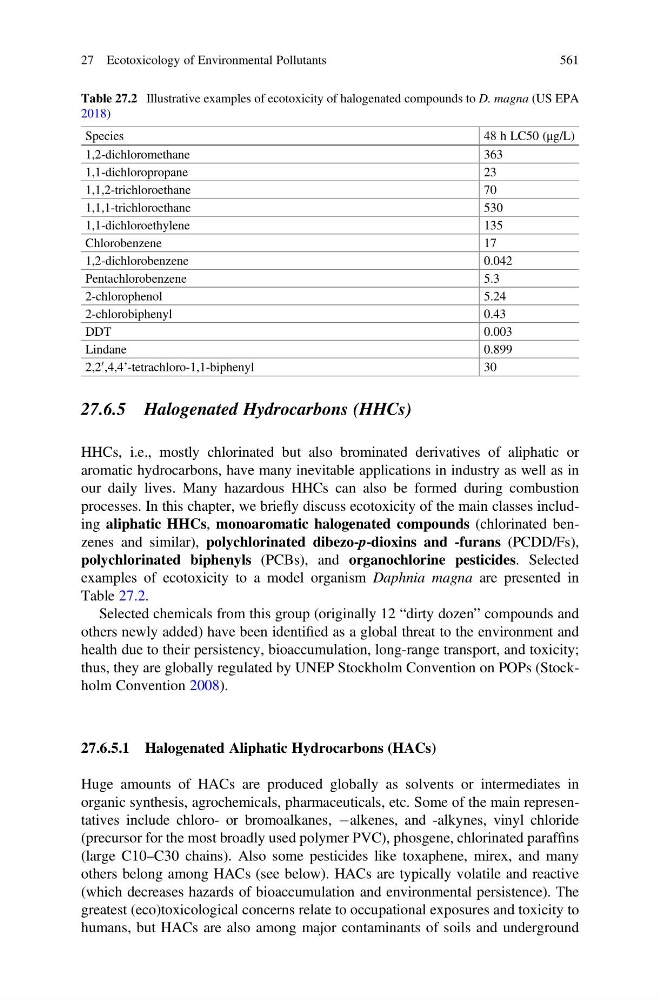
examples of ecotoxicity to a model organism Daphnia magna are presented in
Table 27.2.
Selected chemicals from this group (originally 12 “dirty dozen” compounds and
others newly added) have been identified as a global threat to the environment and
health due to their persistency, bioaccumulation, long-range transport, and toxicity;
thus, they are globally regulated by UNEP Stockholm Convention on POPs (Stockholm Convention 2008).
27.6.5.1 Halogenated Aliphatic Hydrocarbons (HACs)
Huge amounts of HACs are produced globally as solvents or intermediates in
organic synthesis, agrochemicals, pharmaceuticals, etc. Some of the main representatives include chloro- or bromoalkanes, Àalkenes, and -alkynes, vinyl chloride
(precursor for the most broadly used polymer PVC), phosgene, chlorinated paraffins
(large C10–C30 chains). Also some pesticides like toxaphene, mirex, and many
others belong among HACs (see below). HACs are typically volatile and reactive
(which decreases hazards of bioaccumulation and environmental persistence). The
greatest (eco)toxicological concerns relate to occupational exposures and toxicity to
humans, but HACs are also among major contaminants of soils and underground
Table 27.2 Illustrative examples of ecotoxicity of halogenated compounds to D. magna (US EPA
2018)
Species
48 h LC50 (μg/L)
1,2-dichloromethane
363
1,1-dichloropropane
23
1,1,2-trichloroethane
70
1,1,1-trichloroethane
530
1,1-dichloroethylene
135
Chlorobenzene
17
1,2-dichlorobenzene
0.042
Pentachlorobenzene
5.3
2-chlorophenol
5.24
2-chlorobiphenyl
0.43
DDT
0.003
Lindane
0.899
2,2
0 ,4,4’-tetrachloro-1,1-biphenyl
30
27 Ecotoxicology of Environmental Pollutants
561
HHCs, i.e., mostly chlorinated but also brominated derivatives of aliphatic or
aromatic hydrocarbons, have many inevitable applications in industry as well as in
our daily lives. Many hazardous HHCs can also be formed during combustion
processes. In this chapter, we briefly discuss ecotoxicity of the main classes including aliphatic HHCs, monoaromatic halogenated compounds (chlorinated benzenes and similar), polychlorinated dibezo-p-dioxins and -furans (PCDD/Fs),
polychlorinated biphenyls (PCBs), and organochlorine pesticides. Selected
examples of ecotoxicity to a model organism Daphnia magna are presented in
Table 27.2.
Selected chemicals from this group (originally 12 “dirty dozen” compounds and
others newly added) have been identified as a global threat to the environment and
health due to their persistency, bioaccumulation, long-range transport, and toxicity;
thus, they are globally regulated by UNEP Stockholm Convention on POPs (Stockholm Convention 2008).
27.6.5.1 Halogenated Aliphatic Hydrocarbons (HACs)
Huge amounts of HACs are produced globally as solvents or intermediates in
organic synthesis, agrochemicals, pharmaceuticals, etc. Some of the main representatives include chloro- or bromoalkanes, Àalkenes, and -alkynes, vinyl chloride
(precursor for the most broadly used polymer PVC), phosgene, chlorinated paraffins
(large C10–C30 chains). Also some pesticides like toxaphene, mirex, and many
others belong among HACs (see below). HACs are typically volatile and reactive
(which decreases hazards of bioaccumulation and environmental persistence). The
greatest (eco)toxicological concerns relate to occupational exposures and toxicity to
humans, but HACs are also among major contaminants of soils and underground
Table 27.2 Illustrative examples of ecotoxicity of halogenated compounds to D. magna (US EPA
2018)
Species
48 h LC50 (μg/L)
1,2-dichloromethane
363
1,1-dichloropropane
23
1,1,2-trichloroethane
70
1,1,1-trichloroethane
530
1,1-dichloroethylene
135
Chlorobenzene
17
1,2-dichlorobenzene
0.042
Pentachlorobenzene
5.3
2-chlorophenol
5.24
2-chlorobiphenyl
0.43
DDT
0.003
Lindane
0.899
2,2
0 ,4,4’-tetrachloro-1,1-biphenyl
30
27 Ecotoxicology of Environmental Pollutants
561