

pyrene, or disruption of offspring production in springtails induced by cadmium) the
reader should understand that such an effect occurs only under certain favorable
conditions, most importantly at certain specific and sufficiently high concentration
or dose. This concentration of toxic compounds is relatively lower in comparison to
other, i.e., less toxic compounds. However, even the other “less toxic” compounds
may induce the same effects when the conditions have been changed (e.g., increased
doses, prolonged exposure durations).
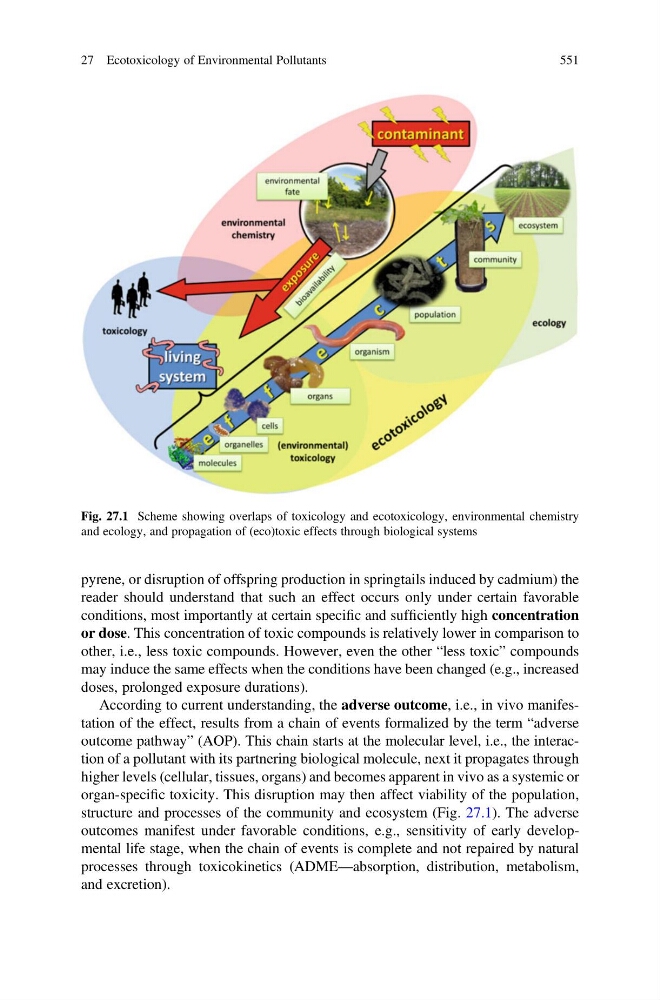
According to current understanding, the adverse outcome, i.e., in vivo manifestation of the effect, results from a chain of events formalized by the term “adverse
outcome pathway” (AOP). This chain starts at the molecular level, i.e., the interaction of a pollutant with its partnering biological molecule, next it propagates through
higher levels (cellular, tissues, organs) and becomes apparent in vivo as a systemic or
organ-specific toxicity. This disruption may then affect viability of the population,
structure and processes of the community and ecosystem (Fig. 27.1). The adverse
outcomes manifest under favorable conditions, e.g., sensitivity of early developmental life stage, when the chain of events is complete and not repaired by natural
processes through toxicokinetics (ADME—absorption, distribution, metabolism,
and excretion).
Fig. 27.1 Scheme showing overlaps of toxicology and ecotoxicology, environmental chemistry
and ecology, and propagation of (eco)toxic effects through biological systems
27 Ecotoxicology of Environmental Pollutants
551
reader should understand that such an effect occurs only under certain favorable
conditions, most importantly at certain specific and sufficiently high concentration
or dose. This concentration of toxic compounds is relatively lower in comparison to
other, i.e., less toxic compounds. However, even the other “less toxic” compounds
may induce the same effects when the conditions have been changed (e.g., increased
doses, prolonged exposure durations).
According to current understanding, the adverse outcome, i.e., in vivo manifestation of the effect, results from a chain of events formalized by the term “adverse
outcome pathway” (AOP). This chain starts at the molecular level, i.e., the interaction of a pollutant with its partnering biological molecule, next it propagates through
higher levels (cellular, tissues, organs) and becomes apparent in vivo as a systemic or
organ-specific toxicity. This disruption may then affect viability of the population,
structure and processes of the community and ecosystem (Fig. 27.1). The adverse
outcomes manifest under favorable conditions, e.g., sensitivity of early developmental life stage, when the chain of events is complete and not repaired by natural
processes through toxicokinetics (ADME—absorption, distribution, metabolism,
and excretion).
Fig. 27.1 Scheme showing overlaps of toxicology and ecotoxicology, environmental chemistry
and ecology, and propagation of (eco)toxic effects through biological systems
27 Ecotoxicology of Environmental Pollutants
551