

difference could be explained by a probably higher content of easily degradable
organic compounds in BL beside GC. Preferential degradation of these substances
may have led only to partial PAH removal in the variation with BL as a composting
co-substrate.
A prediction of the biodegradation efficiency based on F-fraction determination
well correlated with the real results at BL compost (Table 25.2). Nevertheless, the
values predicted for the GC variation were underestimated in the cases of the 4- and
5–6-ring PAHs.
25.4 Conclusion
The presented results suggest that composting is a very robust bioremediation
method by means of which bioavailable amounts of PAHs can be degraded regardless of the character of the contaminated material. A typical feature of composting is
manipulation with a bulk volume of the materials. Since it is based on mixing
non-contaminated materials with contaminated soil (or wood), it may result in a
far greater quantity of the contaminated material if the bioremediation proves not to
be successful. The all above-described remediation processes demonstrate how
important this consideration is. Though the final biodegradation rates were significant, ranging between 62.4% (soil B) and 97% (CTW—GC), the resulting material
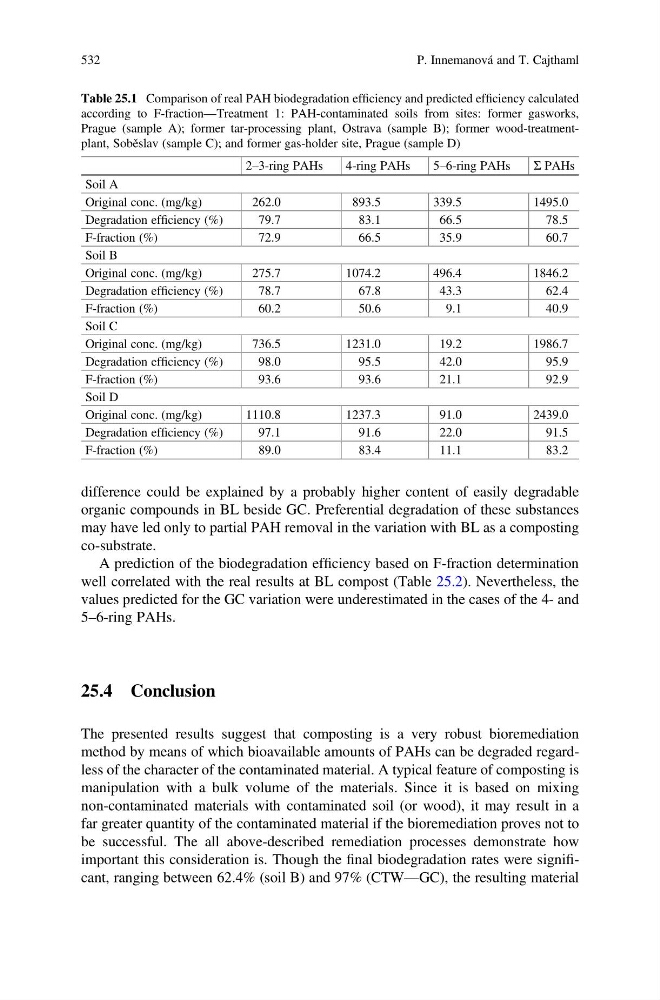
Table 25.1 Comparison of real PAH biodegradation efficiency and predicted efficiency calculated
according to F-fraction—Treatment 1: PAH-contaminated soils from sites: former gasworks,
Prague (sample A); former tar-processing plant, Ostrava (sample B); former wood-treatmentplant, Soběslav (sample C); and former gas-holder site, Prague (sample D)
2–3-ring PAHs
4-ring PAHs
5–6-ring PAHs
Σ PAHs
Soil A
Original conc. (mg/kg)
262.0
893.5
339.5
1495.0
Degradation efficiency (%)
79.7
83.1
66.5
78.5
F-fraction (%)
72.9
66.5
35.9
60.7
Soil B
Original conc. (mg/kg)
275.7
1074.2
496.4
1846.2
Degradation efficiency (%)
78.7
67.8
43.3
62.4
F-fraction (%)
60.2
50.6
9.1
40.9
Soil C
Original conc. (mg/kg)
736.5
1231.0
19.2
1986.7
Degradation efficiency (%)
98.0
95.5
42.0
95.9
F-fraction (%)
93.6
93.6
21.1
92.9
Soil D
Original conc. (mg/kg)
1110.8
1237.3
91.0
2439.0
Degradation efficiency (%)
97.1
91.6
22.0
91.5
F-fraction (%)
89.0
83.4
11.1
83.2
532
P. Innemanová and T. Cajthaml
organic compounds in BL beside GC. Preferential degradation of these substances
may have led only to partial PAH removal in the variation with BL as a composting
co-substrate.
A prediction of the biodegradation efficiency based on F-fraction determination
well correlated with the real results at BL compost (Table 25.2). Nevertheless, the
values predicted for the GC variation were underestimated in the cases of the 4- and
5–6-ring PAHs.
25.4 Conclusion
The presented results suggest that composting is a very robust bioremediation
method by means of which bioavailable amounts of PAHs can be degraded regardless of the character of the contaminated material. A typical feature of composting is
manipulation with a bulk volume of the materials. Since it is based on mixing
non-contaminated materials with contaminated soil (or wood), it may result in a
far greater quantity of the contaminated material if the bioremediation proves not to
be successful. The all above-described remediation processes demonstrate how
important this consideration is. Though the final biodegradation rates were significant, ranging between 62.4% (soil B) and 97% (CTW—GC), the resulting material
Table 25.1 Comparison of real PAH biodegradation efficiency and predicted efficiency calculated
according to F-fraction—Treatment 1: PAH-contaminated soils from sites: former gasworks,
Prague (sample A); former tar-processing plant, Ostrava (sample B); former wood-treatmentplant, Soběslav (sample C); and former gas-holder site, Prague (sample D)
2–3-ring PAHs
4-ring PAHs
5–6-ring PAHs
Σ PAHs
Soil A
Original conc. (mg/kg)
262.0
893.5
339.5
1495.0
Degradation efficiency (%)
79.7
83.1
66.5
78.5
F-fraction (%)
72.9
66.5
35.9
60.7
Soil B
Original conc. (mg/kg)
275.7
1074.2
496.4
1846.2
Degradation efficiency (%)
78.7
67.8
43.3
62.4
F-fraction (%)
60.2
50.6
9.1
40.9
Soil C
Original conc. (mg/kg)
736.5
1231.0
19.2
1986.7
Degradation efficiency (%)
98.0
95.5
42.0
95.9
F-fraction (%)
93.6
93.6
21.1
92.9
Soil D
Original conc. (mg/kg)
1110.8
1237.3
91.0
2439.0
Degradation efficiency (%)
97.1
91.6
22.0
91.5
F-fraction (%)
89.0
83.4
11.1
83.2
532
P. Innemanová and T. Cajthaml