

Additional compounds essential for enzymatic reactions may also be required.
Mediators and/or co-factors, whether naturally present or added, are compounds
with redox potential serving as redox shuttles between the enzyme and substrate.
For example, laccase mediators, e.g., p-coumaric acid, syringaldehyde, or
acetosyringone are essential for catalysis of redox reactions catalyzed by this enzyme
(Ji et al. 2016). Similarly, hydrogen peroxide for peroxidases, organic hydroperoxides
for peroxygenases, and Mn
2+ for manganese peroxidase are necessary for enzyme
action (Acevedo et al. 2010). Ensuring that all necessary substances are lined up at the
same spot for the effective course of a given enzyme-catalyzed reaction is problematic;
this problem, in particular, can be a major obstacle in static, heterogeneous systems
with high and varied sorption properties such as soil (Datta et al. 2017).
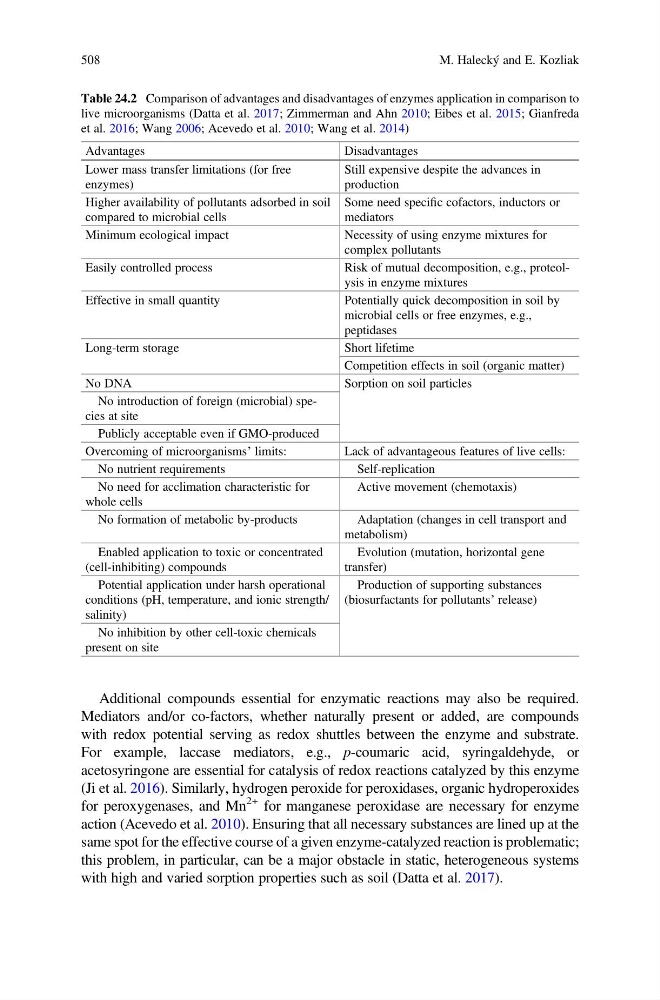
Table 24.2 Comparison of advantages and disadvantages of enzymes application in comparison to
live microorganisms (Datta et al. 2017; Zimmerman and Ahn 2010; Eibes et al. 2015; Gianfreda
et al. 2016; Wang 2006; Acevedo et al. 2010; Wang et al. 2014)
Advantages
Disadvantages
Lower mass transfer limitations (for free
enzymes)
Still expensive despite the advances in
production
Higher availability of pollutants adsorbed in soil
compared to microbial cells
Some need specific cofactors, inductors or
mediators
Minimum ecological impact
Necessity of using enzyme mixtures for
complex pollutants
Easily controlled process
Risk of mutual decomposition, e.g., proteolysis in enzyme mixtures
Effective in small quantity
Potentially quick decomposition in soil by
microbial cells or free enzymes, e.g.,
peptidases
Long-term storage
Short lifetime
Competition effects in soil (organic matter)
No DNA
Sorption on soil particles
No introduction of foreign (microbial) species at site
Publicly acceptable even if GMO-produced
Overcoming of microorganisms’ limits:
Lack of advantageous features of live cells:
No nutrient requirements
Self-replication
No need for acclimation characteristic for
whole cells
Active movement (chemotaxis)
No formation of metabolic by-products
Adaptation (changes in cell transport and
metabolism)
Enabled application to toxic or concentrated
(cell-inhibiting) compounds
Evolution (mutation, horizontal gene
transfer)
Potential application under harsh operational
conditions (pH, temperature, and ionic strength/
salinity)
Production of supporting substances
(biosurfactants for pollutants’ release)
No inhibition by other cell-toxic chemicals
present on site
508
M. Halecký and E. Kozliak
Mediators and/or co-factors, whether naturally present or added, are compounds
with redox potential serving as redox shuttles between the enzyme and substrate.
For example, laccase mediators, e.g., p-coumaric acid, syringaldehyde, or
acetosyringone are essential for catalysis of redox reactions catalyzed by this enzyme
(Ji et al. 2016). Similarly, hydrogen peroxide for peroxidases, organic hydroperoxides
for peroxygenases, and Mn
2+ for manganese peroxidase are necessary for enzyme
action (Acevedo et al. 2010). Ensuring that all necessary substances are lined up at the
same spot for the effective course of a given enzyme-catalyzed reaction is problematic;
this problem, in particular, can be a major obstacle in static, heterogeneous systems
with high and varied sorption properties such as soil (Datta et al. 2017).
Table 24.2 Comparison of advantages and disadvantages of enzymes application in comparison to
live microorganisms (Datta et al. 2017; Zimmerman and Ahn 2010; Eibes et al. 2015; Gianfreda
et al. 2016; Wang 2006; Acevedo et al. 2010; Wang et al. 2014)
Advantages
Disadvantages
Lower mass transfer limitations (for free
enzymes)
Still expensive despite the advances in
production
Higher availability of pollutants adsorbed in soil
compared to microbial cells
Some need specific cofactors, inductors or
mediators
Minimum ecological impact
Necessity of using enzyme mixtures for
complex pollutants
Easily controlled process
Risk of mutual decomposition, e.g., proteolysis in enzyme mixtures
Effective in small quantity
Potentially quick decomposition in soil by
microbial cells or free enzymes, e.g.,
peptidases
Long-term storage
Short lifetime
Competition effects in soil (organic matter)
No DNA
Sorption on soil particles
No introduction of foreign (microbial) species at site
Publicly acceptable even if GMO-produced
Overcoming of microorganisms’ limits:
Lack of advantageous features of live cells:
No nutrient requirements
Self-replication
No need for acclimation characteristic for
whole cells
Active movement (chemotaxis)
No formation of metabolic by-products
Adaptation (changes in cell transport and
metabolism)
Enabled application to toxic or concentrated
(cell-inhibiting) compounds
Evolution (mutation, horizontal gene
transfer)
Potential application under harsh operational
conditions (pH, temperature, and ionic strength/
salinity)
Production of supporting substances
(biosurfactants for pollutants’ release)
No inhibition by other cell-toxic chemicals
present on site
508
M. Halecký and E. Kozliak