

incorporating the hydrophobic pollutants into the micelles as a microphase. In this
case, the hydrophobic pollutants become protected against the water-based
chemicals occurring in the aqueous phase and show an increased formal pollutant
concentration in water above its normal equilibrium value (so-called
pseudosolubility). Mobilization and solubilization are biosurfactant actions that
increase the mobility and bioavailability of not only organic compounds present as
single molecules, e.g., pesticides and PAHs or other hydrocarbons but also liquid
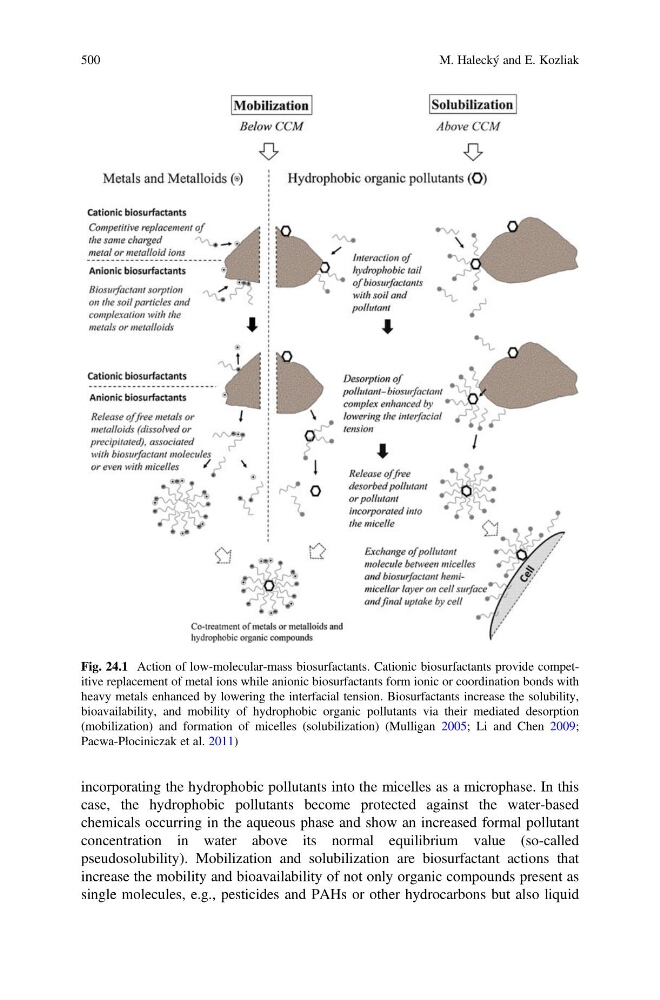
Fig. 24.1 Action of low-molecular-mass biosurfactants. Cationic biosurfactants provide competitive replacement of metal ions while anionic biosurfactants form ionic or coordination bonds with
heavy metals enhanced by lowering the interfacial tension. Biosurfactants increase the solubility,
bioavailability, and mobility of hydrophobic organic pollutants via their mediated desorption
(mobilization) and formation of micelles (solubilization) (Mulligan 2005; Li and Chen 2009;
Pacwa-Płociniczak et al. 2011)
500
M. Halecký and E. Kozliak
case, the hydrophobic pollutants become protected against the water-based
chemicals occurring in the aqueous phase and show an increased formal pollutant
concentration in water above its normal equilibrium value (so-called
pseudosolubility). Mobilization and solubilization are biosurfactant actions that
increase the mobility and bioavailability of not only organic compounds present as
single molecules, e.g., pesticides and PAHs or other hydrocarbons but also liquid
Fig. 24.1 Action of low-molecular-mass biosurfactants. Cationic biosurfactants provide competitive replacement of metal ions while anionic biosurfactants form ionic or coordination bonds with
heavy metals enhanced by lowering the interfacial tension. Biosurfactants increase the solubility,
bioavailability, and mobility of hydrophobic organic pollutants via their mediated desorption
(mobilization) and formation of micelles (solubilization) (Mulligan 2005; Li and Chen 2009;
Pacwa-Płociniczak et al. 2011)
500
M. Halecký and E. Kozliak