

23.3.2 Contaminant Removal in the Course
of the Co-composting Process—Factors
and Mechanisms
23.3.2.1 Sorption Mechanisms
The main physicochemical mechanism of contaminant removal in the course of the
composting process is sorption of contaminants especially to the organic fraction of
the compost, resulting usually in reducing their biological availability, and also their
toxic action on plants and microorganisms (Antizar-Ladislao et al. 2004). This
process, on the one hand, enables relatively quick removal of the contaminants,
but, on the other hand, it complicates the biological degradation of organic contaminants, which may represent a problem from the point of view of compliance with the
regulatory limits. In majority of cases it is necessary that the contaminant is released
from the sorbed phase into the aqueous phase in order to be biodegraded (Harms and
Zehnder 1994; Shelton and Doherty 1997). This desorption might be assisted by the
biosurfactants produced by specific microorganisms, which actually means bioavailability of contaminants is species specific. However, it has been observed that there
are bacteria capable of contaminants degradation without prior desorption. For
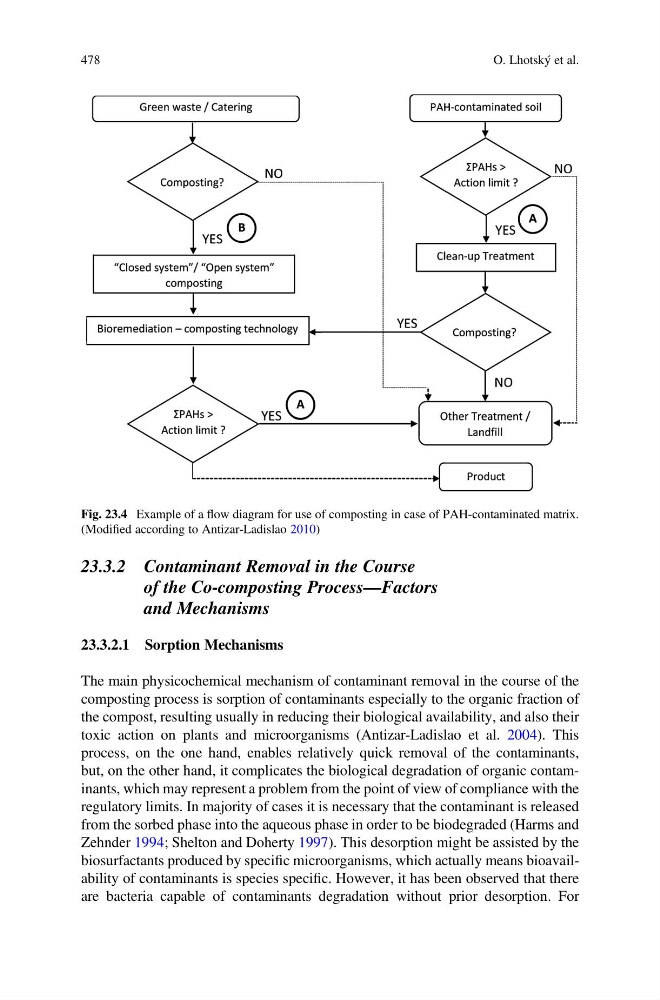
Fig. 23.4 Example of a flow diagram for use of composting in case of PAH-contaminated matrix.
(Modified according to Antizar-Ladislao 2010)
478
O. Lhotský et al.
of the Co-composting Process—Factors
and Mechanisms
23.3.2.1 Sorption Mechanisms
The main physicochemical mechanism of contaminant removal in the course of the
composting process is sorption of contaminants especially to the organic fraction of
the compost, resulting usually in reducing their biological availability, and also their
toxic action on plants and microorganisms (Antizar-Ladislao et al. 2004). This
process, on the one hand, enables relatively quick removal of the contaminants,
but, on the other hand, it complicates the biological degradation of organic contaminants, which may represent a problem from the point of view of compliance with the
regulatory limits. In majority of cases it is necessary that the contaminant is released
from the sorbed phase into the aqueous phase in order to be biodegraded (Harms and
Zehnder 1994; Shelton and Doherty 1997). This desorption might be assisted by the
biosurfactants produced by specific microorganisms, which actually means bioavailability of contaminants is species specific. However, it has been observed that there
are bacteria capable of contaminants degradation without prior desorption. For
Fig. 23.4 Example of a flow diagram for use of composting in case of PAH-contaminated matrix.
(Modified according to Antizar-Ladislao 2010)
478
O. Lhotský et al.