

20.3.4 Microbes and Their Role in the Whole
Nano-Bioremediation Process
The results of the microbial analysis done by the authors indicate that the degradation of the pollutants to a level below the toxicity threshold created preferable
environmental conditions for autochthonous microflora in the site. On the basis of
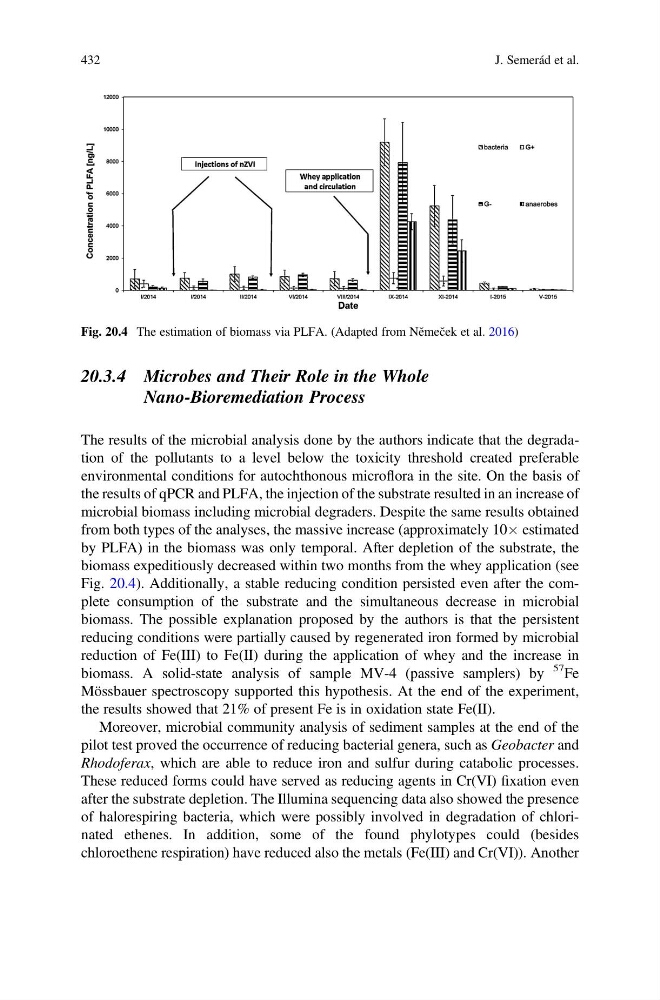
the results of qPCR and PLFA, the injection of the substrate resulted in an increase of
microbial biomass including microbial degraders. Despite the same results obtained
from both types of the analyses, the massive increase (approximately 10Â estimated
by PLFA) in the biomass was only temporal. After depletion of the substrate, the
biomass expeditiously decreased within two months from the whey application (see
Fig. 20.4). Additionally, a stable reducing condition persisted even after the complete consumption of the substrate and the simultaneous decrease in microbial
biomass. The possible explanation proposed by the authors is that the persistent
reducing conditions were partially caused by regenerated iron formed by microbial
reduction of Fe(III) to Fe(II) during the application of whey and the increase in
biomass. A solid-state analysis of sample MV-4 (passive samplers) by
57 Fe
Mössbauer spectroscopy supported this hypothesis. At the end of the experiment,
the results showed that 21% of present Fe is in oxidation state Fe(II).
Moreover, microbial community analysis of sediment samples at the end of the
pilot test proved the occurrence of reducing bacterial genera, such as Geobacter and
Rhodoferax, which are able to reduce iron and sulfur during catabolic processes.
These reduced forms could have served as reducing agents in Cr(VI) fixation even
after the substrate depletion. The Illumina sequencing data also showed the presence
of halorespiring bacteria, which were possibly involved in degradation of chlorinated ethenes. In addition, some of the found phylotypes could (besides
chloroethene respiration) have reduced also the metals (Fe(III) and Cr(VI)). Another
Fig. 20.4 The estimation of biomass via PLFA. (Adapted from Němeček et al. 2016)
432
J. Semerád et al.
Nano-Bioremediation Process
The results of the microbial analysis done by the authors indicate that the degradation of the pollutants to a level below the toxicity threshold created preferable
environmental conditions for autochthonous microflora in the site. On the basis of
the results of qPCR and PLFA, the injection of the substrate resulted in an increase of
microbial biomass including microbial degraders. Despite the same results obtained
from both types of the analyses, the massive increase (approximately 10Â estimated
by PLFA) in the biomass was only temporal. After depletion of the substrate, the
biomass expeditiously decreased within two months from the whey application (see
Fig. 20.4). Additionally, a stable reducing condition persisted even after the complete consumption of the substrate and the simultaneous decrease in microbial
biomass. The possible explanation proposed by the authors is that the persistent
reducing conditions were partially caused by regenerated iron formed by microbial
reduction of Fe(III) to Fe(II) during the application of whey and the increase in
biomass. A solid-state analysis of sample MV-4 (passive samplers) by
57 Fe
Mössbauer spectroscopy supported this hypothesis. At the end of the experiment,
the results showed that 21% of present Fe is in oxidation state Fe(II).
Moreover, microbial community analysis of sediment samples at the end of the
pilot test proved the occurrence of reducing bacterial genera, such as Geobacter and
Rhodoferax, which are able to reduce iron and sulfur during catabolic processes.
These reduced forms could have served as reducing agents in Cr(VI) fixation even
after the substrate depletion. The Illumina sequencing data also showed the presence
of halorespiring bacteria, which were possibly involved in degradation of chlorinated ethenes. In addition, some of the found phylotypes could (besides
chloroethene respiration) have reduced also the metals (Fe(III) and Cr(VI)). Another
Fig. 20.4 The estimation of biomass via PLFA. (Adapted from Němeček et al. 2016)
432
J. Semerád et al.