

wells representing two downgradient lines (first line: MV-2, MV-3, MV-4 and the
second line: MV-5, HV-2, HS-1, HS-2) and one upgradient well, which served as a
control to provide background values (MV-1). In addition, well HV-8 contaminated
only by chlorinated ethenes and located cross-gradient from the contamination
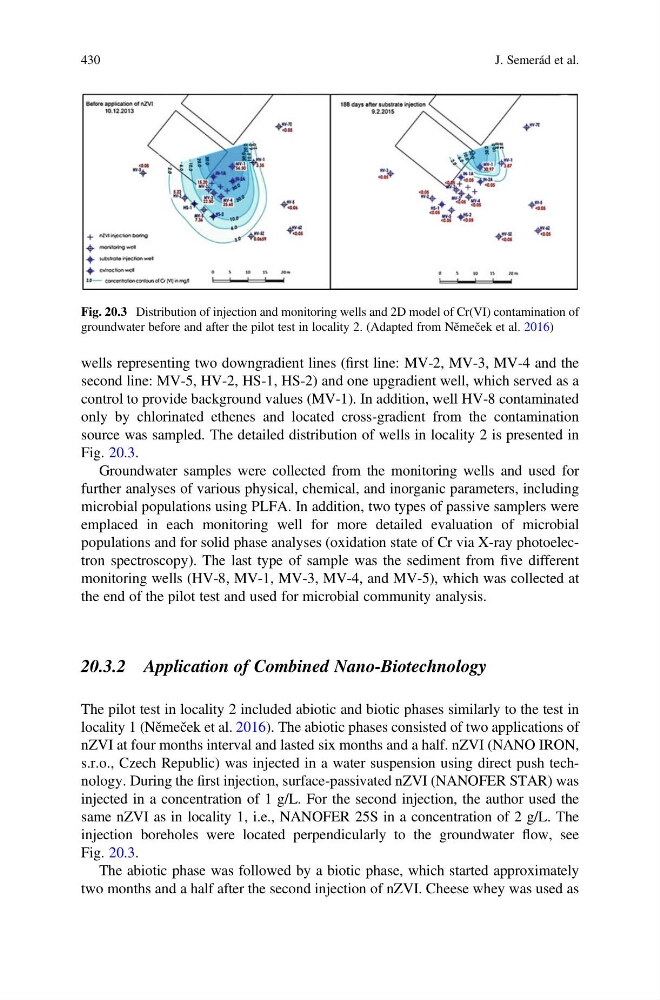
source was sampled. The detailed distribution of wells in locality 2 is presented in
Fig. 20.3.
Groundwater samples were collected from the monitoring wells and used for
further analyses of various physical, chemical, and inorganic parameters, including
microbial populations using PLFA. In addition, two types of passive samplers were
emplaced in each monitoring well for more detailed evaluation of microbial
populations and for solid phase analyses (oxidation state of Cr via X-ray photoelectron spectroscopy). The last type of sample was the sediment from five different
monitoring wells (HV-8, MV-1, MV-3, MV-4, and MV-5), which was collected at
the end of the pilot test and used for microbial community analysis.
20.3.2 Application of Combined Nano-Biotechnology
The pilot test in locality 2 included abiotic and biotic phases similarly to the test in
locality 1 (Němeček et al. 2016). The abiotic phases consisted of two applications of
nZVI at four months interval and lasted six months and a half. nZVI (NANO IRON,
s.r.o., Czech Republic) was injected in a water suspension using direct push technology. During the first injection, surface-passivated nZVI (NANOFER STAR) was
injected in a concentration of 1 g/L. For the second injection, the author used the
same nZVI as in locality 1, i.e., NANOFER 25S in a concentration of 2 g/L. The
injection boreholes were located perpendicularly to the groundwater flow, see
Fig. 20.3.
The abiotic phase was followed by a biotic phase, which started approximately
two months and a half after the second injection of nZVI. Cheese whey was used as
Fig. 20.3 Distribution of injection and monitoring wells and 2D model of Cr(VI) contamination of
groundwater before and after the pilot test in locality 2. (Adapted from Němeček et al. 2016)
430
J. Semerád et al.
second line: MV-5, HV-2, HS-1, HS-2) and one upgradient well, which served as a
control to provide background values (MV-1). In addition, well HV-8 contaminated
only by chlorinated ethenes and located cross-gradient from the contamination
source was sampled. The detailed distribution of wells in locality 2 is presented in
Fig. 20.3.
Groundwater samples were collected from the monitoring wells and used for
further analyses of various physical, chemical, and inorganic parameters, including
microbial populations using PLFA. In addition, two types of passive samplers were
emplaced in each monitoring well for more detailed evaluation of microbial
populations and for solid phase analyses (oxidation state of Cr via X-ray photoelectron spectroscopy). The last type of sample was the sediment from five different
monitoring wells (HV-8, MV-1, MV-3, MV-4, and MV-5), which was collected at
the end of the pilot test and used for microbial community analysis.
20.3.2 Application of Combined Nano-Biotechnology
The pilot test in locality 2 included abiotic and biotic phases similarly to the test in
locality 1 (Němeček et al. 2016). The abiotic phases consisted of two applications of
nZVI at four months interval and lasted six months and a half. nZVI (NANO IRON,
s.r.o., Czech Republic) was injected in a water suspension using direct push technology. During the first injection, surface-passivated nZVI (NANOFER STAR) was
injected in a concentration of 1 g/L. For the second injection, the author used the
same nZVI as in locality 1, i.e., NANOFER 25S in a concentration of 2 g/L. The
injection boreholes were located perpendicularly to the groundwater flow, see
Fig. 20.3.
The abiotic phase was followed by a biotic phase, which started approximately
two months and a half after the second injection of nZVI. Cheese whey was used as
Fig. 20.3 Distribution of injection and monitoring wells and 2D model of Cr(VI) contamination of
groundwater before and after the pilot test in locality 2. (Adapted from Němeček et al. 2016)
430
J. Semerád et al.