

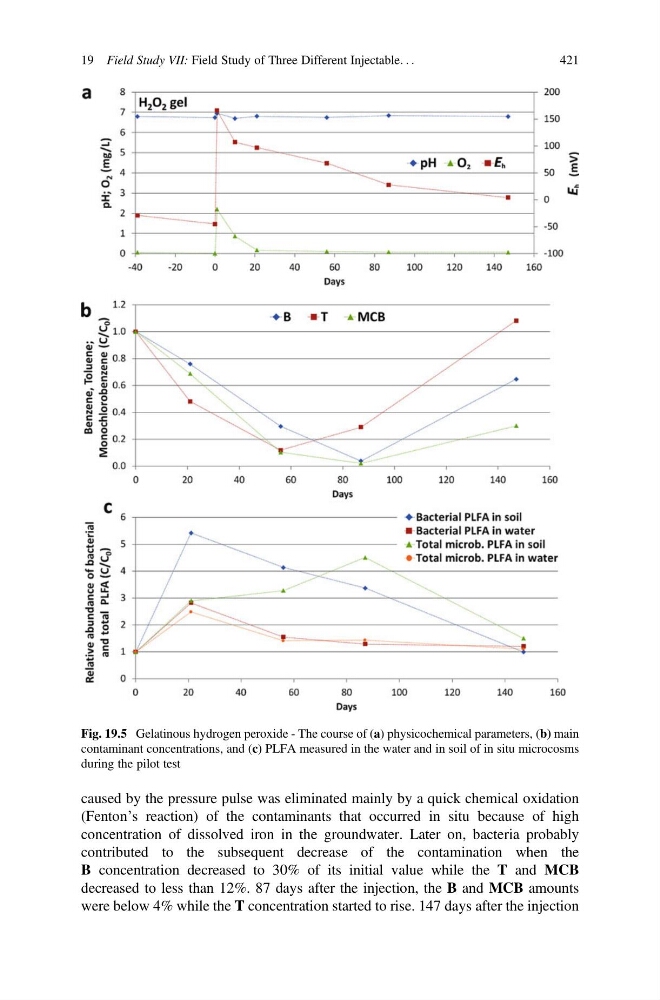
caused by the pressure pulse was eliminated mainly by a quick chemical oxidation
(Fenton’s reaction) of the contaminants that occurred in situ because of high
concentration of dissolved iron in the groundwater. Later on, bacteria probably
contributed to the subsequent decrease of the contamination when the
B concentration decreased to 30% of its initial value while the T and MCB
decreased to less than 12%. 87 days after the injection, the B and MCB amounts
were below 4% while the T concentration started to rise. 147 days after the injection
Fig. 19.5 Gelatinous hydrogen peroxide - The course of (a) physicochemical parameters, (b) main
contaminant concentrations, and (c) PLFA measured in the water and in soil of in situ microcosms
during the pilot test
19 Field Study VII: Field Study of Three Different Injectable. . .
421
(Fenton’s reaction) of the contaminants that occurred in situ because of high
concentration of dissolved iron in the groundwater. Later on, bacteria probably
contributed to the subsequent decrease of the contamination when the
B concentration decreased to 30% of its initial value while the T and MCB
decreased to less than 12%. 87 days after the injection, the B and MCB amounts
were below 4% while the T concentration started to rise. 147 days after the injection
Fig. 19.5 Gelatinous hydrogen peroxide - The course of (a) physicochemical parameters, (b) main
contaminant concentrations, and (c) PLFA measured in the water and in soil of in situ microcosms
during the pilot test
19 Field Study VII: Field Study of Three Different Injectable. . .
421