

2.1 Groundwater and Soil Contamination as a Worldwide
Problem and Opportunity for Nanotechnologies
Groundwater and soil contamination caused by various toxic substances has posed a
serious threat to human and ecological health while it has been of great concern to
the general public worldwide for more than 40 years. In 2011, approximately
1.17 million potentially contaminated sites and 0.127 million contaminated sites
were identified in the European Economic Area (European Environment Agency
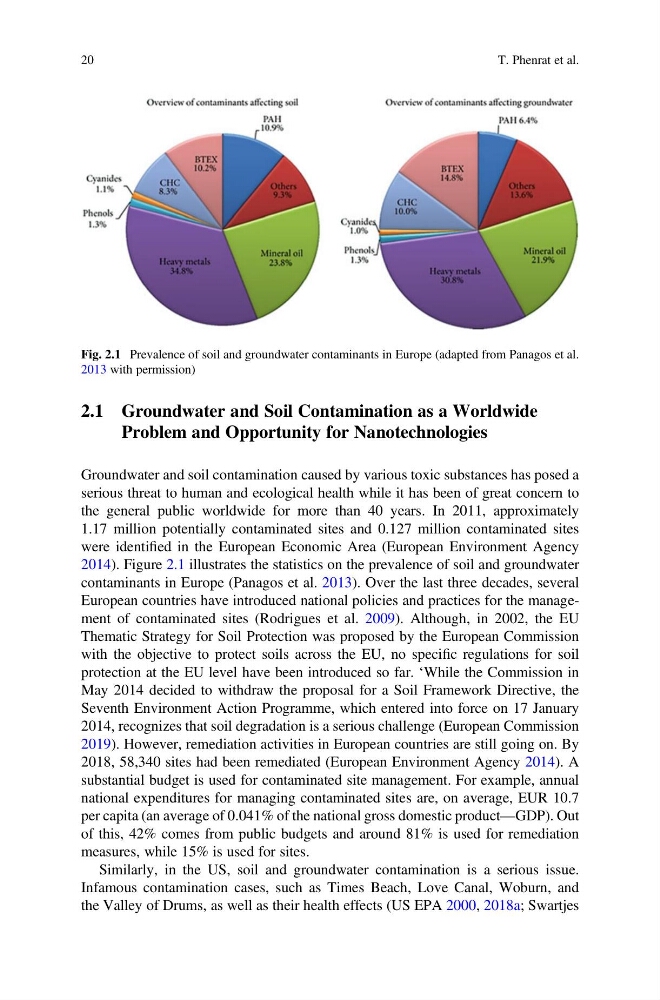
2014). Figure 2.1 illustrates the statistics on the prevalence of soil and groundwater
contaminants in Europe (Panagos et al. 2013). Over the last three decades, several
European countries have introduced national policies and practices for the management of contaminated sites (Rodrigues et al. 2009). Although, in 2002, the EU
Thematic Strategy for Soil Protection was proposed by the European Commission
with the objective to protect soils across the EU, no specific regulations for soil
protection at the EU level have been introduced so far. ‘While the Commission in
May 2014 decided to withdraw the proposal for a Soil Framework Directive, the
Seventh Environment Action Programme, which entered into force on 17 January
2014, recognizes that soil degradation is a serious challenge (European Commission
2019). However, remediation activities in European countries are still going on. By
2018, 58,340 sites had been remediated (European Environment Agency 2014). A
substantial budget is used for contaminated site management. For example, annual
national expenditures for managing contaminated sites are, on average, EUR 10.7
per capita (an average of 0.041% of the national gross domestic product—GDP). Out
of this, 42% comes from public budgets and around 81% is used for remediation
measures, while 15% is used for sites.
Similarly, in the US, soil and groundwater contamination is a serious issue.
Infamous contamination cases, such as Times Beach, Love Canal, Woburn, and
the Valley of Drums, as well as their health effects (US EPA 2000, 2018a; Swartjes
Fig. 2.1 Prevalence of soil and groundwater contaminants in Europe (adapted from Panagos et al.
2013 with permission)
20
T. Phenrat et al.
Problem and Opportunity for Nanotechnologies
Groundwater and soil contamination caused by various toxic substances has posed a
serious threat to human and ecological health while it has been of great concern to
the general public worldwide for more than 40 years. In 2011, approximately
1.17 million potentially contaminated sites and 0.127 million contaminated sites
were identified in the European Economic Area (European Environment Agency
2014). Figure 2.1 illustrates the statistics on the prevalence of soil and groundwater
contaminants in Europe (Panagos et al. 2013). Over the last three decades, several
European countries have introduced national policies and practices for the management of contaminated sites (Rodrigues et al. 2009). Although, in 2002, the EU
Thematic Strategy for Soil Protection was proposed by the European Commission
with the objective to protect soils across the EU, no specific regulations for soil
protection at the EU level have been introduced so far. ‘While the Commission in
May 2014 decided to withdraw the proposal for a Soil Framework Directive, the
Seventh Environment Action Programme, which entered into force on 17 January
2014, recognizes that soil degradation is a serious challenge (European Commission
2019). However, remediation activities in European countries are still going on. By
2018, 58,340 sites had been remediated (European Environment Agency 2014). A
substantial budget is used for contaminated site management. For example, annual
national expenditures for managing contaminated sites are, on average, EUR 10.7
per capita (an average of 0.041% of the national gross domestic product—GDP). Out
of this, 42% comes from public budgets and around 81% is used for remediation
measures, while 15% is used for sites.
Similarly, in the US, soil and groundwater contamination is a serious issue.
Infamous contamination cases, such as Times Beach, Love Canal, Woburn, and
the Valley of Drums, as well as their health effects (US EPA 2000, 2018a; Swartjes
Fig. 2.1 Prevalence of soil and groundwater contaminants in Europe (adapted from Panagos et al.
2013 with permission)
20
T. Phenrat et al.