

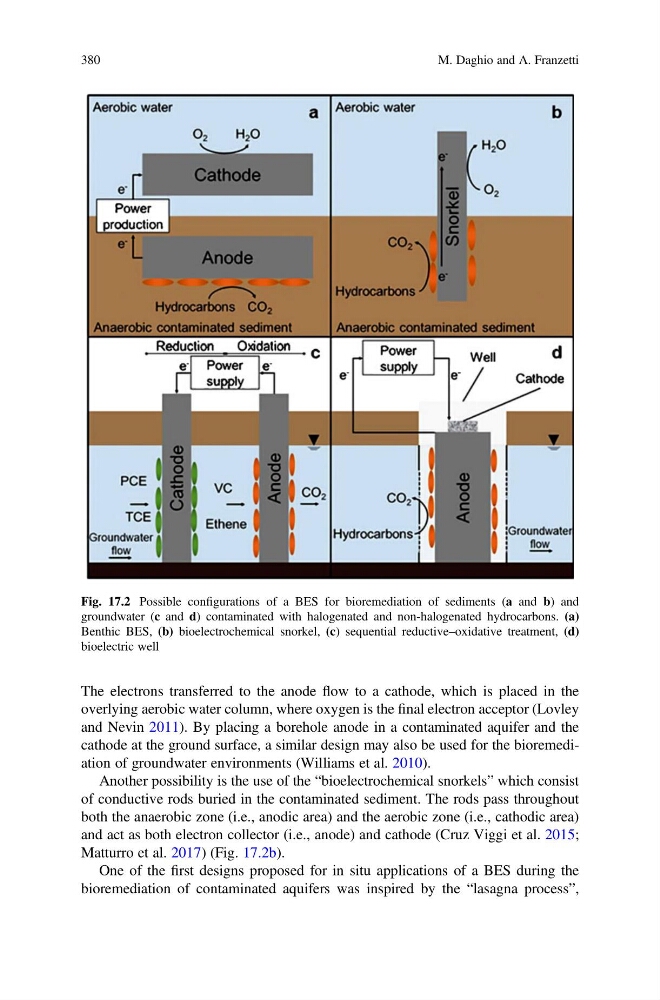
The electrons transferred to the anode flow to a cathode, which is placed in the
overlying aerobic water column, where oxygen is the final electron acceptor (Lovley
and Nevin 2011). By placing a borehole anode in a contaminated aquifer and the
cathode at the ground surface, a similar design may also be used for the bioremediation of groundwater environments (Williams et al. 2010).
Another possibility is the use of the “bioelectrochemical snorkels” which consist
of conductive rods buried in the contaminated sediment. The rods pass throughout
both the anaerobic zone (i.e., anodic area) and the aerobic zone (i.e., cathodic area)
and act as both electron collector (i.e., anode) and cathode (Cruz Viggi et al. 2015;
Matturro et al. 2017) (Fig. 17.2b).
One of the first designs proposed for in situ applications of a BES during the
bioremediation of contaminated aquifers was inspired by the “lasagna process”,
Fig. 17.2 Possible configurations of a BES for bioremediation of sediments (a and b) and
groundwater (c and d) contaminated with halogenated and non-halogenated hydrocarbons. (a)
Benthic BES, (b) bioelectrochemical snorkel, (c) sequential reductive–oxidative treatment, (d)
bioelectric well
380
M. Daghio and A. Franzetti
overlying aerobic water column, where oxygen is the final electron acceptor (Lovley
and Nevin 2011). By placing a borehole anode in a contaminated aquifer and the
cathode at the ground surface, a similar design may also be used for the bioremediation of groundwater environments (Williams et al. 2010).
Another possibility is the use of the “bioelectrochemical snorkels” which consist
of conductive rods buried in the contaminated sediment. The rods pass throughout
both the anaerobic zone (i.e., anodic area) and the aerobic zone (i.e., cathodic area)
and act as both electron collector (i.e., anode) and cathode (Cruz Viggi et al. 2015;
Matturro et al. 2017) (Fig. 17.2b).
One of the first designs proposed for in situ applications of a BES during the
bioremediation of contaminated aquifers was inspired by the “lasagna process”,
Fig. 17.2 Possible configurations of a BES for bioremediation of sediments (a and b) and
groundwater (c and d) contaminated with halogenated and non-halogenated hydrocarbons. (a)
Benthic BES, (b) bioelectrochemical snorkel, (c) sequential reductive–oxidative treatment, (d)
bioelectric well
380
M. Daghio and A. Franzetti