

The first works on BESs focused on the anodic biological oxidation of organic
compounds making use of expensive catalysts (e.g., platinum) to catalyze a chemical
cathodic reaction (e.g., O 2 reduction to H 2 O). Later, the development of biocathodes
(cathodes that exploit biocatalysts) opened up new possibilities for the application of
BESs (Rosenbaum et al. 2011).
Several groups of microorganisms are able to transfer electrons to/from solid
electron acceptors/donors via different extracellular electron transfer (EET) mechanisms as widely reviewed by Lovley (2012), Rosenbaum et al. (2011), and Shi
et al. (2016). Three main mechanisms used by bacteria to transfer electrons to
electrodes have been described so far. Short-range electron transfer has been
extensively studied in Geobacter sulfurreducens. G. sulfurreducens is able to
perform EET by redox active proteins (c-type cytochromes) located on the outer
membrane. In particular, OmcZ seems to play a key role in the process (Lovley
2012). Another possible strategy to perform EET is the long-range transport by
soluble redox mediators (i.e., the electron transfer shuttles). The electron transfer
shuttles are reduced at the outer cell surface and they diffuse to the anode where
they are oxidized and the electrons are donated to the electrode (Lovley 2012). The
shuttles can be exogenous, but several microorganisms are able to use endogenous
molecules (e.g., flavins in Shewanella oneidensis or phenazines in Pseudomonas
aeruginosa) (Lovley 2012; Marsili et al. 2008; Rabaey et al. 2005). Exogenous
shuttles can be natural molecules such as humic acids, which have been largely
proved to act as electron transfer mediators when both minerals and electrodes are
used for the microbial respiration (Milliken and May 2007; Van der Zee and
Cervantes 2009). Artificial exogenous shuttles (e.g., neutral red, ferricyanide,
methyl viologen—MV, riboflavin, anthraquinone-2-sulfonate—AQS, or
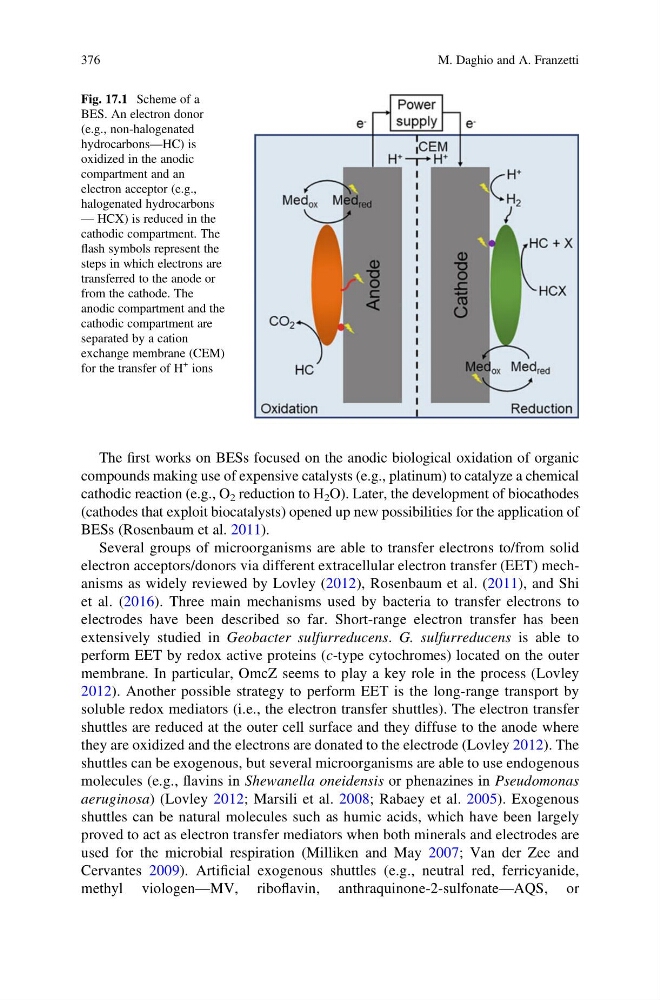
Fig. 17.1 Scheme of a
BES. An electron donor
(e.g., non-halogenated
hydrocarbons—HC) is
oxidized in the anodic
compartment and an
electron acceptor (e.g.,
halogenated hydrocarbons
— HCX) is reduced in the
cathodic compartment. The
flash symbols represent the
steps in which electrons are
transferred to the anode or
from the cathode. The
anodic compartment and the
cathodic compartment are
separated by a cation
exchange membrane (CEM)
for the transfer of H
+ ions
376
M. Daghio and A. Franzetti
compounds making use of expensive catalysts (e.g., platinum) to catalyze a chemical
cathodic reaction (e.g., O 2 reduction to H 2 O). Later, the development of biocathodes
(cathodes that exploit biocatalysts) opened up new possibilities for the application of
BESs (Rosenbaum et al. 2011).
Several groups of microorganisms are able to transfer electrons to/from solid
electron acceptors/donors via different extracellular electron transfer (EET) mechanisms as widely reviewed by Lovley (2012), Rosenbaum et al. (2011), and Shi
et al. (2016). Three main mechanisms used by bacteria to transfer electrons to
electrodes have been described so far. Short-range electron transfer has been
extensively studied in Geobacter sulfurreducens. G. sulfurreducens is able to
perform EET by redox active proteins (c-type cytochromes) located on the outer
membrane. In particular, OmcZ seems to play a key role in the process (Lovley
2012). Another possible strategy to perform EET is the long-range transport by
soluble redox mediators (i.e., the electron transfer shuttles). The electron transfer
shuttles are reduced at the outer cell surface and they diffuse to the anode where
they are oxidized and the electrons are donated to the electrode (Lovley 2012). The
shuttles can be exogenous, but several microorganisms are able to use endogenous
molecules (e.g., flavins in Shewanella oneidensis or phenazines in Pseudomonas
aeruginosa) (Lovley 2012; Marsili et al. 2008; Rabaey et al. 2005). Exogenous
shuttles can be natural molecules such as humic acids, which have been largely
proved to act as electron transfer mediators when both minerals and electrodes are
used for the microbial respiration (Milliken and May 2007; Van der Zee and
Cervantes 2009). Artificial exogenous shuttles (e.g., neutral red, ferricyanide,
methyl viologen—MV, riboflavin, anthraquinone-2-sulfonate—AQS, or
Fig. 17.1 Scheme of a
BES. An electron donor
(e.g., non-halogenated
hydrocarbons—HC) is
oxidized in the anodic
compartment and an
electron acceptor (e.g.,
halogenated hydrocarbons
— HCX) is reduced in the
cathodic compartment. The
flash symbols represent the
steps in which electrons are
transferred to the anode or
from the cathode. The
anodic compartment and the
cathodic compartment are
separated by a cation
exchange membrane (CEM)
for the transfer of H
+ ions
376
M. Daghio and A. Franzetti