

Min and Yoo 2014; Wang et al. 2015). In this chapter only recent papers that deal
with the immobilization of enzymes for bioremediation application are discussed.
16.6.1 Nanoparticles
Spherical nanoparticles are the most studied enzyme carriers that offer many advantages due to their uniform size and spherical shape; however, handling of dry
powders of nanoparticles presents certain health and environmental concerns
(Handy et al. 2008). Retention of the nanoparticles and separation of the reaction
medium are the main obstacles to their large-scale implementation. Sophisticated
instrumentation for such hybrid membrane bioreactors with high-pressure pumps
and proper regulation may help to solve this problem (Gasser et al. 2014). Magnetic
nanoparticles have an additional advantage; they can be separated from the reaction
media by an external magnetic field. Enzyme–nanoparticles conjugates have good
Brownian motion mobility in a homogeneous reaction environment (Jia et al. 2003).
Many types of materials, e.g., silica (Patel et al. 2014), magnetite (Mohamed et al.
2017), TiO 2 (Ahmad and Sardar 2014), gold, silver (Kim et al. 2017; Petkova et al.
2012), polymer (Tay et al. 2016), and core–shell Fe 3 O 4 @SiO 2 nanoparticles (Xia
et al. 2017) have been successfully applied for the immobilization of various
enzymes with pollutant-degradation potential.
The surface of nanoparticles is commonly modified by the introduction of specific
functional groups or coated by specific layers to confer the requested properties that
are essential for successful application. Immobilization of enzymes on modified
nanoparticles is a broad topic and only selected examples are described in the
following text. Laccase immobilization on functionalized magnetite nanoparticles
was optimized by Fortes et al. (2017) and the preparation of chitosan-coated
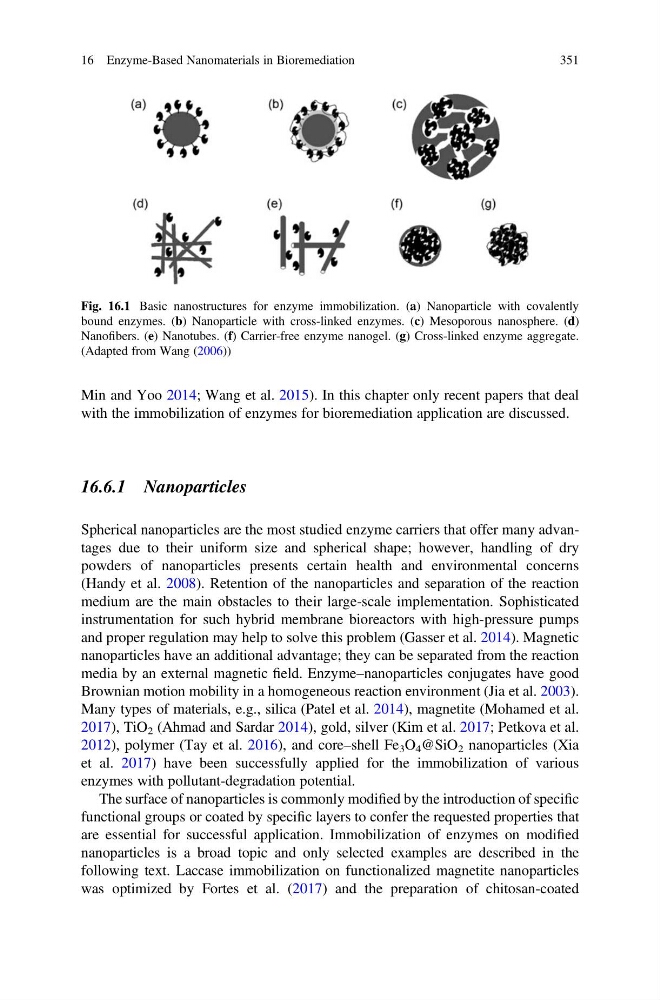
Fig. 16.1 Basic nanostructures for enzyme immobilization. (a) Nanoparticle with covalently
bound enzymes. (b) Nanoparticle with cross-linked enzymes. (c) Mesoporous nanosphere. (d)
Nanofibers. (e) Nanotubes. (f) Carrier-free enzyme nanogel. (g) Cross-linked enzyme aggregate.
(Adapted from Wang (2006))
16 Enzyme-Based Nanomaterials in Bioremediation
351
with the immobilization of enzymes for bioremediation application are discussed.
16.6.1 Nanoparticles
Spherical nanoparticles are the most studied enzyme carriers that offer many advantages due to their uniform size and spherical shape; however, handling of dry
powders of nanoparticles presents certain health and environmental concerns
(Handy et al. 2008). Retention of the nanoparticles and separation of the reaction
medium are the main obstacles to their large-scale implementation. Sophisticated
instrumentation for such hybrid membrane bioreactors with high-pressure pumps
and proper regulation may help to solve this problem (Gasser et al. 2014). Magnetic
nanoparticles have an additional advantage; they can be separated from the reaction
media by an external magnetic field. Enzyme–nanoparticles conjugates have good
Brownian motion mobility in a homogeneous reaction environment (Jia et al. 2003).
Many types of materials, e.g., silica (Patel et al. 2014), magnetite (Mohamed et al.
2017), TiO 2 (Ahmad and Sardar 2014), gold, silver (Kim et al. 2017; Petkova et al.
2012), polymer (Tay et al. 2016), and core–shell Fe 3 O 4 @SiO 2 nanoparticles (Xia
et al. 2017) have been successfully applied for the immobilization of various
enzymes with pollutant-degradation potential.
The surface of nanoparticles is commonly modified by the introduction of specific
functional groups or coated by specific layers to confer the requested properties that
are essential for successful application. Immobilization of enzymes on modified
nanoparticles is a broad topic and only selected examples are described in the
following text. Laccase immobilization on functionalized magnetite nanoparticles
was optimized by Fortes et al. (2017) and the preparation of chitosan-coated
Fig. 16.1 Basic nanostructures for enzyme immobilization. (a) Nanoparticle with covalently
bound enzymes. (b) Nanoparticle with cross-linked enzymes. (c) Mesoporous nanosphere. (d)
Nanofibers. (e) Nanotubes. (f) Carrier-free enzyme nanogel. (g) Cross-linked enzyme aggregate.
(Adapted from Wang (2006))
16 Enzyme-Based Nanomaterials in Bioremediation
351