

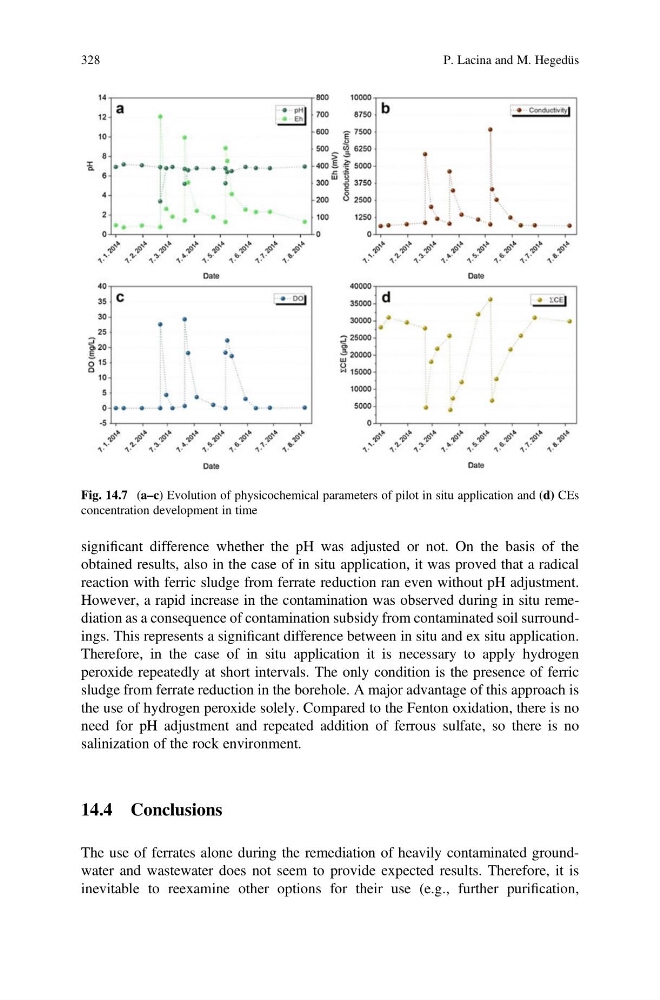
significant difference whether the pH was adjusted or not. On the basis of the
obtained results, also in the case of in situ application, it was proved that a radical
reaction with ferric sludge from ferrate reduction ran even without pH adjustment.
However, a rapid increase in the contamination was observed during in situ remediation as a consequence of contamination subsidy from contaminated soil surroundings. This represents a significant difference between in situ and ex situ application.
Therefore, in the case of in situ application it is necessary to apply hydrogen
peroxide repeatedly at short intervals. The only condition is the presence of ferric
sludge from ferrate reduction in the borehole. A major advantage of this approach is
the use of hydrogen peroxide solely. Compared to the Fenton oxidation, there is no
need for pH adjustment and repeated addition of ferrous sulfate, so there is no
salinization of the rock environment.
14.4 Conclusions
The use of ferrates alone during the remediation of heavily contaminated groundwater and wastewater does not seem to provide expected results. Therefore, it is
inevitable to reexamine other options for their use (e.g., further purification,
Fig. 14.7 (a–c) Evolution of physicochemical parameters of pilot in situ application and (d) CEs
concentration development in time
328
P. Lacina and M. Hegedüs
obtained results, also in the case of in situ application, it was proved that a radical
reaction with ferric sludge from ferrate reduction ran even without pH adjustment.
However, a rapid increase in the contamination was observed during in situ remediation as a consequence of contamination subsidy from contaminated soil surroundings. This represents a significant difference between in situ and ex situ application.
Therefore, in the case of in situ application it is necessary to apply hydrogen
peroxide repeatedly at short intervals. The only condition is the presence of ferric
sludge from ferrate reduction in the borehole. A major advantage of this approach is
the use of hydrogen peroxide solely. Compared to the Fenton oxidation, there is no
need for pH adjustment and repeated addition of ferrous sulfate, so there is no
salinization of the rock environment.
14.4 Conclusions
The use of ferrates alone during the remediation of heavily contaminated groundwater and wastewater does not seem to provide expected results. Therefore, it is
inevitable to reexamine other options for their use (e.g., further purification,
Fig. 14.7 (a–c) Evolution of physicochemical parameters of pilot in situ application and (d) CEs
concentration development in time
328
P. Lacina and M. Hegedüs