

redox potential and dissolved oxygen showed the formation of strong oxidizing
conditions in the water medium.
Figure 14.5 also shows physicochemical parameters of the blank sample compared with the pilot test. In the case of the blank experiment all measurements were
carried out parallel to the measurements carried out during the container test.
The liquid samples for the analysis were prepared in two rounds: (1) just before
the start of the test and (2) immediately after its termination. After they were
collected, all the samples were transported quickly to accredited laboratories in
order to perform sample treatment and analysis. The results of the analysis are listed
in Table 14.2. On the basis of the obtained results, the removal efficiency of the pilot
test was determined. The overall removal efficiency in the monitored contaminants
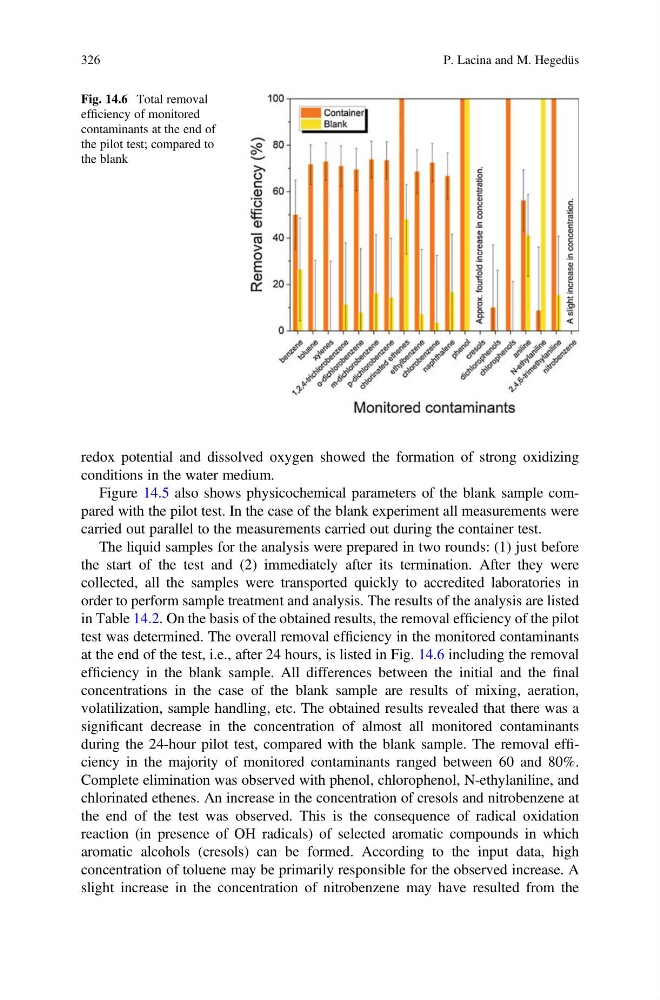
at the end of the test, i.e., after 24 hours, is listed in Fig. 14.6 including the removal
efficiency in the blank sample. All differences between the initial and the final
concentrations in the case of the blank sample are results of mixing, aeration,
volatilization, sample handling, etc. The obtained results revealed that there was a
significant decrease in the concentration of almost all monitored contaminants
during the 24-hour pilot test, compared with the blank sample. The removal efficiency in the majority of monitored contaminants ranged between 60 and 80%.
Complete elimination was observed with phenol, chlorophenol, N-ethylaniline, and
chlorinated ethenes. An increase in the concentration of cresols and nitrobenzene at
the end of the test was observed. This is the consequence of radical oxidation
reaction (in presence of OH radicals) of selected aromatic compounds in which
aromatic alcohols (cresols) can be formed. According to the input data, high
concentration of toluene may be primarily responsible for the observed increase. A
slight increase in the concentration of nitrobenzene may have resulted from the
Fig. 14.6 Total removal
efficiency of monitored
contaminants at the end of
the pilot test; compared to
the blank
326
P. Lacina and M. Hegedüs
conditions in the water medium.
Figure 14.5 also shows physicochemical parameters of the blank sample compared with the pilot test. In the case of the blank experiment all measurements were
carried out parallel to the measurements carried out during the container test.
The liquid samples for the analysis were prepared in two rounds: (1) just before
the start of the test and (2) immediately after its termination. After they were
collected, all the samples were transported quickly to accredited laboratories in
order to perform sample treatment and analysis. The results of the analysis are listed
in Table 14.2. On the basis of the obtained results, the removal efficiency of the pilot
test was determined. The overall removal efficiency in the monitored contaminants
at the end of the test, i.e., after 24 hours, is listed in Fig. 14.6 including the removal
efficiency in the blank sample. All differences between the initial and the final
concentrations in the case of the blank sample are results of mixing, aeration,
volatilization, sample handling, etc. The obtained results revealed that there was a
significant decrease in the concentration of almost all monitored contaminants
during the 24-hour pilot test, compared with the blank sample. The removal efficiency in the majority of monitored contaminants ranged between 60 and 80%.
Complete elimination was observed with phenol, chlorophenol, N-ethylaniline, and
chlorinated ethenes. An increase in the concentration of cresols and nitrobenzene at
the end of the test was observed. This is the consequence of radical oxidation
reaction (in presence of OH radicals) of selected aromatic compounds in which
aromatic alcohols (cresols) can be formed. According to the input data, high
concentration of toluene may be primarily responsible for the observed increase. A
slight increase in the concentration of nitrobenzene may have resulted from the
Fig. 14.6 Total removal
efficiency of monitored
contaminants at the end of
the pilot test; compared to
the blank
326
P. Lacina and M. Hegedüs