

14.1 Introduction
Over the last two decades, water-soluble compounds of iron in high oxidation states
(especially Fe
V and Fe
VI ), also known as ferrates (Sharma et al. 2005; Yates et al.
2014b), have been presented as a promising material for wastewater treatment with
an effort to enhance their efficiency. Not only do they possess relatively strong
oxidizing properties with the capability of degrading a wide range of organic and
inorganic contaminants, but they also provide an environmentally friendly solution
for water treatment processes, which is a number-one priority for newly introduced
materials on the market. Depending on the reaction conditions, Fe
VI (or Fe
V
) species
are reduced to Fe
III or Fe
II , which in an aqueous environment precipitate out in a
form of various polyhydroxy complexes or hydroxides. These compounds are stable
forms of iron commonly found in nature (Yates et al. 2014b) and do not represent
any potential danger to the environment (Jiang and Lloyd 2002; Sharma 2002, 2011;
Sharma et al. 2005; Prucek et al. 2013).
Strong oxidizing properties of ferrates are given by an unusually high oxidation
state of iron. In an aqueous environment, ferrates are unstable and are subjected to a
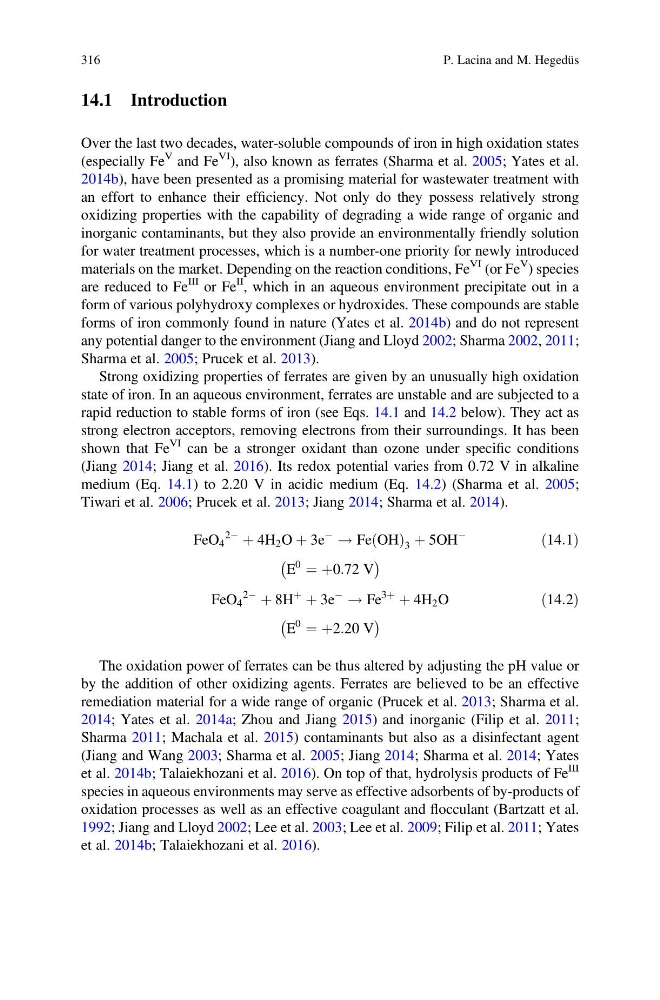
rapid reduction to stable forms of iron (see Eqs. 14.1 and 14.2 below). They act as
strong electron acceptors, removing electrons from their surroundings. It has been
shown that Fe
VI can be a stronger oxidant than ozone under specific conditions
(Jiang 2014; Jiang et al. 2016). Its redox potential varies from 0.72 V in alkaline
medium (Eq. 14.1) to 2.20 V in acidic medium (Eq. 14.2) (Sharma et al. 2005;
Tiwari et al. 2006; Prucek et al. 2013; Jiang 2014; Sharma et al. 2014).
FeO 4
2À
þ 4H 2 O þ 3e
À
! Fe OH
ð Þ 3 þ 5OH
À
ð14:1Þ
E
0
¼ þ0:72 V
À
Á
FeO 4
2À
þ 8H
þ
þ 3e
À
! Fe
3þ
þ 4H 2 O
ð14:2Þ
E
0
¼ þ2:20 V
À
Á
The oxidation power of ferrates can be thus altered by adjusting the pH value or
by the addition of other oxidizing agents. Ferrates are believed to be an effective
remediation material for a wide range of organic (Prucek et al. 2013; Sharma et al.
2014; Yates et al. 2014a; Zhou and Jiang 2015) and inorganic (Filip et al. 2011;
Sharma 2011; Machala et al. 2015) contaminants but also as a disinfectant agent
(Jiang and Wang 2003; Sharma et al. 2005; Jiang 2014; Sharma et al. 2014; Yates
et al. 2014b; Talaiekhozani et al. 2016). On top of that, hydrolysis products of Fe
III
species in aqueous environments may serve as effective adsorbents of by-products of
oxidation processes as well as an effective coagulant and flocculant (Bartzatt et al.
1992; Jiang and Lloyd 2002; Lee et al. 2003; Lee et al. 2009; Filip et al. 2011; Yates
et al. 2014b; Talaiekhozani et al. 2016).
316
P. Lacina and M. Hegedüs
Over the last two decades, water-soluble compounds of iron in high oxidation states
(especially Fe
V and Fe
VI ), also known as ferrates (Sharma et al. 2005; Yates et al.
2014b), have been presented as a promising material for wastewater treatment with
an effort to enhance their efficiency. Not only do they possess relatively strong
oxidizing properties with the capability of degrading a wide range of organic and
inorganic contaminants, but they also provide an environmentally friendly solution
for water treatment processes, which is a number-one priority for newly introduced
materials on the market. Depending on the reaction conditions, Fe
VI (or Fe
V
) species
are reduced to Fe
III or Fe
II , which in an aqueous environment precipitate out in a
form of various polyhydroxy complexes or hydroxides. These compounds are stable
forms of iron commonly found in nature (Yates et al. 2014b) and do not represent
any potential danger to the environment (Jiang and Lloyd 2002; Sharma 2002, 2011;
Sharma et al. 2005; Prucek et al. 2013).
Strong oxidizing properties of ferrates are given by an unusually high oxidation
state of iron. In an aqueous environment, ferrates are unstable and are subjected to a
rapid reduction to stable forms of iron (see Eqs. 14.1 and 14.2 below). They act as
strong electron acceptors, removing electrons from their surroundings. It has been
shown that Fe
VI can be a stronger oxidant than ozone under specific conditions
(Jiang 2014; Jiang et al. 2016). Its redox potential varies from 0.72 V in alkaline
medium (Eq. 14.1) to 2.20 V in acidic medium (Eq. 14.2) (Sharma et al. 2005;
Tiwari et al. 2006; Prucek et al. 2013; Jiang 2014; Sharma et al. 2014).
FeO 4
2À
þ 4H 2 O þ 3e
À
! Fe OH
ð Þ 3 þ 5OH
À
ð14:1Þ
E
0
¼ þ0:72 V
À
Á
FeO 4
2À
þ 8H
þ
þ 3e
À
! Fe
3þ
þ 4H 2 O
ð14:2Þ
E
0
¼ þ2:20 V
À
Á
The oxidation power of ferrates can be thus altered by adjusting the pH value or
by the addition of other oxidizing agents. Ferrates are believed to be an effective
remediation material for a wide range of organic (Prucek et al. 2013; Sharma et al.
2014; Yates et al. 2014a; Zhou and Jiang 2015) and inorganic (Filip et al. 2011;
Sharma 2011; Machala et al. 2015) contaminants but also as a disinfectant agent
(Jiang and Wang 2003; Sharma et al. 2005; Jiang 2014; Sharma et al. 2014; Yates
et al. 2014b; Talaiekhozani et al. 2016). On top of that, hydrolysis products of Fe
III
species in aqueous environments may serve as effective adsorbents of by-products of
oxidation processes as well as an effective coagulant and flocculant (Bartzatt et al.
1992; Jiang and Lloyd 2002; Lee et al. 2003; Lee et al. 2009; Filip et al. 2011; Yates
et al. 2014b; Talaiekhozani et al. 2016).
316
P. Lacina and M. Hegedüs