

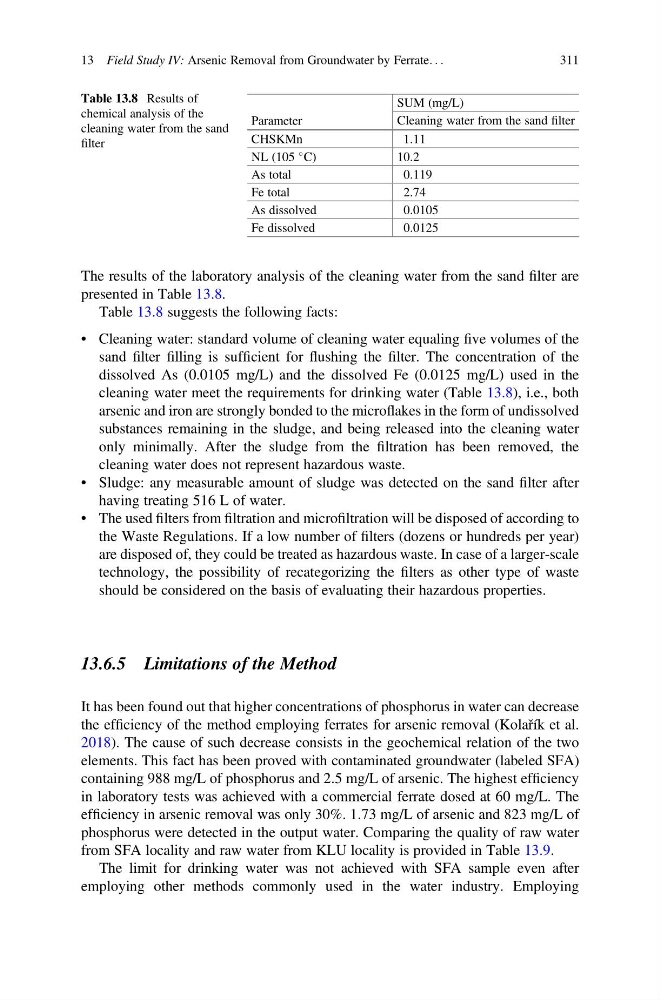
The results of the laboratory analysis of the cleaning water from the sand filter are
presented in Table 13.8.
Table 13.8 suggests the following facts:
• Cleaning water: standard volume of cleaning water equaling five volumes of the
sand filter filling is sufficient for flushing the filter. The concentration of the
dissolved As (0.0105 mg/L) and the dissolved Fe (0.0125 mg/L) used in the
cleaning water meet the requirements for drinking water (Table 13.8), i.e., both
arsenic and iron are strongly bonded to the microflakes in the form of undissolved
substances remaining in the sludge, and being released into the cleaning water
only minimally. After the sludge from the filtration has been removed, the
cleaning water does not represent hazardous waste.
• Sludge: any measurable amount of sludge was detected on the sand filter after
having treating 516 L of water.
• The used filters from filtration and microfiltration will be disposed of according to
the Waste Regulations. If a low number of filters (dozens or hundreds per year)
are disposed of, they could be treated as hazardous waste. In case of a larger-scale
technology, the possibility of recategorizing the filters as other type of waste
should be considered on the basis of evaluating their hazardous properties.
13.6.5 Limitations of the Method
It has been found out that higher concentrations of phosphorus in water can decrease
the efficiency of the method employing ferrates for arsenic removal (Kolařík et al.
2018). The cause of such decrease consists in the geochemical relation of the two
elements. This fact has been proved with contaminated groundwater (labeled SFA)
containing 988 mg/L of phosphorus and 2.5 mg/L of arsenic. The highest efficiency
in laboratory tests was achieved with a commercial ferrate dosed at 60 mg/L. The
efficiency in arsenic removal was only 30%. 1.73 mg/L of arsenic and 823 mg/L of
phosphorus were detected in the output water. Comparing the quality of raw water
from SFA locality and raw water from KLU locality is provided in Table 13.9.
The limit for drinking water was not achieved with SFA sample even after
employing other methods commonly used in the water industry. Employing
Table 13.8 Results of
chemical analysis of the
cleaning water from the sand
filter
Parameter
SUM (mg/L)
Cleaning water from the sand filter
CHSKMn
1.11
NL (105
C)
10.2
As total
0.119
Fe total
2.74
As dissolved
0.0105
Fe dissolved
0.0125
13 Field Study IV: Arsenic Removal from Groundwater by Ferrate. . .
311
presented in Table 13.8.
Table 13.8 suggests the following facts:
• Cleaning water: standard volume of cleaning water equaling five volumes of the
sand filter filling is sufficient for flushing the filter. The concentration of the
dissolved As (0.0105 mg/L) and the dissolved Fe (0.0125 mg/L) used in the
cleaning water meet the requirements for drinking water (Table 13.8), i.e., both
arsenic and iron are strongly bonded to the microflakes in the form of undissolved
substances remaining in the sludge, and being released into the cleaning water
only minimally. After the sludge from the filtration has been removed, the
cleaning water does not represent hazardous waste.
• Sludge: any measurable amount of sludge was detected on the sand filter after
having treating 516 L of water.
• The used filters from filtration and microfiltration will be disposed of according to
the Waste Regulations. If a low number of filters (dozens or hundreds per year)
are disposed of, they could be treated as hazardous waste. In case of a larger-scale
technology, the possibility of recategorizing the filters as other type of waste
should be considered on the basis of evaluating their hazardous properties.
13.6.5 Limitations of the Method
It has been found out that higher concentrations of phosphorus in water can decrease
the efficiency of the method employing ferrates for arsenic removal (Kolařík et al.
2018). The cause of such decrease consists in the geochemical relation of the two
elements. This fact has been proved with contaminated groundwater (labeled SFA)
containing 988 mg/L of phosphorus and 2.5 mg/L of arsenic. The highest efficiency
in laboratory tests was achieved with a commercial ferrate dosed at 60 mg/L. The
efficiency in arsenic removal was only 30%. 1.73 mg/L of arsenic and 823 mg/L of
phosphorus were detected in the output water. Comparing the quality of raw water
from SFA locality and raw water from KLU locality is provided in Table 13.9.
The limit for drinking water was not achieved with SFA sample even after
employing other methods commonly used in the water industry. Employing
Table 13.8 Results of
chemical analysis of the
cleaning water from the sand
filter
Parameter
SUM (mg/L)
Cleaning water from the sand filter
CHSKMn
1.11
NL (105
C)
10.2
As total
0.119
Fe total
2.74
As dissolved
0.0105
Fe dissolved
0.0125
13 Field Study IV: Arsenic Removal from Groundwater by Ferrate. . .
311