

of a commercial ferrate. Such a dose guarantees that the limit for arsenic concentration in drinking water will be met.
If we focus on the test B performance and its results, i.e., the output after
ultrafiltration, it is clear that the final concentrations—Fe 0.0746 mg/L (limit
0.2 mg/L), K 9.85 mg/L (limit is not set; potassium is an essential element in humans
and is seldom, if ever, found in drinking water at levels that could be a concern for
healthy humans and the recommended daily requirement is greater than 3000 mg),
and pH 7.25 (limit for pH 6–8)—comply with the requirements for drinking water.
Adding ferrates has only a minimum impact on the original water content.
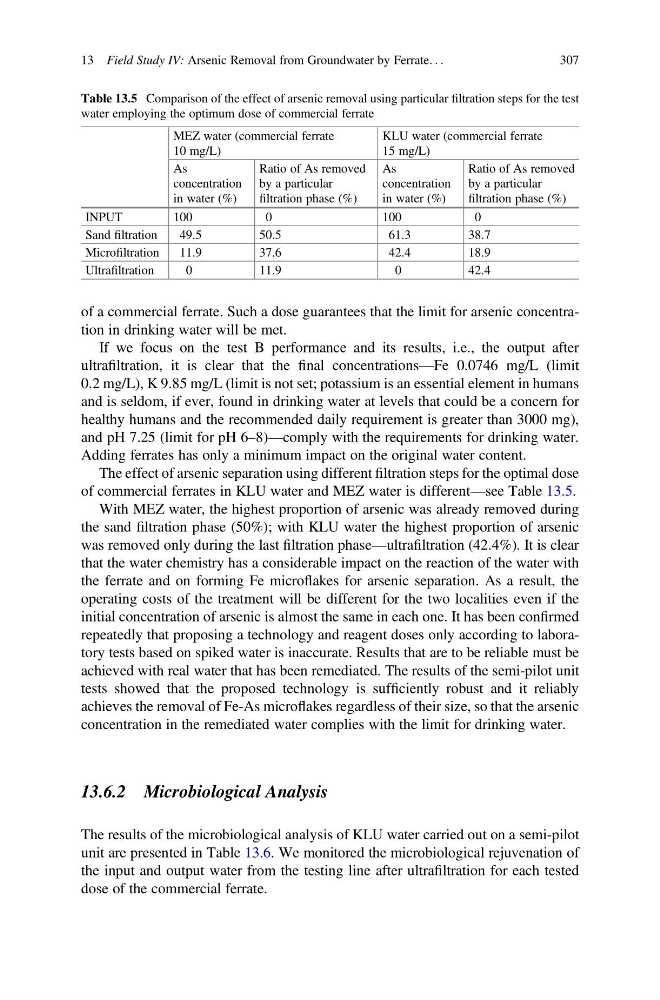
The effect of arsenic separation using different filtration steps for the optimal dose
of commercial ferrates in KLU water and MEZ water is different—see Table 13.5.
With MEZ water, the highest proportion of arsenic was already removed during
the sand filtration phase (50%); with KLU water the highest proportion of arsenic
was removed only during the last filtration phase—ultrafiltration (42.4%). It is clear
that the water chemistry has a considerable impact on the reaction of the water with
the ferrate and on forming Fe microflakes for arsenic separation. As a result, the
operating costs of the treatment will be different for the two localities even if the
initial concentration of arsenic is almost the same in each one. It has been confirmed
repeatedly that proposing a technology and reagent doses only according to laboratory tests based on spiked water is inaccurate. Results that are to be reliable must be
achieved with real water that has been remediated. The results of the semi-pilot unit
tests showed that the proposed technology is sufficiently robust and it reliably
achieves the removal of Fe-As microflakes regardless of their size, so that the arsenic
concentration in the remediated water complies with the limit for drinking water.
13.6.2 Microbiological Analysis
The results of the microbiological analysis of KLU water carried out on a semi-pilot
unit are presented in Table 13.6. We monitored the microbiological rejuvenation of
the input and output water from the testing line after ultrafiltration for each tested
dose of the commercial ferrate.
Table 13.5 Comparison of the effect of arsenic removal using particular filtration steps for the test
water employing the optimum dose of commercial ferrate
MEZ water (commercial ferrate
10 mg/L)
KLU water (commercial ferrate
15 mg/L)
As
concentration
in water (%)
Ratio of As removed
by a particular
filtration phase (%)
As
concentration
in water (%)
Ratio of As removed
by a particular
filtration phase (%)
INPUT
100
0
100
0
Sand filtration
49.5
50.5
61.3
38.7
Microfiltration
11.9
37.6
42.4
18.9
Ultrafiltration
0
11.9
0
42.4
13 Field Study IV: Arsenic Removal from Groundwater by Ferrate. . .
307
If we focus on the test B performance and its results, i.e., the output after
ultrafiltration, it is clear that the final concentrations—Fe 0.0746 mg/L (limit
0.2 mg/L), K 9.85 mg/L (limit is not set; potassium is an essential element in humans
and is seldom, if ever, found in drinking water at levels that could be a concern for
healthy humans and the recommended daily requirement is greater than 3000 mg),
and pH 7.25 (limit for pH 6–8)—comply with the requirements for drinking water.
Adding ferrates has only a minimum impact on the original water content.
The effect of arsenic separation using different filtration steps for the optimal dose
of commercial ferrates in KLU water and MEZ water is different—see Table 13.5.
With MEZ water, the highest proportion of arsenic was already removed during
the sand filtration phase (50%); with KLU water the highest proportion of arsenic
was removed only during the last filtration phase—ultrafiltration (42.4%). It is clear
that the water chemistry has a considerable impact on the reaction of the water with
the ferrate and on forming Fe microflakes for arsenic separation. As a result, the
operating costs of the treatment will be different for the two localities even if the
initial concentration of arsenic is almost the same in each one. It has been confirmed
repeatedly that proposing a technology and reagent doses only according to laboratory tests based on spiked water is inaccurate. Results that are to be reliable must be
achieved with real water that has been remediated. The results of the semi-pilot unit
tests showed that the proposed technology is sufficiently robust and it reliably
achieves the removal of Fe-As microflakes regardless of their size, so that the arsenic
concentration in the remediated water complies with the limit for drinking water.
13.6.2 Microbiological Analysis
The results of the microbiological analysis of KLU water carried out on a semi-pilot
unit are presented in Table 13.6. We monitored the microbiological rejuvenation of
the input and output water from the testing line after ultrafiltration for each tested
dose of the commercial ferrate.
Table 13.5 Comparison of the effect of arsenic removal using particular filtration steps for the test
water employing the optimum dose of commercial ferrate
MEZ water (commercial ferrate
10 mg/L)
KLU water (commercial ferrate
15 mg/L)
As
concentration
in water (%)
Ratio of As removed
by a particular
filtration phase (%)
As
concentration
in water (%)
Ratio of As removed
by a particular
filtration phase (%)
INPUT
100
0
100
0
Sand filtration
49.5
50.5
61.3
38.7
Microfiltration
11.9
37.6
42.4
18.9
Ultrafiltration
0
11.9
0
42.4
13 Field Study IV: Arsenic Removal from Groundwater by Ferrate. . .
307