

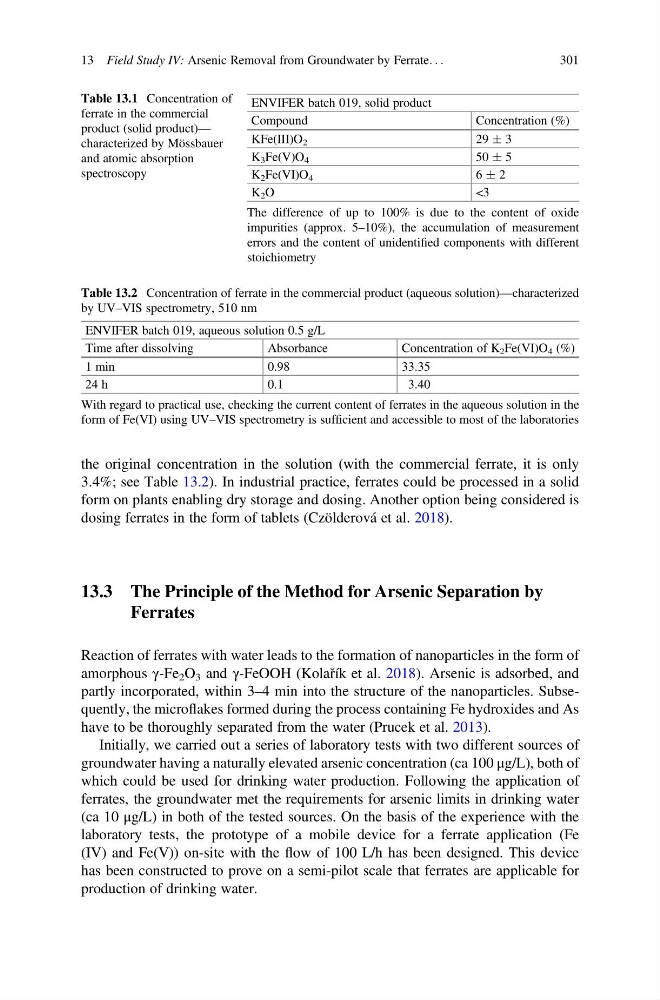
the original concentration in the solution (with the commercial ferrate, it is only
3.4%; see Table 13.2). In industrial practice, ferrates could be processed in a solid
form on plants enabling dry storage and dosing. Another option being considered is
dosing ferrates in the form of tablets (Czölderová et al. 2018).
13.3 The Principle of the Method for Arsenic Separation by
Ferrates
Reaction of ferrates with water leads to the formation of nanoparticles in the form of
amorphous γ-Fe 2 O 3 and γ-FeOOH (Kolařík et al. 2018). Arsenic is adsorbed, and
partly incorporated, within 3–4 min into the structure of the nanoparticles. Subsequently, the microflakes formed during the process containing Fe hydroxides and As
have to be thoroughly separated from the water (Prucek et al. 2013).
Initially, we carried out a series of laboratory tests with two different sources of
groundwater having a naturally elevated arsenic concentration (ca 100 μg/L), both of
which could be used for drinking water production. Following the application of
ferrates, the groundwater met the requirements for arsenic limits in drinking water
(ca 10 μg/L) in both of the tested sources. On the basis of the experience with the
laboratory tests, the prototype of a mobile device for a ferrate application (Fe
(IV) and Fe(V)) on-site with the flow of 100 L/h has been designed. This device
has been constructed to prove on a semi-pilot scale that ferrates are applicable for
production of drinking water.
Table 13.1 Concentration of
ferrate in the commercial
product (solid product)—
characterized by Mössbauer
and atomic absorption
spectroscopy
ENVIFER batch 019, solid product
Compound
Concentration (%)
KFe(III)O 2
29 Æ 3
K 3 Fe(V)O 4
50 Æ 5
K 2 Fe(VI)O 4
6 Æ 2
K 2 O
< 3
The difference of up to 100% is due to the content of oxide
impurities (approx. 5–10%), the accumulation of measurement
errors and the content of unidentified components with different
stoichiometry
Table 13.2 Concentration of ferrate in the commercial product (aqueous solution)—characterized
by UV–VIS spectrometry, 510 nm
ENVIFER batch 019, aqueous solution 0.5 g/L
Time after dissolving
Absorbance
Concentration of K 2 Fe(VI)O 4 (%)
1 min
0.98
33.35
24 h
0.1
3.40
With regard to practical use, checking the current content of ferrates in the aqueous solution in the
form of Fe(VI) using UV–VIS spectrometry is sufficient and accessible to most of the laboratories
13 Field Study IV: Arsenic Removal from Groundwater by Ferrate. . .
301
3.4%; see Table 13.2). In industrial practice, ferrates could be processed in a solid
form on plants enabling dry storage and dosing. Another option being considered is
dosing ferrates in the form of tablets (Czölderová et al. 2018).
13.3 The Principle of the Method for Arsenic Separation by
Ferrates
Reaction of ferrates with water leads to the formation of nanoparticles in the form of
amorphous γ-Fe 2 O 3 and γ-FeOOH (Kolařík et al. 2018). Arsenic is adsorbed, and
partly incorporated, within 3–4 min into the structure of the nanoparticles. Subsequently, the microflakes formed during the process containing Fe hydroxides and As
have to be thoroughly separated from the water (Prucek et al. 2013).
Initially, we carried out a series of laboratory tests with two different sources of
groundwater having a naturally elevated arsenic concentration (ca 100 μg/L), both of
which could be used for drinking water production. Following the application of
ferrates, the groundwater met the requirements for arsenic limits in drinking water
(ca 10 μg/L) in both of the tested sources. On the basis of the experience with the
laboratory tests, the prototype of a mobile device for a ferrate application (Fe
(IV) and Fe(V)) on-site with the flow of 100 L/h has been designed. This device
has been constructed to prove on a semi-pilot scale that ferrates are applicable for
production of drinking water.
Table 13.1 Concentration of
ferrate in the commercial
product (solid product)—
characterized by Mössbauer
and atomic absorption
spectroscopy
ENVIFER batch 019, solid product
Compound
Concentration (%)
KFe(III)O 2
29 Æ 3
K 3 Fe(V)O 4
50 Æ 5
K 2 Fe(VI)O 4
6 Æ 2
K 2 O
< 3
The difference of up to 100% is due to the content of oxide
impurities (approx. 5–10%), the accumulation of measurement
errors and the content of unidentified components with different
stoichiometry
Table 13.2 Concentration of ferrate in the commercial product (aqueous solution)—characterized
by UV–VIS spectrometry, 510 nm
ENVIFER batch 019, aqueous solution 0.5 g/L
Time after dissolving
Absorbance
Concentration of K 2 Fe(VI)O 4 (%)
1 min
0.98
33.35
24 h
0.1
3.40
With regard to practical use, checking the current content of ferrates in the aqueous solution in the
form of Fe(VI) using UV–VIS spectrometry is sufficient and accessible to most of the laboratories
13 Field Study IV: Arsenic Removal from Groundwater by Ferrate. . .
301