

12.4 Conclusions
Pilot-scale field tests with low ferrate(VI) doses for drinking water treatment
achieved average particle removal percentage of 93% for the raw water and 97%
for the ozonized water in terms of particle counting data. No pH neutralization was
required after dosing ferrate(VI). In comparison with using ozonation and FeCl 3
coagulation, ferrate(VI) has the additional benefits: it can remove 10% metformin,
benzotriazole, and acesulfame, whereas FeCl 3 with ozonation cannot. Additionally,
the ferrate(VI)-treated water did not generate bromate, while the ozonated water did.
As for the sewage treatment, pilot-scale tests demonstrated that with very low
dose range, 0.1–0.2 mg Fe
(VI) /L, ferrate(VI) achieved removal targets of phosphorus,
COD, BOD, and suspended solids from the crude sewage, while the dose demand of
ferric sulfate (25 mg Fe/L) was much higher than that of ferrate(VI); these will
reduce the chemical demand and sludge production and therefore generate substantial cost saving in treating sewage. Depending on individual circumstances, the
ferrate(VI) technology could be implemented in wastewater treatment practice.
Acknowledgement This author acknowledges the funding and staff support from Southern Water
in England and Zweckverband Bodensee-Wasserversorgung Water Board of Germany to run the
field trials. Thanks also go to author’s team members including PhD students and postdoc
researchers who assisted staffs when conducting the field tests. The views of this chapter may not
necessarily represent those of the stated water companies.
Average R% = 63.5
0
100
200
300
400
500
600
700
800
900
1000
1100
1200
1
2
3
4
5
6
7
8
9
10 11 12 13
Day
[SS] (mg/L)
0.0
10.0
20.0
30.0
40.0
50.0
60.0
70.0
80.0
90.0
100.0
% Removal
Crude
PST Effluent
% removal
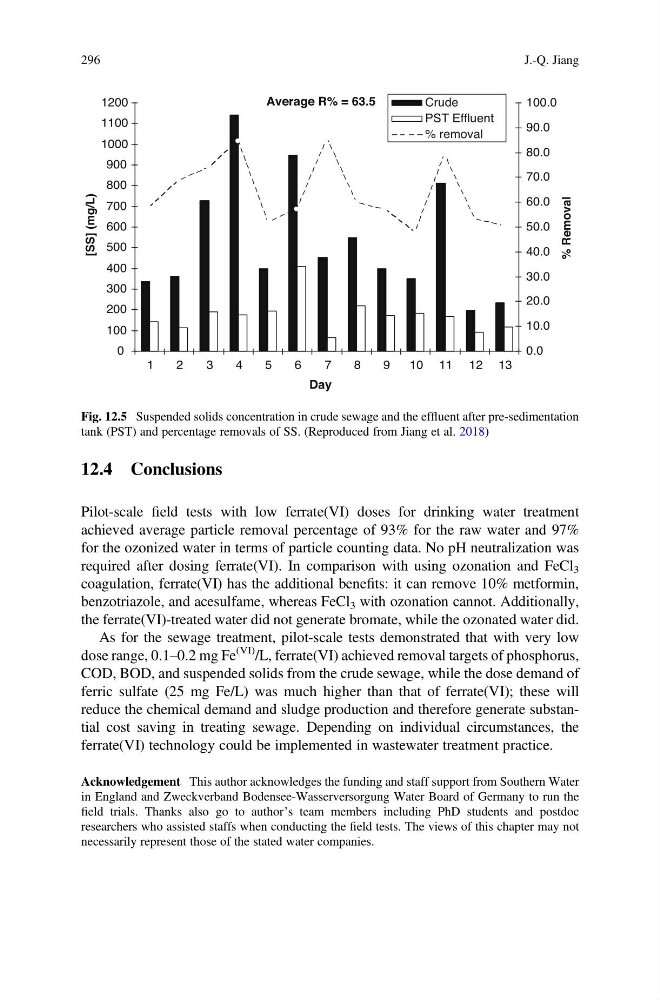
Fig. 12.5 Suspended solids concentration in crude sewage and the effluent after pre-sedimentation
tank (PST) and percentage removals of SS. (Reproduced from Jiang et al. 2018)
296
J.-Q. Jiang
Pilot-scale field tests with low ferrate(VI) doses for drinking water treatment
achieved average particle removal percentage of 93% for the raw water and 97%
for the ozonized water in terms of particle counting data. No pH neutralization was
required after dosing ferrate(VI). In comparison with using ozonation and FeCl 3
coagulation, ferrate(VI) has the additional benefits: it can remove 10% metformin,
benzotriazole, and acesulfame, whereas FeCl 3 with ozonation cannot. Additionally,
the ferrate(VI)-treated water did not generate bromate, while the ozonated water did.
As for the sewage treatment, pilot-scale tests demonstrated that with very low
dose range, 0.1–0.2 mg Fe
(VI) /L, ferrate(VI) achieved removal targets of phosphorus,
COD, BOD, and suspended solids from the crude sewage, while the dose demand of
ferric sulfate (25 mg Fe/L) was much higher than that of ferrate(VI); these will
reduce the chemical demand and sludge production and therefore generate substantial cost saving in treating sewage. Depending on individual circumstances, the
ferrate(VI) technology could be implemented in wastewater treatment practice.
Acknowledgement This author acknowledges the funding and staff support from Southern Water
in England and Zweckverband Bodensee-Wasserversorgung Water Board of Germany to run the
field trials. Thanks also go to author’s team members including PhD students and postdoc
researchers who assisted staffs when conducting the field tests. The views of this chapter may not
necessarily represent those of the stated water companies.
Average R% = 63.5
0
100
200
300
400
500
600
700
800
900
1000
1100
1200
1
2
3
4
5
6
7
8
9
10 11 12 13
Day
[SS] (mg/L)
0.0
10.0
20.0
30.0
40.0
50.0
60.0
70.0
80.0
90.0
100.0
% Removal
Crude
PST Effluent
% removal
Fig. 12.5 Suspended solids concentration in crude sewage and the effluent after pre-sedimentation
tank (PST) and percentage removals of SS. (Reproduced from Jiang et al. 2018)
296
J.-Q. Jiang