

Co and Co-based materials also possess excellent characteristics for H 2 O 2
electrogeneration in EF and PEF. Barros et al. prepared a GDE modified with 5%
Co-phthalocyanine for the EF treatment of 400 mL of solutions containing 100 mg/L
of the food dyes Amaranth (Barros et al. 2014b) and Tartrazine (Barros et al. 2014a),
with 0.1 M K 2 SO 4 and 0.15 mM Fe
2+ at pH 2.5, using a three-electrode undivided
cell with a Pt anode at E cath ¼ À0.70 V vs. Ag/AgCl. After 90 min, 79% and 98%
decolorization, with 67% and 75% TOC removal, related to 370 and 219 kWh per kg
TOC removed, were obtained, respectively. Ridruejo et al. (2018) showed the
viability of a CoS 2 /MWCNTs GDE cathode to degrade 150 mL of 0.112 mM of
the anaesthetic tetracaine in 0.05 M Na 2 SO 4 at pH 3.0 in a two-electrode cell with a
BDD anode at j ¼ 100 mA/cm
2 . The authors found the complete drug disappearance
at 120 and 60 min of EO-H 2 O 2 and PEF with a 6 W UVA lamp, respectively, with
TOC reductions of 43% and 60% at 180 min. The superiority of PEF was explained
by the generation of
•
OH from Fenton’s reaction (Eq. 11.2) and the photoreduction
of photoactive Fe(OH)
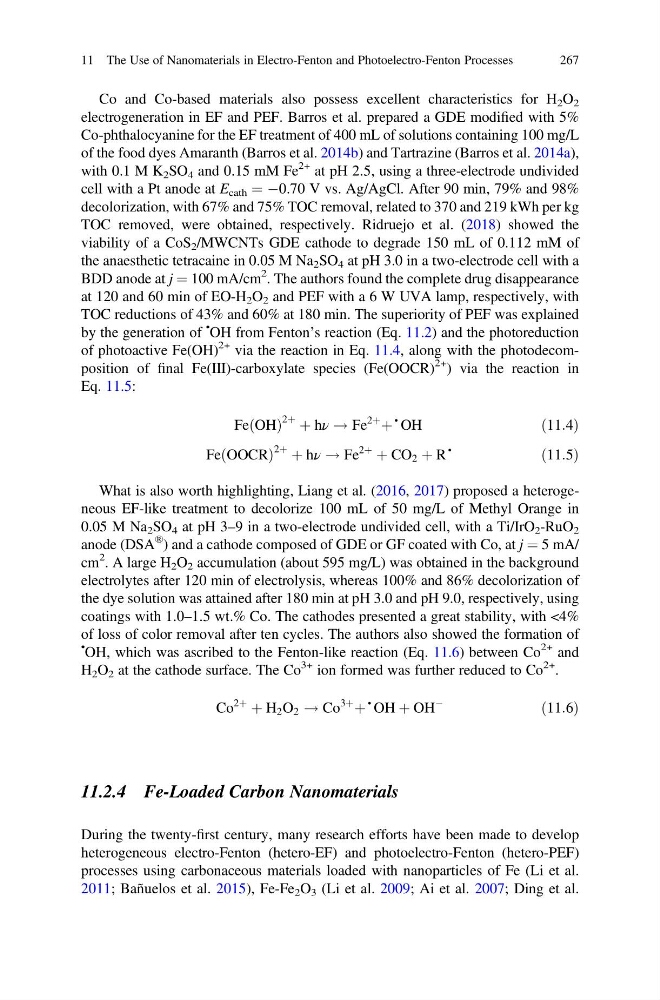
2+ via the reaction in Eq. 11.4, along with the photodecomposition of final Fe(III)-carboxylate species (Fe(OOCR)
2+ ) via the reaction in
Eq. 11.5:
Fe OH
ð Þ
2þ þ hν ! Fe
2þ
þ
• OH
ð11:4Þ
Fe OOCR
ð
Þ
2þ þ hν ! Fe
2þ
þ CO 2 þ R
•
ð11:5Þ
What is also worth highlighting, Liang et al. (2016, 2017) proposed a heterogeneous EF-like treatment to decolorize 100 mL of 50 mg/L of Methyl Orange in
0.05 M Na 2 SO 4 at pH 3–9 in a two-electrode undivided cell, with a Ti/IrO 2 -RuO 2
anode (DSA
® ) and a cathode composed of GDE or GF coated with Co, at j ¼ 5 mA/
cm
2 . A large H 2 O 2 accumulation (about 595 mg/L) was obtained in the background
electrolytes after 120 min of electrolysis, whereas 100% and 86% decolorization of
the dye solution was attained after 180 min at pH 3.0 and pH 9.0, respectively, using
coatings with 1.0–1.5 wt.% Co. The cathodes presented a great stability, with <4%
of loss of color removal after ten cycles. The authors also showed the formation of
•
OH, which was ascribed to the Fenton-like reaction (Eq. 11.6) between Co
2+ and
H 2 O 2 at the cathode surface. The Co
3+ ion formed was further reduced to Co
2+ .
Co
2þ
þ H 2 O 2 ! Co
3þ
þ
• OH þ OH
À
ð11:6Þ
11.2.4 Fe-Loaded Carbon Nanomaterials
During the twenty-first century, many research efforts have been made to develop
heterogeneous electro-Fenton (hetero-EF) and photoelectro-Fenton (hetero-PEF)
processes using carbonaceous materials loaded with nanoparticles of Fe (Li et al.
2011; Bañuelos et al. 2015), Fe-Fe 2 O 3 (Li et al. 2009; Ai et al. 2007; Ding et al.
11 The Use of Nanomaterials in Electro-Fenton and Photoelectro-Fenton Processes
267
electrogeneration in EF and PEF. Barros et al. prepared a GDE modified with 5%
Co-phthalocyanine for the EF treatment of 400 mL of solutions containing 100 mg/L
of the food dyes Amaranth (Barros et al. 2014b) and Tartrazine (Barros et al. 2014a),
with 0.1 M K 2 SO 4 and 0.15 mM Fe
2+ at pH 2.5, using a three-electrode undivided
cell with a Pt anode at E cath ¼ À0.70 V vs. Ag/AgCl. After 90 min, 79% and 98%
decolorization, with 67% and 75% TOC removal, related to 370 and 219 kWh per kg
TOC removed, were obtained, respectively. Ridruejo et al. (2018) showed the
viability of a CoS 2 /MWCNTs GDE cathode to degrade 150 mL of 0.112 mM of
the anaesthetic tetracaine in 0.05 M Na 2 SO 4 at pH 3.0 in a two-electrode cell with a
BDD anode at j ¼ 100 mA/cm
2 . The authors found the complete drug disappearance
at 120 and 60 min of EO-H 2 O 2 and PEF with a 6 W UVA lamp, respectively, with
TOC reductions of 43% and 60% at 180 min. The superiority of PEF was explained
by the generation of
•
OH from Fenton’s reaction (Eq. 11.2) and the photoreduction
of photoactive Fe(OH)
2+ via the reaction in Eq. 11.4, along with the photodecomposition of final Fe(III)-carboxylate species (Fe(OOCR)
2+ ) via the reaction in
Eq. 11.5:
Fe OH
ð Þ
2þ þ hν ! Fe
2þ
þ
• OH
ð11:4Þ
Fe OOCR
ð
Þ
2þ þ hν ! Fe
2þ
þ CO 2 þ R
•
ð11:5Þ
What is also worth highlighting, Liang et al. (2016, 2017) proposed a heterogeneous EF-like treatment to decolorize 100 mL of 50 mg/L of Methyl Orange in
0.05 M Na 2 SO 4 at pH 3–9 in a two-electrode undivided cell, with a Ti/IrO 2 -RuO 2
anode (DSA
® ) and a cathode composed of GDE or GF coated with Co, at j ¼ 5 mA/
cm
2 . A large H 2 O 2 accumulation (about 595 mg/L) was obtained in the background
electrolytes after 120 min of electrolysis, whereas 100% and 86% decolorization of
the dye solution was attained after 180 min at pH 3.0 and pH 9.0, respectively, using
coatings with 1.0–1.5 wt.% Co. The cathodes presented a great stability, with <4%
of loss of color removal after ten cycles. The authors also showed the formation of
•
OH, which was ascribed to the Fenton-like reaction (Eq. 11.6) between Co
2+ and
H 2 O 2 at the cathode surface. The Co
3+ ion formed was further reduced to Co
2+ .
Co
2þ
þ H 2 O 2 ! Co
3þ
þ
• OH þ OH
À
ð11:6Þ
11.2.4 Fe-Loaded Carbon Nanomaterials
During the twenty-first century, many research efforts have been made to develop
heterogeneous electro-Fenton (hetero-EF) and photoelectro-Fenton (hetero-PEF)
processes using carbonaceous materials loaded with nanoparticles of Fe (Li et al.
2011; Bañuelos et al. 2015), Fe-Fe 2 O 3 (Li et al. 2009; Ai et al. 2007; Ding et al.
11 The Use of Nanomaterials in Electro-Fenton and Photoelectro-Fenton Processes
267