

E cath ¼ À0.65 V/SCE for 120 min. The same trend was obtained when the performance of the EF process was assessed using 50 mg/L p-nitrophenol under the above
conditions using 0.2 mM Fe
3+ as catalyst, reaching 67%, 83%, and 99% substrate
decay at 60 min and 22%, 32%, and 51% mineralization at 120 min with GF, GF-A,
and GF-B, respectively. The superiority of GF-B containing N-doped carbon
nanoparticles was related to the higher current recorded, which promoted the H 2 O 2
production and the reduction of Fe
3+ to Fe
2+ , thereby increasing the amount of
•
OH
generated.
N-doping then favors the occurrence of the two-electron ORR to yield H 2 O 2 since
it increases the chemically active sites, the O 2 chemisorption, and the hydrophilicity
of the carbon surface (Khataee and Hasanzadeh 2017). This has been confirmed for
the other modified nanocarbons like N-CNTs (Zhang et al. 2008) and an
N-Gr@CNTs composite GDE (Liu et al. 2016), which were used to treat 250 mL
of Methyl Orange and 100 mL of 50 mg/L dimethyl phthalate solutions in 0.05 M
Na 2 SO 4 with 0.2–0.5 mM Fe
2+ at pH 3.0 by EF using three-electrode undivided cells
with a Pt anode at E cath of À0.85 and À0.50 V/SCE, respectively. In the former
system, 100% decolorization was obtained after 60 min using N-CNTs, a value
higher than 82% found with an unmodified CNTs cathode. In the other case, the
highest TOC removal of 52% at 180 min with the N-Gr@CNTs GDE was superior to
26%, 12%, 7.4%, and 38% reached with Gr@CNTs GDE, CNTs-based GDE,
Gr-based GDE, and graphite-based GDE as the cathode, respectively. However, a
contradictory interpretation of the behavior of the N-doped carbonaceous cathodes
has been proposed in the recent work of Yang et al. (2018b). These authors prepared
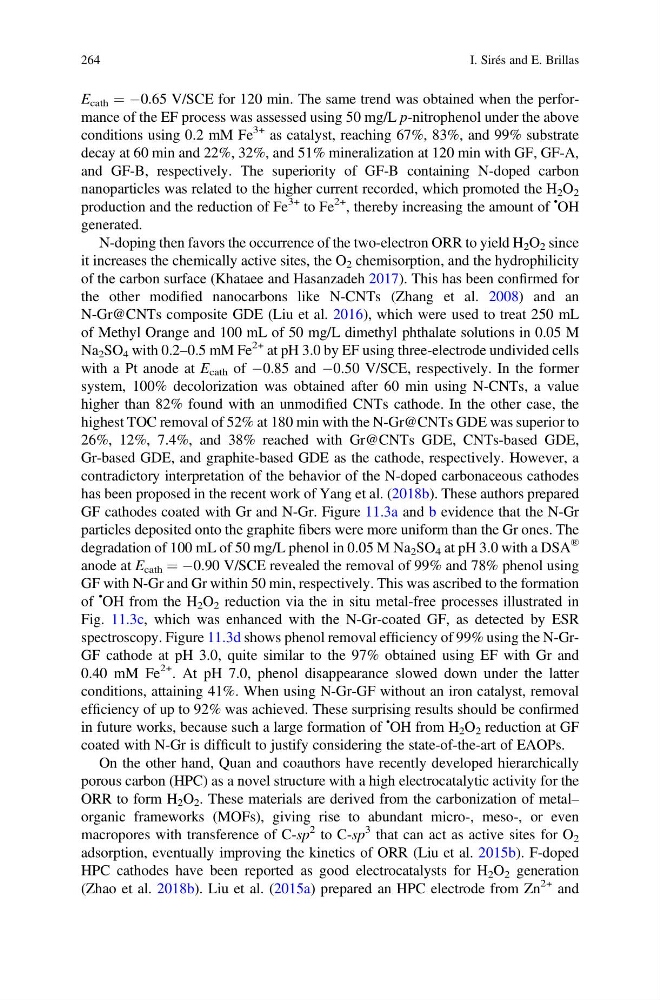
GF cathodes coated with Gr and N-Gr. Figure 11.3a and b evidence that the N-Gr
particles deposited onto the graphite fibers were more uniform than the Gr ones. The
degradation of 100 mL of 50 mg/L phenol in 0.05 M Na 2 SO 4 at pH 3.0 with a DSA
®
anode at E cath ¼ À0.90 V/SCE revealed the removal of 99% and 78% phenol using
GF with N-Gr and Gr within 50 min, respectively. This was ascribed to the formation
of
•
OH from the H 2 O 2 reduction via the in situ metal-free processes illustrated in
Fig. 11.3c, which was enhanced with the N-Gr-coated GF, as detected by ESR
spectroscopy. Figure 11.3d shows phenol removal efficiency of 99% using the N-GrGF cathode at pH 3.0, quite similar to the 97% obtained using EF with Gr and
0.40 mM Fe
2+ . At pH 7.0, phenol disappearance slowed down under the latter
conditions, attaining 41%. When using N-Gr-GF without an iron catalyst, removal
efficiency of up to 92% was achieved. These surprising results should be confirmed
in future works, because such a large formation of
•
OH from H 2 O 2 reduction at GF
coated with N-Gr is difficult to justify considering the state-of-the-art of EAOPs.
On the other hand, Quan and coauthors have recently developed hierarchically
porous carbon (HPC) as a novel structure with a high electrocatalytic activity for the
ORR to form H 2 O 2 . These materials are derived from the carbonization of metal–
organic frameworks (MOFs), giving rise to abundant micro-, meso-, or even
macropores with transference of C-sp
2 to C-sp
3 that can act as active sites for O 2
adsorption, eventually improving the kinetics of ORR (Liu et al. 2015b). F-doped
HPC cathodes have been reported as good electrocatalysts for H 2 O 2 generation
(Zhao et al. 2018b). Liu et al. (2015a) prepared an HPC electrode from Zn
2+ and
264
I. Sirés and E. Brillas
conditions using 0.2 mM Fe
3+ as catalyst, reaching 67%, 83%, and 99% substrate
decay at 60 min and 22%, 32%, and 51% mineralization at 120 min with GF, GF-A,
and GF-B, respectively. The superiority of GF-B containing N-doped carbon
nanoparticles was related to the higher current recorded, which promoted the H 2 O 2
production and the reduction of Fe
3+ to Fe
2+ , thereby increasing the amount of
•
OH
generated.
N-doping then favors the occurrence of the two-electron ORR to yield H 2 O 2 since
it increases the chemically active sites, the O 2 chemisorption, and the hydrophilicity
of the carbon surface (Khataee and Hasanzadeh 2017). This has been confirmed for
the other modified nanocarbons like N-CNTs (Zhang et al. 2008) and an
N-Gr@CNTs composite GDE (Liu et al. 2016), which were used to treat 250 mL
of Methyl Orange and 100 mL of 50 mg/L dimethyl phthalate solutions in 0.05 M
Na 2 SO 4 with 0.2–0.5 mM Fe
2+ at pH 3.0 by EF using three-electrode undivided cells
with a Pt anode at E cath of À0.85 and À0.50 V/SCE, respectively. In the former
system, 100% decolorization was obtained after 60 min using N-CNTs, a value
higher than 82% found with an unmodified CNTs cathode. In the other case, the
highest TOC removal of 52% at 180 min with the N-Gr@CNTs GDE was superior to
26%, 12%, 7.4%, and 38% reached with Gr@CNTs GDE, CNTs-based GDE,
Gr-based GDE, and graphite-based GDE as the cathode, respectively. However, a
contradictory interpretation of the behavior of the N-doped carbonaceous cathodes
has been proposed in the recent work of Yang et al. (2018b). These authors prepared
GF cathodes coated with Gr and N-Gr. Figure 11.3a and b evidence that the N-Gr
particles deposited onto the graphite fibers were more uniform than the Gr ones. The
degradation of 100 mL of 50 mg/L phenol in 0.05 M Na 2 SO 4 at pH 3.0 with a DSA
®
anode at E cath ¼ À0.90 V/SCE revealed the removal of 99% and 78% phenol using
GF with N-Gr and Gr within 50 min, respectively. This was ascribed to the formation
of
•
OH from the H 2 O 2 reduction via the in situ metal-free processes illustrated in
Fig. 11.3c, which was enhanced with the N-Gr-coated GF, as detected by ESR
spectroscopy. Figure 11.3d shows phenol removal efficiency of 99% using the N-GrGF cathode at pH 3.0, quite similar to the 97% obtained using EF with Gr and
0.40 mM Fe
2+ . At pH 7.0, phenol disappearance slowed down under the latter
conditions, attaining 41%. When using N-Gr-GF without an iron catalyst, removal
efficiency of up to 92% was achieved. These surprising results should be confirmed
in future works, because such a large formation of
•
OH from H 2 O 2 reduction at GF
coated with N-Gr is difficult to justify considering the state-of-the-art of EAOPs.
On the other hand, Quan and coauthors have recently developed hierarchically
porous carbon (HPC) as a novel structure with a high electrocatalytic activity for the
ORR to form H 2 O 2 . These materials are derived from the carbonization of metal–
organic frameworks (MOFs), giving rise to abundant micro-, meso-, or even
macropores with transference of C-sp
2 to C-sp
3 that can act as active sites for O 2
adsorption, eventually improving the kinetics of ORR (Liu et al. 2015b). F-doped
HPC cathodes have been reported as good electrocatalysts for H 2 O 2 generation
(Zhao et al. 2018b). Liu et al. (2015a) prepared an HPC electrode from Zn
2+ and
264
I. Sirés and E. Brillas