

characterized by nanometric shell size and thickness; and among others includes
carbon nanotubes (CNTs), graphene (Gr) and its derivatives (graphene oxide
(GO) and reduced graphene oxide (rGO)), nanofibers, nanodiamonds, nanocoils,
nanoribbon, and fullerene. The latter group is composed of ordered mesoporous
carbons and carbon fibers, which are constructed through various methodologies.
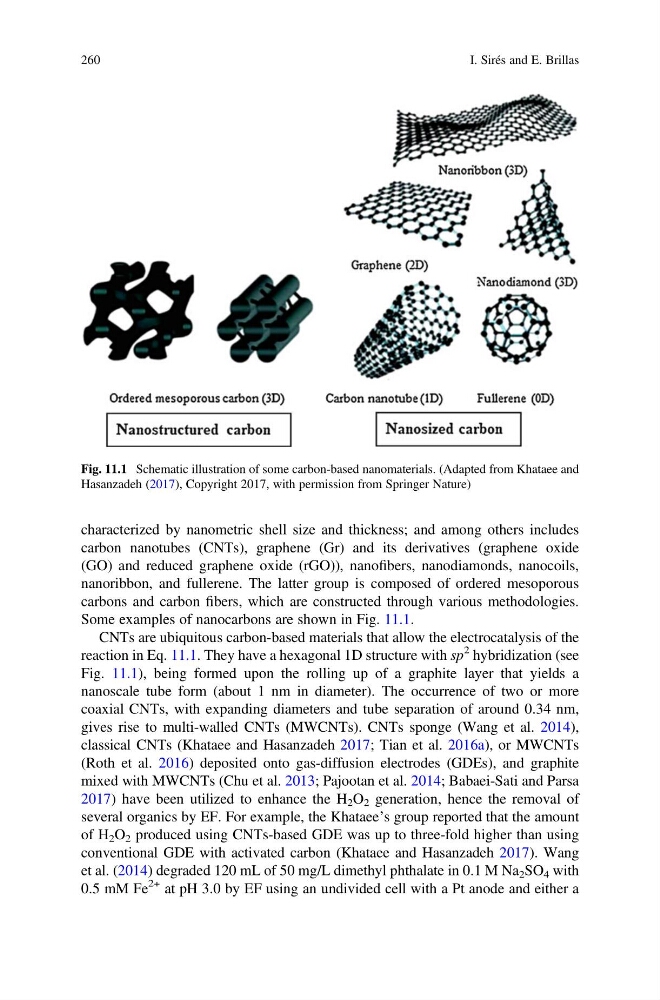
Some examples of nanocarbons are shown in Fig. 11.1.
CNTs are ubiquitous carbon-based materials that allow the electrocatalysis of the
reaction in Eq. 11.1. They have a hexagonal 1D structure with sp
2 hybridization (see
Fig. 11.1), being formed upon the rolling up of a graphite layer that yields a
nanoscale tube form (about 1 nm in diameter). The occurrence of two or more
coaxial CNTs, with expanding diameters and tube separation of around 0.34 nm,
gives rise to multi-walled CNTs (MWCNTs). CNTs sponge (Wang et al. 2014),
classical CNTs (Khataee and Hasanzadeh 2017; Tian et al. 2016a), or MWCNTs
(Roth et al. 2016) deposited onto gas-diffusion electrodes (GDEs), and graphite
mixed with MWCNTs (Chu et al. 2013; Pajootan et al. 2014; Babaei-Sati and Parsa
2017) have been utilized to enhance the H 2 O 2 generation, hence the removal of
several organics by EF. For example, the Khataee’s group reported that the amount
of H 2 O 2 produced using CNTs-based GDE was up to three-fold higher than using
conventional GDE with activated carbon (Khataee and Hasanzadeh 2017). Wang
et al. (2014) degraded 120 mL of 50 mg/L dimethyl phthalate in 0.1 M Na 2 SO 4 with
0.5 mM Fe
2+ at pH 3.0 by EF using an undivided cell with a Pt anode and either a
Fig. 11.1 Schematic illustration of some carbon-based nanomaterials. (Adapted from Khataee and
Hasanzadeh (2017), Copyright 2017, with permission from Springer Nature)
260
I. Sirés and E. Brillas
carbon nanotubes (CNTs), graphene (Gr) and its derivatives (graphene oxide
(GO) and reduced graphene oxide (rGO)), nanofibers, nanodiamonds, nanocoils,
nanoribbon, and fullerene. The latter group is composed of ordered mesoporous
carbons and carbon fibers, which are constructed through various methodologies.
Some examples of nanocarbons are shown in Fig. 11.1.
CNTs are ubiquitous carbon-based materials that allow the electrocatalysis of the
reaction in Eq. 11.1. They have a hexagonal 1D structure with sp
2 hybridization (see
Fig. 11.1), being formed upon the rolling up of a graphite layer that yields a
nanoscale tube form (about 1 nm in diameter). The occurrence of two or more
coaxial CNTs, with expanding diameters and tube separation of around 0.34 nm,
gives rise to multi-walled CNTs (MWCNTs). CNTs sponge (Wang et al. 2014),
classical CNTs (Khataee and Hasanzadeh 2017; Tian et al. 2016a), or MWCNTs
(Roth et al. 2016) deposited onto gas-diffusion electrodes (GDEs), and graphite
mixed with MWCNTs (Chu et al. 2013; Pajootan et al. 2014; Babaei-Sati and Parsa
2017) have been utilized to enhance the H 2 O 2 generation, hence the removal of
several organics by EF. For example, the Khataee’s group reported that the amount
of H 2 O 2 produced using CNTs-based GDE was up to three-fold higher than using
conventional GDE with activated carbon (Khataee and Hasanzadeh 2017). Wang
et al. (2014) degraded 120 mL of 50 mg/L dimethyl phthalate in 0.1 M Na 2 SO 4 with
0.5 mM Fe
2+ at pH 3.0 by EF using an undivided cell with a Pt anode and either a
Fig. 11.1 Schematic illustration of some carbon-based nanomaterials. (Adapted from Khataee and
Hasanzadeh (2017), Copyright 2017, with permission from Springer Nature)
260
I. Sirés and E. Brillas