

Fenton (1894) first discovered the hydroxyl radical by the oxidation of tartaric
acid via hydrogen peroxide. The breakdown of the hydrogen peroxide to hydroxyl
radicals is accomplished via UV radiation having wavelength range between 190 nm
and 280 nm. For this reaction, the hydrogen peroxide molecule must absorb a photon
(Deng and Zhao 2015).
H 2 O 2 þ hγ ! 2
• OH
ð10:1Þ
It is also possible to generate hydroxyl radicals using ozone (O 3 ). However, this is
a two-step reaction and two photons are needed to produce hydroxyl radical (Deng
and Zhao 2015).
O 3 þ hγ þ H 2 O ! H 2 O 2 þ O 2
ð10:2Þ
H 2 O 2 þ O 2 ! 2
• OH
ð10:3Þ
Table 10.1 Relative
oxidation potential of the
different oxidizing species
Oxidizing agent
Symbol
Oxidation potential E
0 (V)
Fluorine
F 2
3.03
Hydroxyl radical
•
OH
2.80
Atomic oxygen
O
2.42
Ozone
O 3
2.07
Hydrogen peroxide
H 2 O 2
1.78
Perhydroxyl radical
•
O 2 H
1.70
Permanganate ion
MnO 4
À
1.67
Hypochlorous acid
HClO
1.49
Chlorine
Cl 2
1.36
Chlorine dioxide
ClO 2
1.27
Oxygen
O 2
1.23
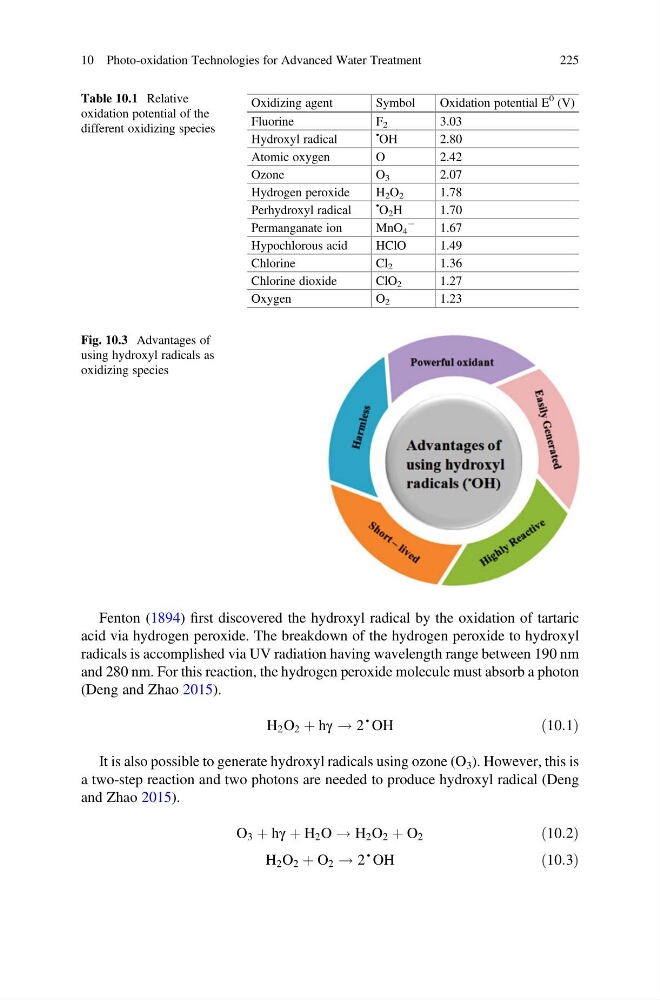
Fig. 10.3 Advantages of
using hydroxyl radicals as
oxidizing species
10 Photo-oxidation Technologies for Advanced Water Treatment
225
acid via hydrogen peroxide. The breakdown of the hydrogen peroxide to hydroxyl
radicals is accomplished via UV radiation having wavelength range between 190 nm
and 280 nm. For this reaction, the hydrogen peroxide molecule must absorb a photon
(Deng and Zhao 2015).
H 2 O 2 þ hγ ! 2
• OH
ð10:1Þ
It is also possible to generate hydroxyl radicals using ozone (O 3 ). However, this is
a two-step reaction and two photons are needed to produce hydroxyl radical (Deng
and Zhao 2015).
O 3 þ hγ þ H 2 O ! H 2 O 2 þ O 2
ð10:2Þ
H 2 O 2 þ O 2 ! 2
• OH
ð10:3Þ
Table 10.1 Relative
oxidation potential of the
different oxidizing species
Oxidizing agent
Symbol
Oxidation potential E
0 (V)
Fluorine
F 2
3.03
Hydroxyl radical
•
OH
2.80
Atomic oxygen
O
2.42
Ozone
O 3
2.07
Hydrogen peroxide
H 2 O 2
1.78
Perhydroxyl radical
•
O 2 H
1.70
Permanganate ion
MnO 4
À
1.67
Hypochlorous acid
HClO
1.49
Chlorine
Cl 2
1.36
Chlorine dioxide
ClO 2
1.27
Oxygen
O 2
1.23
Fig. 10.3 Advantages of
using hydroxyl radicals as
oxidizing species
10 Photo-oxidation Technologies for Advanced Water Treatment
225