

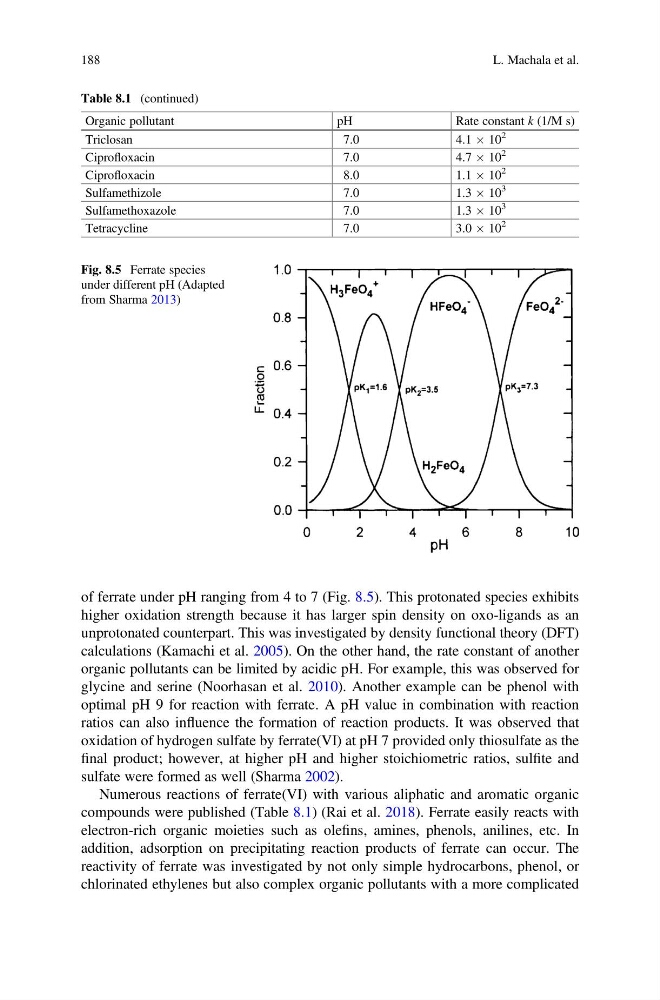
of ferrate under pH ranging from 4 to 7 (Fig. 8.5). This protonated species exhibits
higher oxidation strength because it has larger spin density on oxo-ligands as an
unprotonated counterpart. This was investigated by density functional theory (DFT)
calculations (Kamachi et al. 2005). On the other hand, the rate constant of another
organic pollutants can be limited by acidic pH. For example, this was observed for
glycine and serine (Noorhasan et al. 2010). Another example can be phenol with
optimal pH 9 for reaction with ferrate. A pH value in combination with reaction
ratios can also influence the formation of reaction products. It was observed that
oxidation of hydrogen sulfate by ferrate(VI) at pH 7 provided only thiosulfate as the
final product; however, at higher pH and higher stoichiometric ratios, sulfite and
sulfate were formed as well (Sharma 2002).
Numerous reactions of ferrate(VI) with various aliphatic and aromatic organic
compounds were published (Table 8.1) (Rai et al. 2018). Ferrate easily reacts with
electron-rich organic moieties such as olefins, amines, phenols, anilines, etc. In
addition, adsorption on precipitating reaction products of ferrate can occur. The
reactivity of ferrate was investigated by not only simple hydrocarbons, phenol, or
chlorinated ethylenes but also complex organic pollutants with a more complicated
Table 8.1 (continued)
Organic pollutant
pH
Rate constant k (1/M s)
Triclosan
7.0
4.1 Â 10
2
Ciprofloxacin
7.0
4.7 Â 10
2
Ciprofloxacin
8.0
1.1 Â 10
2
Sulfamethizole
7.0
1.3 Â 10
3
Sulfamethoxazole
7.0
1.3 Â 10
3
Tetracycline
7.0
3.0 Â 10
2
Fig. 8.5 Ferrate species
under different pH (Adapted
from Sharma 2013)
188
L. Machala et al.
higher oxidation strength because it has larger spin density on oxo-ligands as an
unprotonated counterpart. This was investigated by density functional theory (DFT)
calculations (Kamachi et al. 2005). On the other hand, the rate constant of another
organic pollutants can be limited by acidic pH. For example, this was observed for
glycine and serine (Noorhasan et al. 2010). Another example can be phenol with
optimal pH 9 for reaction with ferrate. A pH value in combination with reaction
ratios can also influence the formation of reaction products. It was observed that
oxidation of hydrogen sulfate by ferrate(VI) at pH 7 provided only thiosulfate as the
final product; however, at higher pH and higher stoichiometric ratios, sulfite and
sulfate were formed as well (Sharma 2002).
Numerous reactions of ferrate(VI) with various aliphatic and aromatic organic
compounds were published (Table 8.1) (Rai et al. 2018). Ferrate easily reacts with
electron-rich organic moieties such as olefins, amines, phenols, anilines, etc. In
addition, adsorption on precipitating reaction products of ferrate can occur. The
reactivity of ferrate was investigated by not only simple hydrocarbons, phenol, or
chlorinated ethylenes but also complex organic pollutants with a more complicated
Table 8.1 (continued)
Organic pollutant
pH
Rate constant k (1/M s)
Triclosan
7.0
4.1 Â 10
2
Ciprofloxacin
7.0
4.7 Â 10
2
Ciprofloxacin
8.0
1.1 Â 10
2
Sulfamethizole
7.0
1.3 Â 10
3
Sulfamethoxazole
7.0
1.3 Â 10
3
Tetracycline
7.0
3.0 Â 10
2
Fig. 8.5 Ferrate species
under different pH (Adapted
from Sharma 2013)
188
L. Machala et al.