

technologies employing environmentally friendly agents and chemicals used during
the processes. Monitoring intermediates and residuals of pollutants as well as testing
toxicity of the final products of reactions are more and more required. In this way,
ferrates represent effective and promising agents for water treatment of various
organic pollutants.
The majority of studies on organic pollutants degradation by ferrates focuses on
the use of ferrate(VI). This is a sensible approach because the stability of high-valent
iron species in a water solution is dramatically different. While ferrate(VI) is relatively stable, from minutes to days, depending on the solution composition and
physicochemical conditions, ferrate(IV) and ferrate(V) decay in seconds resulting in
an already mentioned stable ferrate(VI) and trivalent iron products. Hence, ferrate
(VI) reacts with organic pollutants although the primary oxidative agents used at the
beginning were ferrate(IV) or ferrate(V). This also plays its role in focusing on iron
(VI) within ferrate research. On the other hand, it is a well-known fact that ferrate
(V) is more reactive than ferrate(VI).
From the kinetic perspective, the reactivity of ferrate(VI) with organic pollutants
is described as second-order with the second-order rate constants from 3.0 Â 10
À2 to
1.7 Â 10
7 1/(M s) (see Table 8.1). Only in the case of an excess of ferrate or
pollutants, the system behaves as the first-order. In this special case, the apparent
second-order rate constant is often examined as a function of pH (Sharma 2013). The
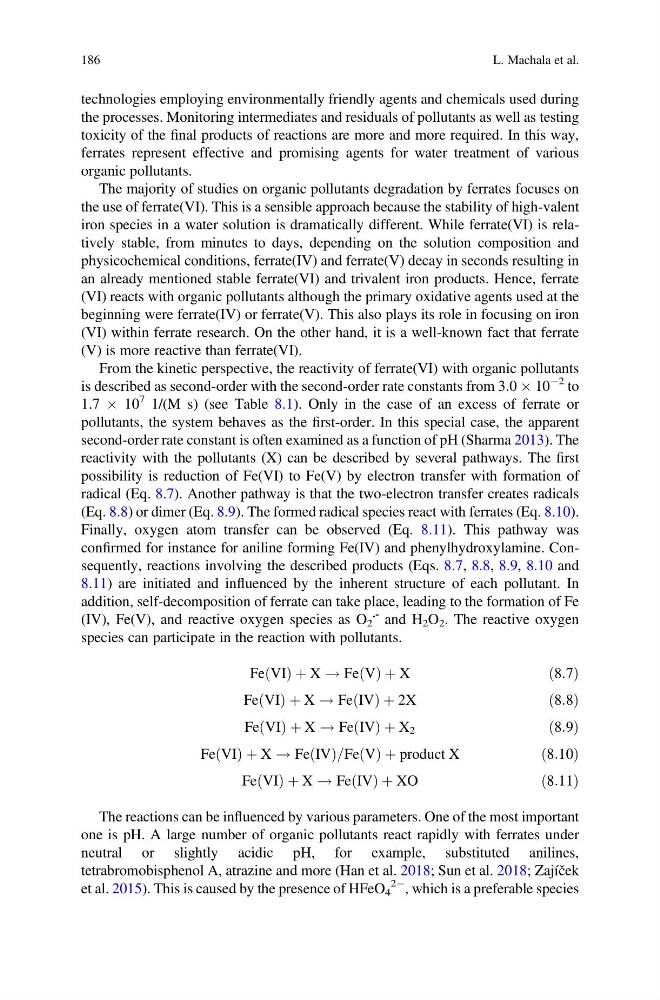
reactivity with the pollutants (X) can be described by several pathways. The first
possibility is reduction of Fe(VI) to Fe(V) by electron transfer with formation of
radical (Eq. 8.7). Another pathway is that the two-electron transfer creates radicals
(Eq. 8.8) or dimer (Eq. 8.9). The formed radical species react with ferrates (Eq. 8.10).
Finally, oxygen atom transfer can be observed (Eq. 8.11). This pathway was
confirmed for instance for aniline forming Fe(IV) and phenylhydroxylamine. Consequently, reactions involving the described products (Eqs. 8.7, 8.8, 8.9, 8.10 and
8.11) are initiated and influenced by the inherent structure of each pollutant. In
addition, self-decomposition of ferrate can take place, leading to the formation of Fe
(IV), Fe(V), and reactive oxygen species as O 2
.- and H 2 O 2 . The reactive oxygen
species can participate in the reaction with pollutants.
Fe VI
ð Þ þ X ! Fe V
ð Þ þ X
ð8:7Þ
Fe VI
ð Þ þ X ! Fe IV
ð Þ þ 2X
ð8:8Þ
Fe VI
ð Þ þ X ! Fe IV
ð Þ þ X 2
ð8:9Þ
Fe VI
ð Þ þ X ! Fe IV
ð Þ=Fe V
ð Þ þ product X
ð8:10Þ
Fe VI
ð Þ þ X ! Fe IV
ð Þ þ XO
ð8:11Þ
The reactions can be influenced by various parameters. One of the most important
one is pH. A large number of organic pollutants react rapidly with ferrates under
neutral or slightly acidic pH, for example, substituted anilines,
tetrabromobisphenol A, atrazine and more (Han et al. 2018; Sun et al. 2018; Zajíček
et al. 2015). This is caused by the presence of HFeO 4
2À
, which is a preferable species
186
L. Machala et al.
the processes. Monitoring intermediates and residuals of pollutants as well as testing
toxicity of the final products of reactions are more and more required. In this way,
ferrates represent effective and promising agents for water treatment of various
organic pollutants.
The majority of studies on organic pollutants degradation by ferrates focuses on
the use of ferrate(VI). This is a sensible approach because the stability of high-valent
iron species in a water solution is dramatically different. While ferrate(VI) is relatively stable, from minutes to days, depending on the solution composition and
physicochemical conditions, ferrate(IV) and ferrate(V) decay in seconds resulting in
an already mentioned stable ferrate(VI) and trivalent iron products. Hence, ferrate
(VI) reacts with organic pollutants although the primary oxidative agents used at the
beginning were ferrate(IV) or ferrate(V). This also plays its role in focusing on iron
(VI) within ferrate research. On the other hand, it is a well-known fact that ferrate
(V) is more reactive than ferrate(VI).
From the kinetic perspective, the reactivity of ferrate(VI) with organic pollutants
is described as second-order with the second-order rate constants from 3.0 Â 10
À2 to
1.7 Â 10
7 1/(M s) (see Table 8.1). Only in the case of an excess of ferrate or
pollutants, the system behaves as the first-order. In this special case, the apparent
second-order rate constant is often examined as a function of pH (Sharma 2013). The
reactivity with the pollutants (X) can be described by several pathways. The first
possibility is reduction of Fe(VI) to Fe(V) by electron transfer with formation of
radical (Eq. 8.7). Another pathway is that the two-electron transfer creates radicals
(Eq. 8.8) or dimer (Eq. 8.9). The formed radical species react with ferrates (Eq. 8.10).
Finally, oxygen atom transfer can be observed (Eq. 8.11). This pathway was
confirmed for instance for aniline forming Fe(IV) and phenylhydroxylamine. Consequently, reactions involving the described products (Eqs. 8.7, 8.8, 8.9, 8.10 and
8.11) are initiated and influenced by the inherent structure of each pollutant. In
addition, self-decomposition of ferrate can take place, leading to the formation of Fe
(IV), Fe(V), and reactive oxygen species as O 2
.- and H 2 O 2 . The reactive oxygen
species can participate in the reaction with pollutants.
Fe VI
ð Þ þ X ! Fe V
ð Þ þ X
ð8:7Þ
Fe VI
ð Þ þ X ! Fe IV
ð Þ þ 2X
ð8:8Þ
Fe VI
ð Þ þ X ! Fe IV
ð Þ þ X 2
ð8:9Þ
Fe VI
ð Þ þ X ! Fe IV
ð Þ=Fe V
ð Þ þ product X
ð8:10Þ
Fe VI
ð Þ þ X ! Fe IV
ð Þ þ XO
ð8:11Þ
The reactions can be influenced by various parameters. One of the most important
one is pH. A large number of organic pollutants react rapidly with ferrates under
neutral or slightly acidic pH, for example, substituted anilines,
tetrabromobisphenol A, atrazine and more (Han et al. 2018; Sun et al. 2018; Zajíček
et al. 2015). This is caused by the presence of HFeO 4
2À
, which is a preferable species
186
L. Machala et al.