

covered with a lid. The crucible was then put into the furnace and annealed at
1000
C for 30 min at an N 2 flow of 150 L/h. Before the termination of annealing,
another metallic annealing crucible was cooled by liquid nitrogen; afterwards, liquid
nitrogen was poured to the crucible. After removing the crucible from the furnace,
the melt was poured into the crucible filled with liquid nitrogen. The as-prepared
K 3 FeO 4 is stable below the level of liquid nitrogen. After it was frozen, K 3 FeO 4 was
transferred to a porcelain dish with nitrogen and was put into a glove box. Again,
more than 90% of Fe(V) (atomic percent of Fe) can be achieved. When the mixture
of Fe(III) oxide and KNO 3 is heated at 1100
C, potassium ferrate(VI) (K 2 FeO 4 ) can
be prepared; however, it will yield only 30% purity.
8.3 Experimental Methods for the Characterization of AsPrepared Ferrates and Determination of Their Purity
The relative amount of a ferrate in liquid and solid phases can be determined by
using a variety of different analytical techniques (Mura et al. 2017; Sharma et al.
2015), such as volumetric, electrochemical (cyclic voltammetry and potentiometry),
and spectroscopic techniques (Fourier-transform infrared spectroscopy—FTIR,
57 Fe
Mössbauer spectroscopy). The concentration of ferrates in the solution can be
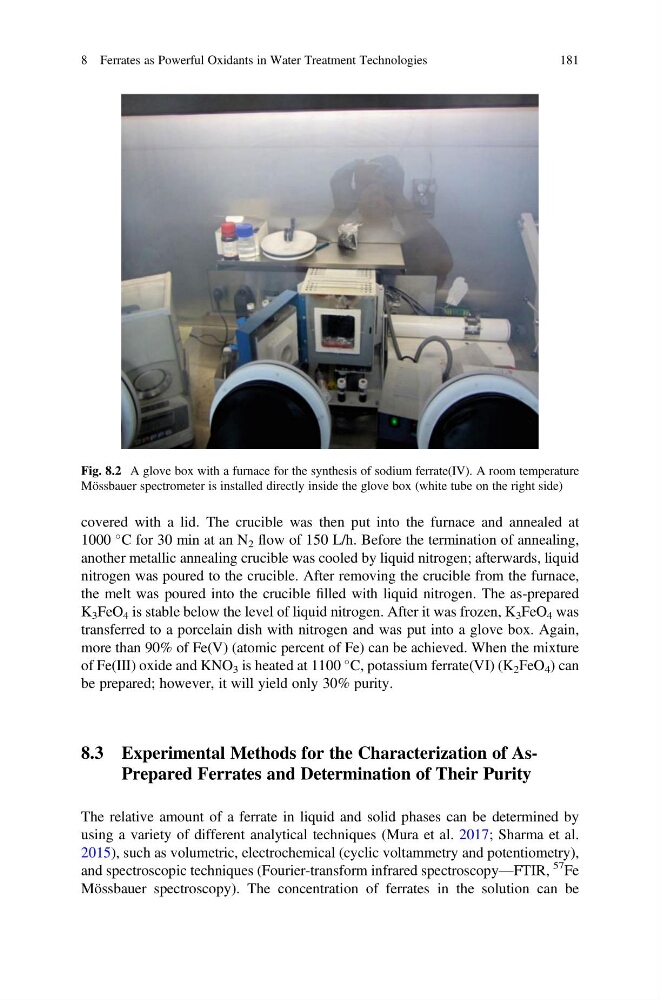
Fig. 8.2 A glove box with a furnace for the synthesis of sodium ferrate(IV). A room temperature
Mössbauer spectrometer is installed directly inside the glove box (white tube on the right side)
8 Ferrates as Powerful Oxidants in Water Treatment Technologies
181
1000
C for 30 min at an N 2 flow of 150 L/h. Before the termination of annealing,
another metallic annealing crucible was cooled by liquid nitrogen; afterwards, liquid
nitrogen was poured to the crucible. After removing the crucible from the furnace,
the melt was poured into the crucible filled with liquid nitrogen. The as-prepared
K 3 FeO 4 is stable below the level of liquid nitrogen. After it was frozen, K 3 FeO 4 was
transferred to a porcelain dish with nitrogen and was put into a glove box. Again,
more than 90% of Fe(V) (atomic percent of Fe) can be achieved. When the mixture
of Fe(III) oxide and KNO 3 is heated at 1100
C, potassium ferrate(VI) (K 2 FeO 4 ) can
be prepared; however, it will yield only 30% purity.
8.3 Experimental Methods for the Characterization of AsPrepared Ferrates and Determination of Their Purity
The relative amount of a ferrate in liquid and solid phases can be determined by
using a variety of different analytical techniques (Mura et al. 2017; Sharma et al.
2015), such as volumetric, electrochemical (cyclic voltammetry and potentiometry),
and spectroscopic techniques (Fourier-transform infrared spectroscopy—FTIR,
57 Fe
Mössbauer spectroscopy). The concentration of ferrates in the solution can be
Fig. 8.2 A glove box with a furnace for the synthesis of sodium ferrate(IV). A room temperature
Mössbauer spectrometer is installed directly inside the glove box (white tube on the right side)
8 Ferrates as Powerful Oxidants in Water Treatment Technologies
181