

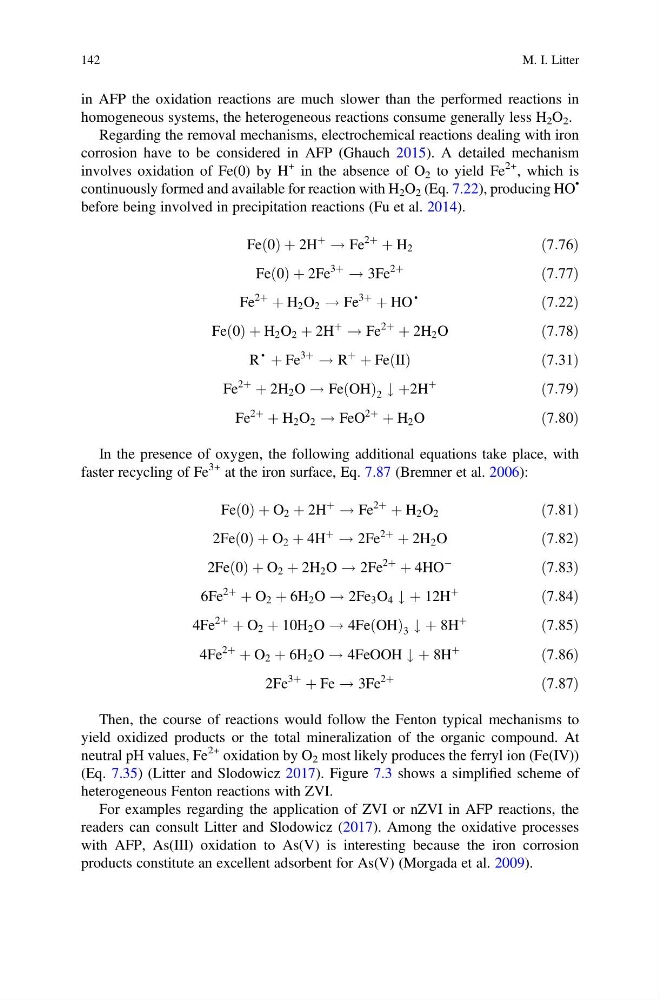
in AFP the oxidation reactions are much slower than the performed reactions in
homogeneous systems, the heterogeneous reactions consume generally less H 2 O 2 .
Regarding the removal mechanisms, electrochemical reactions dealing with iron
corrosion have to be considered in AFP (Ghauch 2015). A detailed mechanism
involves oxidation of Fe(0) by H
+ in the absence of O 2 to yield Fe
2+ , which is
continuously formed and available for reaction with H 2 O 2 (Eq. 7.22), producing HO
•
before being involved in precipitation reactions (Fu et al. 2014).
Fe 0
ð Þ þ 2H
þ
! Fe
2þ
þ H 2
ð7:76Þ
Fe 0
ð Þ þ 2Fe
3þ
! 3Fe
2þ
ð7:77Þ
Fe
2þ
þ H 2 O 2 ! Fe
3þ
þ HO
•
ð7:22Þ
Fe 0
ð Þ þ H 2 O 2 þ 2H
þ
! Fe
2þ
þ 2H 2 O
ð7:78Þ
R
•
þ Fe
3þ
! R
þ
þ Fe II
ð Þ
ð7:31Þ
Fe
2þ
þ 2H 2 O ! Fe OH
ð Þ 2 # þ2H
þ
ð7:79Þ
Fe
2þ
þ H 2 O 2 ! FeO
2þ
þ H 2 O
ð7:80Þ
In the presence of oxygen, the following additional equations take place, with
faster recycling of Fe
3+ at the iron surface, Eq. 7.87 (Bremner et al. 2006):
Fe 0
ð Þ þ O 2 þ 2H
þ
! Fe
2þ
þ H 2 O 2
ð7:81Þ
2Fe 0
ð Þ þ O 2 þ 4H
þ
! 2Fe
2þ
þ 2H 2 O
ð7:82Þ
2Fe 0
ð Þ þ O 2 þ 2H 2 O ! 2Fe
2þ
þ 4HO
À
ð7:83Þ
6Fe
2þ
þ O 2 þ 6H 2 O ! 2Fe 3 O 4 # þ 12H
þ
ð7:84Þ
4Fe
2þ
þ O 2 þ 10H 2 O ! 4Fe OH
ð Þ 3 # þ 8H
þ
ð7:85Þ
4Fe
2þ
þ O 2 þ 6H 2 O ! 4FeOOH # þ 8H
þ
ð7:86Þ
2Fe
3þ
þ Fe ! 3Fe
2þ
ð7:87Þ
Then, the course of reactions would follow the Fenton typical mechanisms to
yield oxidized products or the total mineralization of the organic compound. At
neutral pH values, Fe
2+ oxidation by O 2 most likely produces the ferryl ion (Fe(IV))
(Eq. 7.35) (Litter and Slodowicz 2017). Figure 7.3 shows a simplified scheme of
heterogeneous Fenton reactions with ZVI.
For examples regarding the application of ZVI or nZVI in AFP reactions, the
readers can consult Litter and Slodowicz (2017). Among the oxidative processes
with AFP, As(III) oxidation to As(V) is interesting because the iron corrosion
products constitute an excellent adsorbent for As(V) (Morgada et al. 2009).
142
M. I. Litter
homogeneous systems, the heterogeneous reactions consume generally less H 2 O 2 .
Regarding the removal mechanisms, electrochemical reactions dealing with iron
corrosion have to be considered in AFP (Ghauch 2015). A detailed mechanism
involves oxidation of Fe(0) by H
+ in the absence of O 2 to yield Fe
2+ , which is
continuously formed and available for reaction with H 2 O 2 (Eq. 7.22), producing HO
•
before being involved in precipitation reactions (Fu et al. 2014).
Fe 0
ð Þ þ 2H
þ
! Fe
2þ
þ H 2
ð7:76Þ
Fe 0
ð Þ þ 2Fe
3þ
! 3Fe
2þ
ð7:77Þ
Fe
2þ
þ H 2 O 2 ! Fe
3þ
þ HO
•
ð7:22Þ
Fe 0
ð Þ þ H 2 O 2 þ 2H
þ
! Fe
2þ
þ 2H 2 O
ð7:78Þ
R
•
þ Fe
3þ
! R
þ
þ Fe II
ð Þ
ð7:31Þ
Fe
2þ
þ 2H 2 O ! Fe OH
ð Þ 2 # þ2H
þ
ð7:79Þ
Fe
2þ
þ H 2 O 2 ! FeO
2þ
þ H 2 O
ð7:80Þ
In the presence of oxygen, the following additional equations take place, with
faster recycling of Fe
3+ at the iron surface, Eq. 7.87 (Bremner et al. 2006):
Fe 0
ð Þ þ O 2 þ 2H
þ
! Fe
2þ
þ H 2 O 2
ð7:81Þ
2Fe 0
ð Þ þ O 2 þ 4H
þ
! 2Fe
2þ
þ 2H 2 O
ð7:82Þ
2Fe 0
ð Þ þ O 2 þ 2H 2 O ! 2Fe
2þ
þ 4HO
À
ð7:83Þ
6Fe
2þ
þ O 2 þ 6H 2 O ! 2Fe 3 O 4 # þ 12H
þ
ð7:84Þ
4Fe
2þ
þ O 2 þ 10H 2 O ! 4Fe OH
ð Þ 3 # þ 8H
þ
ð7:85Þ
4Fe
2þ
þ O 2 þ 6H 2 O ! 4FeOOH # þ 8H
þ
ð7:86Þ
2Fe
3þ
þ Fe ! 3Fe
2þ
ð7:87Þ
Then, the course of reactions would follow the Fenton typical mechanisms to
yield oxidized products or the total mineralization of the organic compound. At
neutral pH values, Fe
2+ oxidation by O 2 most likely produces the ferryl ion (Fe(IV))
(Eq. 7.35) (Litter and Slodowicz 2017). Figure 7.3 shows a simplified scheme of
heterogeneous Fenton reactions with ZVI.
For examples regarding the application of ZVI or nZVI in AFP reactions, the
readers can consult Litter and Slodowicz (2017). Among the oxidative processes
with AFP, As(III) oxidation to As(V) is interesting because the iron corrosion
products constitute an excellent adsorbent for As(V) (Morgada et al. 2009).
142
M. I. Litter