

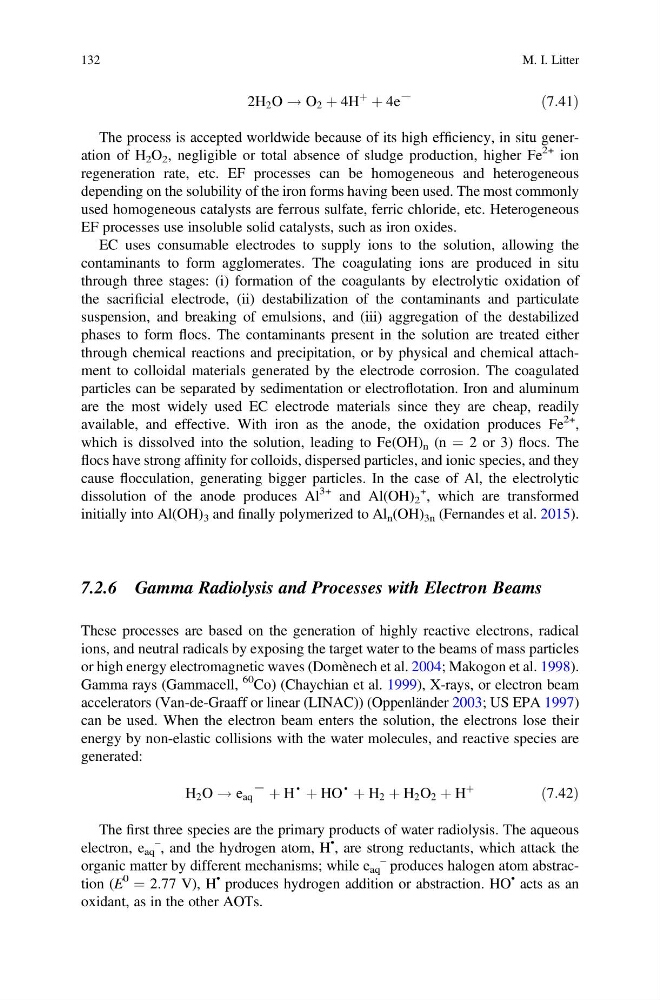
2H 2 O ! O 2 þ 4H
þ
þ 4e À
ð7:41Þ
The process is accepted worldwide because of its high efficiency, in situ generation of H 2 O 2 , negligible or total absence of sludge production, higher Fe
2+ ion
regeneration rate, etc. EF processes can be homogeneous and heterogeneous
depending on the solubility of the iron forms having been used. The most commonly
used homogeneous catalysts are ferrous sulfate, ferric chloride, etc. Heterogeneous
EF processes use insoluble solid catalysts, such as iron oxides.
EC uses consumable electrodes to supply ions to the solution, allowing the
contaminants to form agglomerates. The coagulating ions are produced in situ
through three stages: (i) formation of the coagulants by electrolytic oxidation of
the sacrificial electrode, (ii) destabilization of the contaminants and particulate
suspension, and breaking of emulsions, and (iii) aggregation of the destabilized
phases to form flocs. The contaminants present in the solution are treated either
through chemical reactions and precipitation, or by physical and chemical attachment to colloidal materials generated by the electrode corrosion. The coagulated
particles can be separated by sedimentation or electroflotation. Iron and aluminum
are the most widely used EC electrode materials since they are cheap, readily
available, and effective. With iron as the anode, the oxidation produces Fe
2+ ,
which is dissolved into the solution, leading to Fe(OH) n (n ¼ 2 or 3) flocs. The
flocs have strong affinity for colloids, dispersed particles, and ionic species, and they
cause flocculation, generating bigger particles. In the case of Al, the electrolytic
dissolution of the anode produces Al
3+ and Al(OH) 2
+
, which are transformed
initially into Al(OH) 3 and finally polymerized to Al n (OH) 3n (Fernandes et al. 2015).
7.2.6 Gamma Radiolysis and Processes with Electron Beams
These processes are based on the generation of highly reactive electrons, radical
ions, and neutral radicals by exposing the target water to the beams of mass particles
or high energy electromagnetic waves (Domènech et al. 2004; Makogon et al. 1998).
Gamma rays (Gammacell,
60 Co) (Chaychian et al. 1999), X-rays, or electron beam
accelerators (Van-de-Graaff or linear (LINAC)) (Oppenländer 2003; US EPA 1997)
can be used. When the electron beam enters the solution, the electrons lose their
energy by non-elastic collisions with the water molecules, and reactive species are
generated:
H 2 O ! e aq
À þ H
•
þ HO
•
þ H 2 þ H 2 O 2 þ H
þ
ð7:42Þ
The first three species are the primary products of water radiolysis. The aqueous
electron, e aq
– , and the hydrogen atom, H
• , are strong reductants, which attack the
organic matter by different mechanisms; while e aq
– produces halogen atom abstraction (E
0
¼ 2.77 V), H
• produces hydrogen addition or abstraction. HO
• acts as an
oxidant, as in the other AOTs.
132
M. I. Litter
þ
þ 4e À
ð7:41Þ
The process is accepted worldwide because of its high efficiency, in situ generation of H 2 O 2 , negligible or total absence of sludge production, higher Fe
2+ ion
regeneration rate, etc. EF processes can be homogeneous and heterogeneous
depending on the solubility of the iron forms having been used. The most commonly
used homogeneous catalysts are ferrous sulfate, ferric chloride, etc. Heterogeneous
EF processes use insoluble solid catalysts, such as iron oxides.
EC uses consumable electrodes to supply ions to the solution, allowing the
contaminants to form agglomerates. The coagulating ions are produced in situ
through three stages: (i) formation of the coagulants by electrolytic oxidation of
the sacrificial electrode, (ii) destabilization of the contaminants and particulate
suspension, and breaking of emulsions, and (iii) aggregation of the destabilized
phases to form flocs. The contaminants present in the solution are treated either
through chemical reactions and precipitation, or by physical and chemical attachment to colloidal materials generated by the electrode corrosion. The coagulated
particles can be separated by sedimentation or electroflotation. Iron and aluminum
are the most widely used EC electrode materials since they are cheap, readily
available, and effective. With iron as the anode, the oxidation produces Fe
2+ ,
which is dissolved into the solution, leading to Fe(OH) n (n ¼ 2 or 3) flocs. The
flocs have strong affinity for colloids, dispersed particles, and ionic species, and they
cause flocculation, generating bigger particles. In the case of Al, the electrolytic
dissolution of the anode produces Al
3+ and Al(OH) 2
+
, which are transformed
initially into Al(OH) 3 and finally polymerized to Al n (OH) 3n (Fernandes et al. 2015).
7.2.6 Gamma Radiolysis and Processes with Electron Beams
These processes are based on the generation of highly reactive electrons, radical
ions, and neutral radicals by exposing the target water to the beams of mass particles
or high energy electromagnetic waves (Domènech et al. 2004; Makogon et al. 1998).
Gamma rays (Gammacell,
60 Co) (Chaychian et al. 1999), X-rays, or electron beam
accelerators (Van-de-Graaff or linear (LINAC)) (Oppenländer 2003; US EPA 1997)
can be used. When the electron beam enters the solution, the electrons lose their
energy by non-elastic collisions with the water molecules, and reactive species are
generated:
H 2 O ! e aq
À þ H
•
þ HO
•
þ H 2 þ H 2 O 2 þ H
þ
ð7:42Þ
The first three species are the primary products of water radiolysis. The aqueous
electron, e aq
– , and the hydrogen atom, H
• , are strong reductants, which attack the
organic matter by different mechanisms; while e aq
– produces halogen atom abstraction (E
0
¼ 2.77 V), H
• produces hydrogen addition or abstraction. HO
• acts as an
oxidant, as in the other AOTs.
132
M. I. Litter